

Mathematics and Its Logics
Mathematics and Its Logics
Looking for an examination copy?
If you are interested in the title for your course we can consider offering an examination copy. To register your interest please contact collegesales@cambridge.org providing details of the course you are teaching.
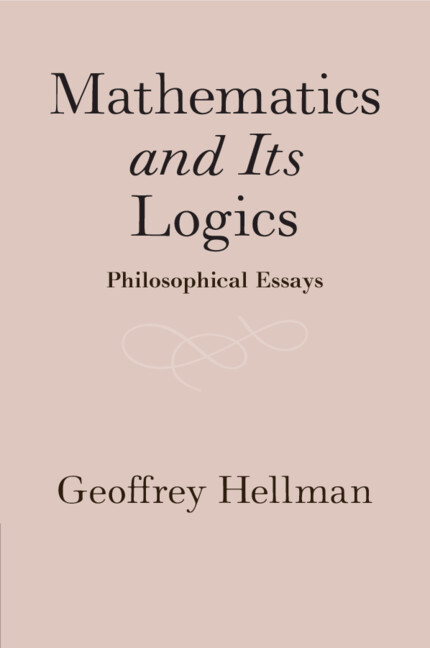
In these essays Geoffrey Hellman presents a strong case for a healthy pluralism in mathematics and its logics, supporting peaceful coexistence despite what appear to be contradictions between different systems, and positing different frameworks serving different legitimate purposes. The essays refine and extend Hellman's modal-structuralist account of mathematics, developing a height-potentialist view of higher set theory which recognizes indefinite extendability of models and stages at which sets occur. In the first of three new essays written for this volume, Hellman shows how extendability can be deployed to derive the axiom of Infinity and that of Replacement, improving on earlier accounts; he also shows how extendability leads to attractive, novel resolutions of the set-theoretic paradoxes. Other essays explore advantages and limitations of restrictive systems - nominalist, predicativist, and constructivist. Also included are two essays, with Solomon Feferman, on predicative foundations of arithmetic.
- Makes a strong case for pluralism in logic and mathematics, with different frameworks serving different legitimate purposes.
- Furthers the development of the modal-structural approach in philosophy and foundations of mathematics.
- Explores the key benefits and limitations of restrictive approaches to mathematics, nominalism, predicativism, and constructivism
Product details
- Published: November 2022
- Format: Paperback
- ISBN: 9781108714006
- Length: 296 pages
- Dimensions: 229 × 152 × 16 mm
- Weight: 0.44kg
- Availability: Available

Table of Contents
- Introduction
- Part I. Structuralism, Extendability, and Nominalism:
- 1. Structuralism without Structures?
- 2. What Is Categorical Structuralism?
- 3. On the Significance of the Burali-Forti Paradox
- 4. Extending the Iterative Conception of Set: A Height-Potentialist Perspective
- 5. On Nominalism
- 6. Maoist Mathematics? Critical Study of John Burgess and Gideon Rosen, A Subject with No Object: Strategies for Nominalistic Interpretation of Mathematics (Oxford, 1997)
- Part II. Predicative Mathematics and Beyond:
- 7. Predicative Foundations of Arithmetic (with Solomon Feferman)
- 8. Challenges to Predicative Foundations of Arithmetic (with Solomon Feferman)
- 9. Predicativism as a Philosophical Position
- 10. On the Gödel-Friedman Program
- Part III. Logics of Mathematics:
- 11. Logical Truth by Linguistic Convention
- 12. Never Say 'Never'! On the Communication Problem between Intuitionism and Classicism
- 13. Constructive Mathematics and Quantum Mechanics: Unbounded Operators and the Spectral Theorem
- 14. If 'If-Then' Then What?
- 15. Mathematical Pluralism: The Case of Smooth Infinitesimal Analysis.
- Show more



