

Corruption and the Voter's Decision
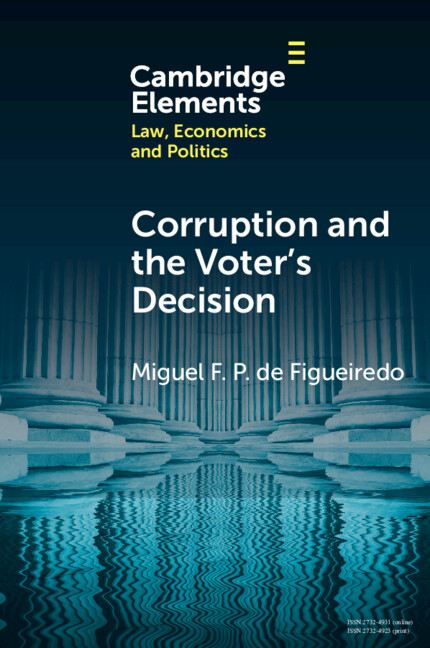
Corruption and the Voter's Decision
Looking for an examination copy?
If you are interested in the title for your course we can consider offering an examination copy. To register your interest please contact collegesales@cambridge.org providing details of the course you are teaching.
Despite voters' distaste for corruption, corrupt politicians frequently get reelected. This Element provides a framework for understanding when corrupt politicians are reelected. One unexplored source of electoral accountability is court rulings on candidate malfeasance, which are increasingly determining politicians' electoral prospects. The findings suggest that (1) low-income voters – in contrast to higher-income voters – are responsive to such rulings. Unlike earlier studies, we explore multiple trade-offs voters weigh when confronting corrupt candidates, including the candidate's party, policy positions, and personal attributes. The results also surprisingly show (2) low-income voters, like higher-income voters, weigh corruption allegations and policy positions similarly, and are slightly more responsive to candidate attributes. Moreover, irrespective of voter income, (3) party labels insulate candidates from corruption, and (4) candidate attributes like gender have little effect. The results have implications for when voters punish corrupt politicians, the success of anti-corruption campaigns, and the design and legitimacy of electoral institutions.
Product details
- Published: March 2025
- Format: Adobe eBook Reader
- ISBN: 9781009499729
- Length: 0 pages
- Availability: This ISBN is for an eBook version which is distributed on our behalf by a third party.

Table of Contents
- 1. Introduction
- 2. Electoral accountability and public opinion
- 3. A Framework for analyzing candidate corruption and voting behavior
- 4. Corruption and the voter's decision: evidence from a conjoint experiment
- 5. Conclusion
- References.
- Show more



