Cambridge Computer Science   View basketHelp
Home > Science, Technology & Medicine > Computer Science > Logic in Computer Science
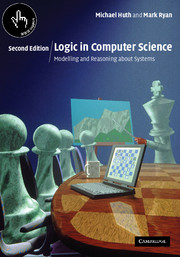
Logic in Computer Science   Michael Huth and Mark Ryan

Your next step

Inspect

Resources

Sample chapter

Order

Cambridge alerts

Customer services

  • Telephone +44(0)1223 326050
  • Fax +44(0)1223 326111
  • email email us

Recent years have seen the development of powerful tools for verifying hardware and software systems, as companies worldwide realise the need for improved means of validating their products. There is increasing demand for training in basic methods in formal reasoning so that students can gain proficiency in logic-based verification methods. The second edition of this successful textbook addresses all the points above, by continuing to provide a clear introduction to formal reasoning which is both relevant to the needs of modern computer science courses and rigorous enough for practical application. Improvements to the first edition have been made throughout, with extra and expanded sections on SAT solvers, existential/universal second-order logic, micro-models, programming by contract and total correctness. The coverage of model-checking has been substantially updated. Further exercises have been added. Web support for the book includes worked solutions for all exercises for teachers.

  • Complete update of hugely popular first edition
  • Related to new software tools
  • Lots of exercises, with solutions for lecturers (from solutions@cambridge.org), and book resources available from the author's web link, above

Contents

  • Foreword
  •  
  • 1. Propositional logic
  • 2. Predicate logic
  • 3. Verification by model checking
  • 4. Program verification
  • 5. Modal logics and agents
  • 6. Binary decision diagrams
  •  
  • Bibliography
  • Index

From reviews of the first edition:

'This is an excellent textbook on logic and formal methods which is very suitable for computer science students...not only to be recommended for students, but for anyone interested in applications of logic in computer science.'

Theory and Practice of Logic Programming

'... an unusual, inspiring and remarkable book ... one can find in it all the material which is suitable for undergraduate and beginning graduate students in computer science and electrical engineering who will profit by using it in their professional activities in the near future.'

Zentralblatt MATH