

Informal Logic
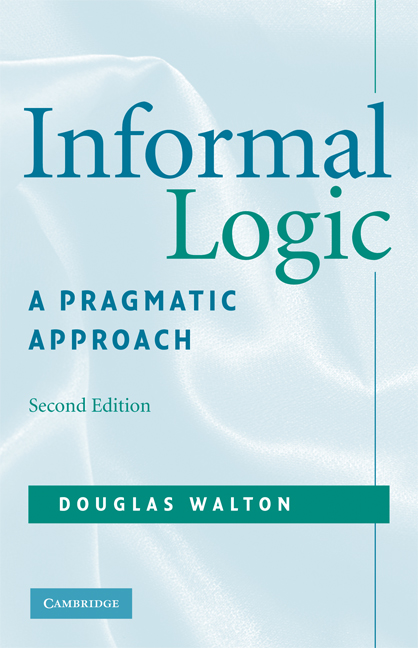
Informal Logic
Looking for an examination copy?
If you are interested in the title for your course we can consider offering an examination copy. To register your interest please contact collegesales@cambridge.org providing details of the course you are teaching.
Informal Logic is an introductory guidebook to the basic principles of constructing sound arguments and criticizing bad ones. Non-technical in approach, it is based on 186 examples, which Douglas Walton, a leading authority in the field of informal logic, discusses and evaluates in clear, illustrative detail. Walton explains how errors, fallacies, and other key failures of argument occur. He shows how correct uses of argument are based on sound strategies for reasoned persuasion and critical responses. Among the many subjects covered are: forms of valid argument, defeasible arguments, relevance, appeals to emotion, personal attack, straw man argument, jumping to a conclusion, uses and abuses of expert opinion, problems in drawing conclusions from polls and statistics, loaded terms, equivocation, arguments from analogy, and techniques of posing, replying to, and criticizing questions. This new edition takes into account many new developments in the field of argumentation study that have occurred since 1989, many created by the author. Drawing on these developments, Walton includes and analyzes 36 new topical examples and also brings in recent work on argumentation schemes. Ideally suited for use in courses in informal logic and introduction to philosophy, this book will also be valuable to students of pragmatics, rhetoric, and speech communication.
- Uses practical methods applied to everyday arguments based on a pragmatic theory
- The theory is supported by 186 examples
- Both correct and faulty uses of argument are explained, including many important kinds of errors and fallacies
Reviews & endorsements
"Walton here updates his fine book on informal logic/critical thinking...Probably the best work on critical thinking to date, this volume would be an excellent text for courses on informal logic...Summing up: Essential. "
- R. Puligandla, University of Toledo, Choice
Product details
- Published: June 2008
- Format: Paperback
- ISBN: 9780521713801
- Length: 366 pages
- Dimensions: 216 × 140 × 20 mm
- Weight: 0.43kg
- Availability: Available






Table of Contents
- 1. Argument as reasoned dialogue
- 2. Questions and answers in dialogue
- 3. Criticism of irrelevance
- 4. Appeals to emotion
- 5. Valid arguments
- 6. Personal attack in argumentation
- 7. Appeals to authority
- 8. Inductive errors, bias, and fallacies
- 9. Natural language argumentation.
- Show more



