

Modelling for Field Biologists and Other Interesting People
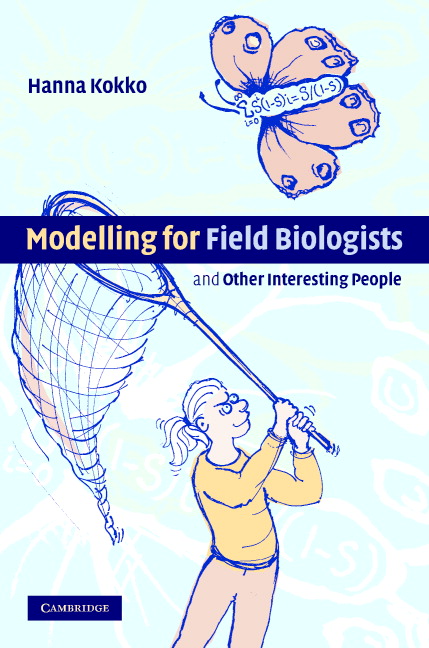
Modelling for Field Biologists and Other Interesting People
Looking for an examination copy?
If you are interested in the title for your course we can consider offering an examination copy. To register your interest please contact collegesales@cambridge.org providing details of the course you are teaching.
Students of evolutionary and behavioural ecology are often unfamiliar with mathematical techniques, though much of biology relies on mathematics. Evolutionary ideas are often complex, meaning that the logic of hypotheses proposed should not only be tested empirically but also mathematically. There are numerous different modelling tools used by ecologists, ranging from population genetic 'bookkeeping', to game theory and individual-based computer simulations. Due to the many different modelling options available, it is often difficult to know where to start. Hanna Kokko has designed this 2007 book to help with these decisions. Each method described is illustrated with one or two biologically interesting examples that have been chosen to help overcome fears of many biologists when faced with mathematical work, whilst also providing the programming code (Matlab) for each problem. Aimed primarily at students of evolutionary and behavioural ecology, this book will be of interest to any biologist interested in mathematical modelling.
- Written in a truly friendly style for a topic that is widely perceived to be difficult
- Each chapter is used to present one method and the topic is introduced by examining one or two biologically relevant and interesting questions rather than by theoretical constructions of 'pure' mathematics
- Matlab code is included in boxes throughout not disrupting the main flow of the text: the code is also available online at: http://www.helsinki.fi/~hmkokko/modelling
Reviews & endorsements
"While this volume is a witty, well written, and wonderful introduction to game theory, optimization, simulations, and the distillation of complex problems into simple models, the reader should not be fooled."
G.C. Stevens, Choice Magazine
"The informal but concise writing style kept me interested, which is not necessarily easy to do for a book on mathematical modeling. Overall, I enjoyed the book very much and recommend that others take a look."
Norman Elliott, Entomological Society of America
Product details
- Published: July 2007
- Format: Hardback
- ISBN: 9780521831321
- Length: 242 pages
- Dimensions: 235 × 160 × 20 mm
- Weight: 0.526kg
- Contains: 46 b/w illus.
- Availability: Available




Table of Contents
- Preface
- 1. Modelling philosophy, where we get momentarily lost in a forest, but emerge intact
- 2. Population genetics, where we find males that treat females quite badly, and some salmon get caught
- 3. Quantitative genetics, where we learn to handle a bewildering number of loci, after which a whiff of predators does not scare us at all
- 4. Optimization methods, where spiders get quite exhausted, and the author confesses an embarrassing mistake from the distant past
- 5. Dynamic optimization, where we travel north, and learn how to survive the winter
- 6. Game theory, where we get caught in a traffic jam, and end up wondering where all those trees came from
- 7. Self-consistent games and evolutionary invasion analysis where winter is approaching once again, and we wonder if the promise of the coming spring should convince us to stay put
- 8. Individual-based simulations, where virtual butterflies try to fly out of our reach, until ruthless exploitation of student labour finally captures them
- 9. Concluding remarks, where we ask which chapter you liked most (or disliked least), and end the book with a most useful quote
- Appendix: a quick guide to Matlab.
- Show more



