You are viewing content intended for a different location. This may affect your ability to shop online.

Our systems are now restored following recent technical disruption, and we’re working hard to catch up on publishing. We apologise for the inconvenience caused. Find out more

Recommended product

Popular links

Popular links


The Impact of Early Life Trauma on Health and Disease
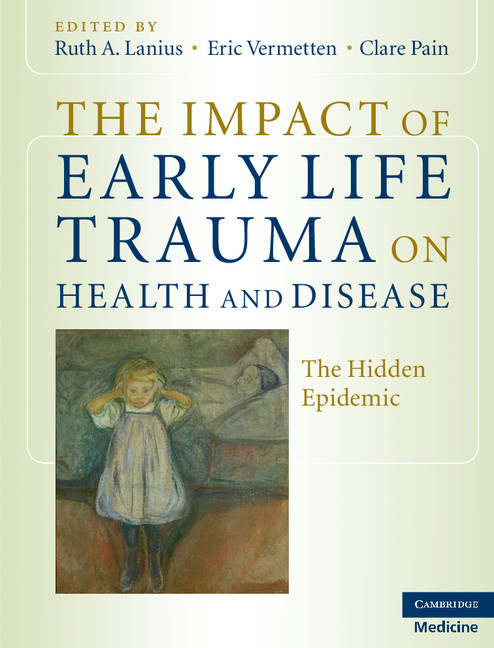
The Impact of Early Life Trauma on Health and Disease

The Impact of Early Life Trauma on Health and Disease

The Hidden Epidemic
Editors:
Ruth A. Lanius, University of Western Ontario
Eric Vermetten, Universiteit Utrecht, The Netherlands
Clare Pain, University of Toronto
Martin J. Dorahy, Onno van der Hart, Warwick Middleton, Karestan C. Koenen, Andrea Roberts, Deborah Stone, Erin Dunn, Constance J. Dalenberg, Kelsey Paulson, Nathan Szajnberg, Amit Goldenberg, Udi Harari, Alexander McFarlane, Jean-François Bureau, Jodi Martin, Karlen Lyons-Ruth, Bessel van der Kolk, Wendy d' Andrea, Julian D. Ford, Vincent J. Felitti, Robert F. Anda, Alicia F. Lieberman, Gail Richter-Levin, Shlomit Jacobson-Pick, Rosario Montirosso, Renato Borgatti, Ed Tronick, Martin H. Teicher, Keren Rabi, Yi-Shin Sheu, Sally B. Seraphin, Susan L. Andersen, Michael D. De Bellis, Phillip A. Fisher, Megan Gunner, Allan N. Schore, Kelly Skelton, Tamara Weiss, Bekh Bradley, Jamie L. LaPrairie, Christine M. Heim, Charles B. Nemeroff, Douglas Bremmer, Eric Vermetten, Ruth Lanius, Christian Schmahl, Fatih Ozbay, Vansh Sharma, Joan Kaufman, Bruce McEwan, Dennis Charney, Steven Southwick, John Briere, Monica Hodges, Melody D. Combs, Anne P. DePrince, Oxana Palesh, Felicia Heidenreich, Mónica Ruiz-Casares, Cécile Rousseau, Jon G. Allen, Peter Fonagy, Anthony Bateman, Richard J. Loewenstein, Victor Welzant, Kathleen M. Chard, Amy F. Buckley, Anthony Charuvastra, Marylene Cloitre, Clare Pain, Pat Ogden, Tal Astrachan, Carla Bernardes, Judith Herman
Published:
September 2010
Availability:
Available
Format:
Hardback
ISBN:
9780521880268

Looking for an examination copy?

If you are interested in the title for your course we can consider offering an examination copy. To register your interest please contact collegesales@cambridge.org providing details of the course you are teaching.

$165.00 (P) USD
Hardback
$165.00 (Z) USD
eBook

    There is now ample evidence from the preclinical and clinical fields that early life trauma has both dramatic and long-lasting effects on neurobiological systems and functions that are involved in different forms of psychopathology as well as on health in general. To date, a comprehensive review of the recent research on the effects of early and later life trauma is lacking. This book fills an obvious gap in academic and clinical literature by providing reviews which summarize and synthesize these findings. Topics considered and discussed include the possible biological and neuropsychological effects of trauma at different epochs and their effect on health. This book will be essential reading for psychiatrists, clinical psychologists, mental health professionals, social workers, pediatricians and specialists in child development.

    • The most comprehensive summary of recent and accumulated evidence for the impact of early life trauma
    • An essential psychiatry text, written by internationally recognised experts and opinion leaders
    • Covers an increasingly important and previously neglected area of psychopathology

    Reviews & endorsements

    ' … 'The topic of this book is important and the information presented is timely and extensive …' The Journal of Psychological Medicine

    Product details

    • Published: September 2010
    • Format: Hardback
    • ISBN: 9780521880268
    • Length: 329 pages
    • Dimensions: 252 × 193 × 20 mm
    • Weight: 0.99kg
    • Contains: 20 b/w illus. 30 tables
    • Availability: Available

    Table of Contents

    • Part I. Early Life Trauma, Impact of Health and Disease
    • Section 1. Childhood Trauma: Epidemiology and Historical Themes:
    • 1. The history of early life trauma and abuse from the 1850s to the current time: how the past influences the present
    • 2. The epidemiology of early life trauma
    • 3. Historical themes in the study of recovered and false memories of trauma
    • 4. Early life trauma, later outcome: results from longitudinal studies and clinical observations
    • Synopsis
    • Section 2. The Effects of Life Trauma: Mental and Physical Health:
    • 5. Attachment dysregulation as hidden trauma in infancy
    • 6. Towards a developmental trauma in infancy, early stress, maternal buffering, and psychiatric morbidity in young adulthood
    • 7. Complex adult sequelae of early life exposure to psychological trauma
    • 8. The relationship of adverse childhood experiences to adult health, well being, social function and health care
    • Synopsis
    • Part II. Biological Approaches to Early Life Trauma
    • Section 3. The Impact of Early Life Trauma: Psychobiological Sequelae in Children:
    • 9. Translational studies of the effects of early life stress
    • 10. Lateral asymmetries in infants' regulatory and communicative gestures
    • 11. Neurobiology of childhood trauma and adversity
    • 12. Neurobiology of neglect
    • 13. Early life trauma as a risk factor for disease in adulthood
    • Synopsis
    • Section 4. The Impact of Childhood Trauma: Psychobiological Sequelae in Adults:
    • 14. Early life stress and psychiatric risk/resilience: the importance of a developmental neurobiological model in understanding gene by environment interactions
    • 15. Neuroendocrine effects of early life trauma
    • 16. Long lasting effects of early life trauma on neurobiological circuits
    • 17. Biological framework for early life related traumatic dissociation
    • 18. The role of resilience in early life trauma
    • Synopsis
    • Part III. Clinical Perspectives, Assessment and Treatment of Trauma Spectrum Disorders
    • Section 5. Assessment on the Impact of Early Life Trauma: Clinical Science and Societal Effects:
    • 19. Assessment of early- and mid-childhood trauma in adults
    • 20. Memory and trauma: examining disruptions in implicit, explicit and autobiographical memory
    • 21. Scientific progress and methodological issues in the study of recovered and false memories of trauma
    • 22. The psychosocial consequences of organized violence in children
    • Synopsis
    • Section 6. Strategies to Reduce Impact:
    • 23. The role of mentalizing in treating attachment trauma
    • 24. Pragmatic approaches to stage oriented treatment for complex post traumatic stress and dissociative disorders
    • 25. Cognitive behavioral treatments
    • 26. Emotions and emotion regulation in the process of trauma recovery: implications for the treatment of post traumatic stress disorder
    • 27. Psychodynamic psychotherapy: adaptations for the treatment of patients with chronic complex PSTD
    • Synopsis
    • Epilogue
    • Index.

    Contributors

    Martin J. Dorahy, Onno van der Hart, Warwick Middleton, Karestan C. Koenen, Andrea Roberts, Deborah Stone, Erin Dunn, Constance J. Dalenberg, Kelsey Paulson, Nathan Szajnberg, Amit Goldenberg, Udi Harari, Alexander McFarlane, Jean-François Bureau, Jodi Martin, Karlen Lyons-Ruth, Bessel van der Kolk, Wendy d' Andrea, Julian D. Ford, Vincent J. Felitti, Robert F. Anda, Alicia F. Lieberman, Gail Richter-Levin, Shlomit Jacobson-Pick, Rosario Montirosso, Renato Borgatti, Ed Tronick, Martin H. Teicher, Keren Rabi, Yi-Shin Sheu, Sally B. Seraphin, Susan L. Andersen, Michael D. De Bellis, Phillip A. Fisher, Megan Gunner, Allan N. Schore, Kelly Skelton, Tamara Weiss, Bekh Bradley, Jamie L. LaPrairie, Christine M. Heim, Charles B. Nemeroff, Douglas Bremmer, Eric Vermetten, Ruth Lanius, Christian Schmahl, Fatih Ozbay, Vansh Sharma, Joan Kaufman, Bruce McEwan, Dennis Charney, Steven Southwick, John Briere, Monica Hodges, Melody D. Combs, Anne P. DePrince, Oxana Palesh, Felicia Heidenreich, Mónica Ruiz-Casares, Cécile Rousseau, Jon G. Allen, Peter Fonagy, Anthony Bateman, Richard J. Loewenstein, Victor Welzant, Kathleen M. Chard, Amy F. Buckley, Anthony Charuvastra, Marylene Cloitre, Clare Pain, Pat Ogden, Tal Astrachan, Carla Bernardes, Judith Herman

    Editors

    Ruth A. Lanius , University of Western Ontario

    Ruth A. Lanius is Associate Professor, Harris-Woodman Chair, the University of Western Ontario, Canada.

    Eric Vermetten , Universiteit Utrecht, The Netherlands

    Eric Vermetten, MD, PhD, was trained as a psychiatrist and psychotherapist in the Netherlands and finished his residency at Yale University where he worked in a postdoctoral role before moving to Emory University. In 2001, he was employed by the Dutch Army and in 2007 became Officer (ranked COL) in the Dutch Military. He is Head of Research in the Military Mental Health Service with the Department of Defense. He also holds the position of Associate Professor of Psychiatry in the Neuroscience Division of the University Medical Center, Utrecht. In his research, he looks at the biological basis of trauma-related disorders and strategies for early prevention. He is interested in mind-body connections and has published widely on PTSD, dissociation, hypnosis and narrative psychotherapy. He has published over 100 papers on these topics. After serving as President of the Dutch Society of Hypnosis (2000–2006), he served as President of the International Society of Hypnosis (2006–2009), and is now on the Board of the International Society of Traumatic Stress (ISTSS). Among his most recent books are Traumatic Dissociation (with Martin Dorahy and David Spiegel), published by the American Psychiatric Press in 2007, and Neurendocrinology of PTSD, (with Ron de Kloet and Melly Oitzl), published in the series Progress in Brain Research in 2008. Dr Vermetten is an ad hoc reviewer for numerous journals and granting agencies. He has lectured on PTSD across the globe, and in 2012 edited a Dutch textbook on the subject.

    Clare Pain , University of Toronto

    Clare Pain is Assistant Professor, Department of Psychiatry, University of Toronto, Canada.