

Technocracy and Democracy in Latin America
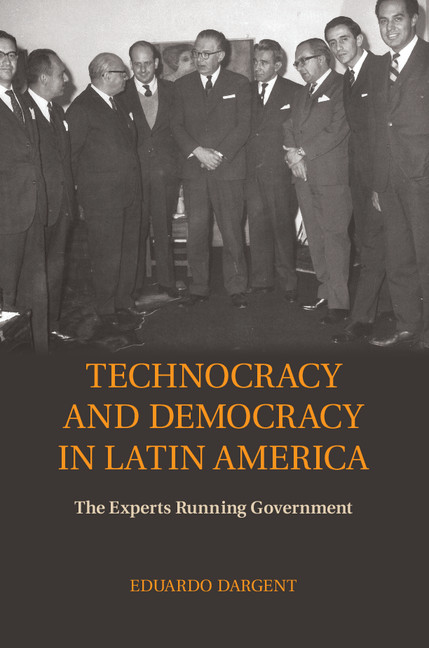
Technocracy and Democracy in Latin America
Looking for an examination copy?
If you are interested in the title for your course we can consider offering an examination copy. To register your interest please contact collegesales@cambridge.org providing details of the course you are teaching.
Praised by some as islands of efficiency in a sea of unprofessional, politicized and corrupt states, and criticized by others for removing wide areas of policy making from the democratic arena, technocrats have become prominent and controversial actors in Latin American politics. Nonelected state officials with advanced educations from top universities, technocrats achieve considerable autonomy from political and economic actors and exert great influence over their countries' fates. This finding poses an intriguing paradox. These experts lack an independent base of authority, such as popular election, and the tenure enjoyed by professional bureaucrats. What, then, explains the power of technocrats in democratic Latin America? Why do they enjoy and maintain greater policy influence in some areas than in others? Through analysis of economic and health policy in Colombia from 1958 to 2011 and in Peru from 1980 to 2011, Technocracy and Democracy in Latin America answers these and other questions about experts in Latin America.
- An in-depth, qualitative, comparative analysis of experts' power in Colombia and Peru
- Includes analysis of policy documents, media coverage, and academic articles
- Features interviews with more than 150 technocrats, top ranked politicians, civil society actors, and academics
Reviews & endorsements
"The best comparative analysis of technocratic policy from any region of the world. Students of Latin America, country experts, scholars on democracy, and anyone interested in the politics of knowledge need to read this book. Theoretically acute and empirically rigorous."
Miguel Angel Centeno, Musgrave Professor of Sociology and International Affairs, Princeton University, New Jersey
"Drawing on hundreds of interviews with politicians and policy makers, and careful analysis of the governance of the economy and the health sector in Colombia and Peru, Eduardo Dargent provides a welcome reorientation of political science toward the outputs of policy in this exploration of the striking subnational variation in state capacity."
Hillel Soifer, Temple University, Philadelphia
"This path breaking book offers a serious challenge to theorists who have long argued that technocrats derive their power from other actors, including politicians, businesses and international financial institutions. This is first-rate comparative politics research, with eye-opening implications."
Kent Eaton, University of California, Santa Cruz
"A much-needed study of the power and limitations of technocrats in Latin American democracies … a major contribution to comparative research on state reform and policy making."
Steven Levitsky, Harvard University, Massachusetts
"In a brilliantly crafted comparative analysis, Eduardo Dargent develops a persuasive theoretical framework that explains the relative autonomy of technocrats. The rich evidence from the economic and health policy issue areas in Peru and Colombia robustly support his arguments."
Eduardo Silva, Lydian Chair Professor of Political Science, Tulane University, Louisiana
"Eduardo Dargent breaks with the dominant idea that technocrats are almost entirely subordinated to their political masters … a theoretically sophisticated and extremely well-documented work."
Patricio Silva, Universiteit Leiden
Product details
- Published: November 2014
- Format: Hardback
- ISBN: 9781107059870
- Length: 216 pages
- Dimensions: 235 × 157 × 18 mm
- Weight: 0.5kg
- Contains: 10 b/w illus. 10 tables
- Availability: Available


Table of Contents
- 1. Introduction: technocracy under democracy
- 2. Technocrats in Latin American democracies: agents or actors?
- 3. A theory of technocratic autonomy
- 4. Economic technocrats in Colombia (1958–2011)
- 5. Economic technocrats in Peru (1980–3
- 1990–2011)
- 6. Health technocrats in Colombia (1966–70
- 1993–2013)
- 7. Health technocrats in Peru (1990–2002)
- 8. Conclusion: technocratic autonomy, its limits, and democracy in Latin America.
- Show more



