

Industrial Forests and Mechanical Marvels
Industrial Forests and Mechanical Marvels
Looking for an examination copy?
If you are interested in the title for your course we can consider offering an examination copy. To register your interest please contact collegesales@cambridge.org providing details of the course you are teaching.
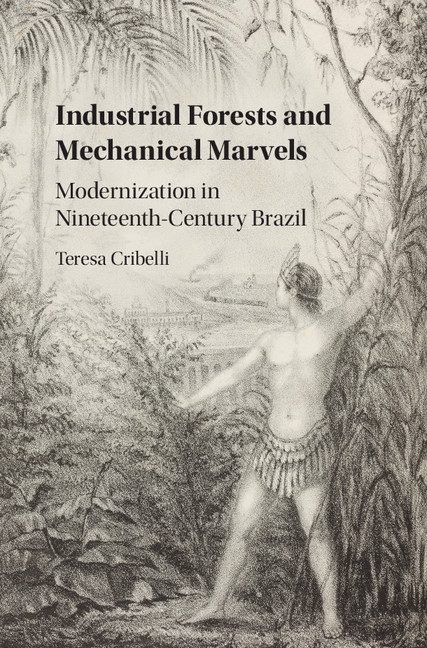
An account of modernization and technological innovation in nineteenth-century Brazil that provides a distinctly Brazilian perspective. Existing scholarship on the period describes the beginnings of Brazilian modernization as a European or North American import dependent on foreign capital, transfers of technology, and philosophical inspiration. Promoters of modernization were considered few in number, derivative in their thinking, or thwarted by an entrenched slaveholding elite hostile to industrialization. Teresa Cribelli presents a more nuanced picture. Nineteenth-century Brazilians selected among the transnational flow of ideas and technologies with care and attention to the specific conditions of their tropical nation. Studying underutilized sources, Cribelli illuminates a distinctly Brazilian vision of modernization that challenges the view that Brazil, a nation dependent on slave labor for much of the nineteenth century, was merely reactive in the face of the modernization models of the North Atlantic industrializing nations.
- Brings Brazilian perspectives to the foreground in understanding modernization in Brazil during the nineteenth century
- Traces the roots of Brazilian economic thought in nineteenth-century economic development
- Explores new territory in the realm of patents and Brazilian technological innovation, particularly in the coffee sector
Reviews & endorsements
'Teresa Cribelli’s Industrial Forests and Mechanical Marvels: Modernization in Nineteenth-Century Brazil offers a rich counter to histories that take the Brazilian Empire as a derivative case. The book stands against several commonplace assumptions in the field: that modernizing ideas in Brazil were late to come; were of external, notably British, provenance; and remained uncomfortably 'out of place' amid the trappings of a slave society … Cribelli succeeds in illustrating how Brazilian society was abuzz with polemics and plans related to improvement … In closing, the book presents a roadmap for future research that will be of special use to graduate students initiating work on Brazilian history. More importantly, this work is a welcome addition to courses on Brazil in the United States, where students may now be introduced to the Brazilian Empire not as a backward slave society but as a hotbed of technological ingenuity.' José Juan Pérez Meléndez, H-LatAm
'Teresa Cribelli’s fine monograph Industrial Forests and Mechanical Marvels: Modernization in Nineteenth-Century Brazil examines how elites in imperial Brazil thought about modernization, how it applied to their own society, and how they attempted to adapt European ideas and technologies to Brazil.' Marshall C. Eakin, The American Historical Review
Product details
- Published: July 2016
- Format: Hardback
- ISBN: 9781107100565
- Length: 274 pages
- Dimensions: 235 × 158 × 20 mm
- Weight: 0.52kg
- Contains: 26 b/w illus. 1 map
- Availability: Available


Table of Contents
- 1. Nineteenth-century modernization in Brazil
- 2. The vocabulary of Brazilian modernization
- 3. Industrial forests
- 4. The most useful of instruments: plows and agricultural innovation
- 5. Road-building and railroads: challenges to modernization
- 6. Trolleys, railroads, and factories, or civilization and barbarism
- Conclusion
- Bibliography
- Index.
- Show more



