

France under Fire
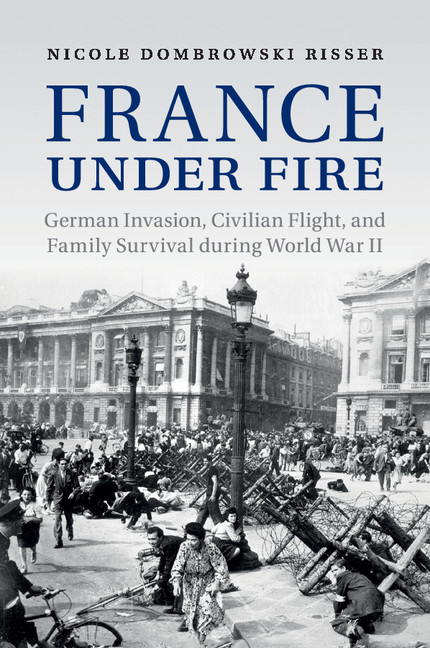
France under Fire
Looking for an examination copy?
If you are interested in the title for your course we can consider offering an examination copy. To register your interest please contact collegesales@cambridge.org providing details of the course you are teaching.
'We request an immediate favour of you, to build a shelter for us women and small children, because we have absolutely no place to take refuge and we are terrified!' This French mother's petition sent to her mayor on the eve of Germany's 1940 invasion of France reveals civilians' security concerns unleashed by Second World War Blitzkrieg fighting tactics. Unprepared for air warfare's assault on civilian psyches, French planners were among the first in history to respond to civilian security challenges posed by aerial bombardment. France Under Fire offers a social, political and military examination of the origins of the French refugee crisis of 1940, a mass displacement of eight million civilians fleeing German combatants. Scattered throughout a divided France, refugees turned to German Occupation officials and Vichy administrators for relief and repatriation. Their solutions raised questions about occupying powers' obligations to civilians and elicited new definitions of refugees' rights.
- Includes first-hand accounts of the challenge to protect civilian populations from the dangers of aerial bombardment and land invasion
- Reveals how civilian women persistently petitioned French and German officials to meet their survival needs
- Provides a social, military and political examination of the origins of the French refugee crises of World War II
Reviews & endorsements
"Using dramatic personal testimony, Dombrowski Risser uncovers how the 1940 "Exodus" politicized women, what the longer-term repercussions of mass migration were, and how refugee return policies were used to exclude Jews and other "undesirables". France under Fire significantly enriches historical scholarship on civilian displacement, German-French interplay during the French occupation, and ethnic cleansing during World War Two."
Julia Torrie, St Thomas University
"Risser’s findings make a real contribution to our knowledge of this historical episode, now remote but still within living memory."
Ian Birchall, European History Quarterly
'An ambitious book, [Dombrowski] Risser sets out to examine the intersection of the civilian and military experience under total war by looking at the mass exodus and internal displacement of domestic and foreign refugees in France during World War II.' Lynne Taylor, H-France
Product details
- Published: July 2012
- Format: Adobe eBook Reader
- ISBN: 9781139534642
- Length: 0 pages
- Weight: 0kg
- Contains: 4 b/w illus. 3 maps 11 tables
- Availability: This ISBN is for an eBook version which is distributed on our behalf by a third party.


.jpg)
.jpg)
Table of Contents
- Introduction: no more 'behind the lines'
- Part I. Civilians in the Line of Fire:
- 1. Securing the homeland
- 2. Mothers move against military and bureaucratic entrenchment
- 3. Pulling the plug on the city of lights
- 4. Civilian survival on the open road
- Part II. Refugees, Rights, and Return in a Divided Land:
- 5. Provincial towns feed and shelter refugees
- 6. Paving the road for refugees' return
- 7. German exclusions inaugurate a policy of ethnic cleansing
- 8. Disappointment and despair in the occupied zone
- Conclusion.
- Show more



