Skip to main content Accessibility help
×
  • Cited by 13
    • Show more authors
    • You may already have access via personal or institutional login
    • Select format
    • Publisher:
      Cambridge University Press
      Publication date:
      05 March 2015
      26 February 2015
      ISBN:
      9781316144558
      9781107093034
      9781107471511
      Dimensions:
      (228 x 152 mm)
      Weight & Pages:
      0.5kg, 246 Pages
      Dimensions:
      (229 x 152 mm)
      Weight & Pages:
      0.37kg, 246 Pages
    You may already have access via personal or institutional login
  • Selected: Digital
    Add to cart View cart Buy from Cambridge.org

    Book description

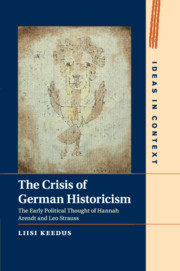
    Hannah Arendt and Leo Strauss - two major political thinkers of the twentieth century, both of German-Jewish background and forced into exile in America - were never friends or intellectual interlocutors. Yet they shared a radical critique of contemporary idioms of politically oriented discourses and a lifelong effort to modify reflective approaches to political experience. Liisi Keedus reveals how Arendt's and Strauss's thinking about political modernity was the product of a common intellectual formation in Weimar Germany, by examining the cross-disciplinary debates guiding their early work. Through a historical reconstruction of their shared interrogative horizons - comprising questions regarding the possibility of an ethically engaged political philosophy after two world wars, the political fate of Jewry, the implications of modern conceptions of freedom, and the relation between theoria and praxis - Keedus unravels striking similarities, as well as genuine antagonisms, between the two thinkers.

    Awards

    A Choice Outstanding Academic Title 2015

    Reviews

    'This insightful and well-researched book reads like a thriller. True to its title, the book covers the responses of Arendt and Strauss to the German historical school and to the historicized philosophy of the Weimar years. It also deals with the situation that Arendt and Strauss faced as Jews in Germany during those years. But the book is not limited to these topics nor is it limited to the early years of Arendt and Strauss … Highly recommended. General readers, upper-division undergraduate students, and above.'

    Source: Choice

    'There is much from which one can learn in this book. Keedus has read broadly in the intellectual and political debates in Germany in the early twentieth century. Learning about the contemporary cultural impact of a Friedrich Gogarten or a Karl Barth is interesting in its own right, and the sense of cultural crisis associated with such thinkers is relevant to the political philosophies later articulated by Arendt and Strauss … Keedus’s book offers the paradox of a historicist treatment of thinkers who (as her own argument highlights) rebelled against historicism.'

    Ronald Beiner Source: The Review of Politics

    'I believe the great merit of the book consists in broadening the scope of themes and authors to which and whom Strauss and Arendt have related and in introducing much new source material.'

    Wout Cornelissen Source: History of Political Thought

    Refine List

    Actions for selected content:

    Select all | Deselect all
    • View selected items
    • Export citations
    • Download PDF (zip)
    • Save to Kindle
    • Save to Dropbox
    • Save to Google Drive

    Save Search

    You can save your searches here and later view and run them again in "My saved searches".

    Please provide a title, maximum of 40 characters.
    ×

    Contents

    Metrics

    Altmetric attention score

    Full text views

    Total number of HTML views: 0
    Total number of PDF views: 0 *
    Loading metrics...

    Book summary page views

    Total views: 0 *
    Loading metrics...

    * Views captured on Cambridge Core between #date#. This data will be updated every 24 hours.

    Usage data cannot currently be displayed.

    Accessibility standard: Unknown

    Why this information is here

    This section outlines the accessibility features of this content - including support for screen readers, full keyboard navigation and high-contrast display options. This may not be relevant for you.

    Accessibility Information

    Accessibility compliance for the PDF of this book is currently unknown and may be updated in the future.