

The Industrious Revolution
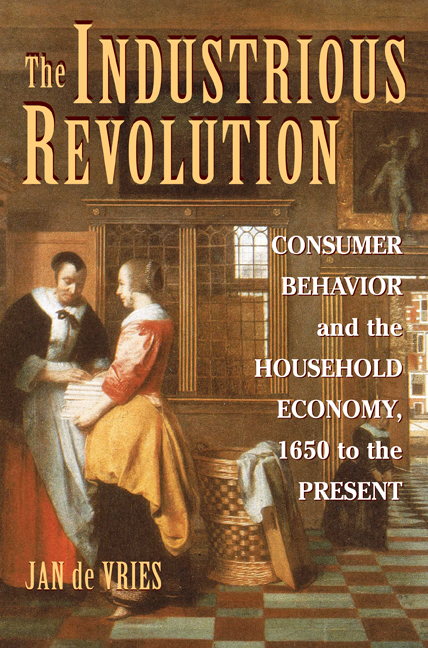
The Industrious Revolution
Looking for an examination copy?
If you are interested in the title for your course we can consider offering an examination copy. To register your interest please contact collegesales@cambridge.org providing details of the course you are teaching.
In the long eighteenth century, new consumer aspirations combined with a new industrious behavior to fundamentally alter the material cultures of northwest Europe and North America. This “industrious revolution” is the context in which the economic acceleration associated with the Industrial Revolution took shape. This study explores the intellectual understanding of the new importance of consumer goods as well as the actual consumer behavior of households of all income levels. De Vries examines how the activation and evolution of consumer demand shaped the course of economic development, situating consumer behavior in the context of the household economy. He considers the changing consumption goals of households from the seventeenth century to the present and analyzes how household decisions have mediated between macro-level economic growth and actual human betterment. Ultimately, de Vries’ research reveals key strengths and weaknesses of existing consumer theory, suggesting revisions that add historical realism to economic abstractions.
- A study of consumption spanning from the early modern period right up to the present day
- Views economic factors, like consumerism and consumption, within the context of the family unit
- Based on copious research and a far-reaching analysis of European history; proposes important revisions to consumer theory
Reviews & endorsements
"Combining an encylcopaedic knowledge of the history of consumption of early-modern north-western Europe with a vigorous determination to use recent economic theory to unlock its meaning, Jan de Vries' The Industrious Revolution is by turns fascinating, provocative and illuminating. No student of consumption, whether historian or economist, can afford to ignore it." -John Brewer, California Institute of Technology
“This is an important book. The appearance of 'new goods' in the eighteenth century elicited a growing work effort and provided a spur to economic growth even more important than the industrial revolution itself. A similar profusion in the last few decades (and the rise of education) has driven women out of the home again and back into work. De Vries is a masterly and imaginative historian, who demonstrates enduring regularities behind the craving for goods over the last three centuries.” -Avner Offer, All Souls College, University of Oxford
“One of the most accomplished and influential economic historians of our age has produced a magisterial work that will force the entire profession to rethink the history of the household, work, leisure, and consumption in Europe over three centuries. Based on a wide and deep knowledge of his subject, De Vries has taken a novel and original approach to the joint determination of income and consumption by households. The “Industrious Revolution” will be discussed and taught for many years.” -Joel Mokyr, Northwestern University
"… this book will interest all concerned with human behaviour in its many forms … it contains interesting insights into the ways behaviour has changed over the past couple of centuries …" The Financial Times
"Buy, buy buy." -Times Literary Supplement
"A remarkable achievement, this seminal study will stimulate debate and research for years. Indispensable for academics and advanced undergraduates, it will intrigue some general readers. Essential" -Choice
"...it is staggerinly erudite, insightful, stimulating, and on all the main points, convincing." -Hans-Joachim Voth, EH.NET
"...breathtakingly erudite, accessibly written, and admirably concise." -John Styles, Journal of Economic History
"I would urge those who instinctively shy from books that trade in such terms as 'backward bending supply curves' to pick up this volume. If you read only one work of economic history this year, let this be it." -Michael Kwass, American Historical Review
"De Vries's work is a masterful synthesis that defies summary in a short review. He systematically summarizes, challenges, dissects, and reconstitutes countless interpretations that have formed the basis of the early modern economic historiography. For that reason alone, this book should be read by undergraduates and graduate students alike."
Canadian Journal of History, Stephen Moore
Product details
- Published: July 2008
- Format: Adobe eBook Reader
- ISBN: 9780511406140
- Length: 0 pages
- Weight: 0kg
- Availability: This ISBN is for an eBook version which is distributed on our behalf by a third party.








Table of Contents
- 1. The transformation of consumer desire in the long eighteenth century
- 2. The origins of the Industrious Revolution
- 3. The Industrious Revolution: the supply of labor
- 4. The Industrious Revolution: consumer demand
- 5. The breadwinner-homemaker household
- 6. A second Industrious Revolution?
- Appendix I.
- Show more



