

The Promise and Limits of Private Power
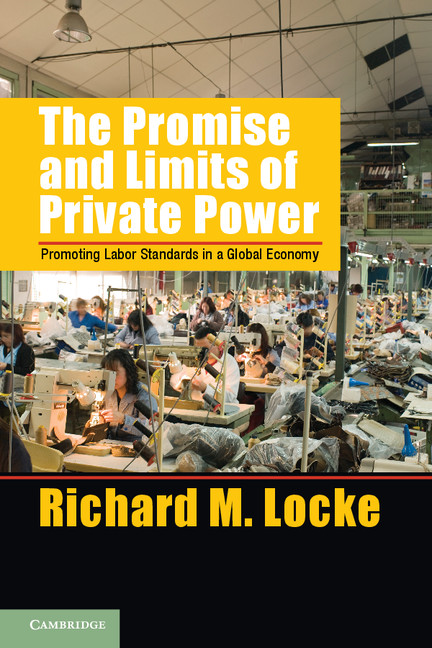
The Promise and Limits of Private Power
Looking for an examination copy?
If you are interested in the title for your course we can consider offering an examination copy. To register your interest please contact collegesales@cambridge.org providing details of the course you are teaching.
This book examines and evaluates various private initiatives to enforce fair labor standards within global supply chains. Using unique data (internal audit reports and access to more than 120 supply chain factories and 700 interviews in 14 countries) from several major global brands, including NIKE, HP and the International Labor Organization's Factory Improvement Programme in Vietnam, this book examines both the promise and the limitations of different approaches to actually improve working conditions, wages and working hours for the millions of workers employed in today's global supply chains. Through a careful, empirically grounded analysis of these programs, this book illustrates the mix of private and public regulation needed to address these complex issues in a global economy.
- Empirical contribution: first study that gains access to the internal factory audits of major corporations and analyzes them, showing the true functions of thousands of factories scattered throughout the developing world that produce goods we consume every day; analyzes current labor conditions and labor rights within today's global supply chains
- Theoretical contribution: explores how private voluntary and state regulations can combine to tackle labor problems in a world of shifting firm boundaries, dynamic supply chains and growing efforts to complement traditional forms of regulation with emerging private forms of regulation
- Practical contribution: suggests pragmatic strategies for key actors, such as multinational corporations, transnational NGOs, governments, in promoting labor standards
Reviews & endorsements
“Richard Locke confronts issues that are of central concern to scholars, as well as to activists, firms, and consumers: Under what conditions, and through which mechanisms, will workers involved in global supply chains be treated fairly? Locke’s answer is that no single mechanism – corporate codes of conduct, capacity building, or host government regulation – is sufficient to effect improvements in workers’ conditions. Locke argues protecting workers will require a combination of firm-level efforts, long-standing supply-chain relationships, and government effort. He draws on a rich collection of factory-level audit data, as well as in-depth interviews in a range of countries, to explore the determinants of variation in workers’ rights outcomes, and to illustrate the conditions under which sustained improvements might occur.”
Layna Mosley, Professor of Political Science, University of North Carolina at Chapel Hill
“This is an outstanding book examining labor issues in global supply chains. The key strength is the level and quality of access Richard Locke has to company-level data. This type and level of access is quite unprecedented in political science. Theoretically, the book raises important issues regarding the efficacy of voluntary regulation, particularly the merits of compliance-based versus capacity-based approaches.”
Aseem Prakash, Walker Family Professor for the College of Arts and Sciences, University of Washington
“This book is seminal in setting out how collaborative governance of global supply chains can deliver better employment conditions and distributive justice. Global business, governments, and NGOs with different beliefs about the proper role of business and the state should treat this as a wake-up call. The Promise and Limits of Private Power will quickly become the definitive reference on labor standards and set a high benchmark for those who study this issue.”
Professor Mari Sako, Said Business School, University of Oxford
"Richard M. Locke’s book, The Promise and Limits of Private Power: Promoting
Labor Standards in a Global Economy, does a remarkable job in this hotly contested terrain of dissecting the daunting challenges of trying to improve global labour standards, while also outlining sustainable solutions that are supported by a range of key industry actors … Locke’s analysis has very significant methodological implications for anyone seeking to understand labour standards in the global economy."
Gary Gereffi, Socio-Economic Review
Product details
- Published: April 2013
- Format: Adobe eBook Reader
- ISBN: 9781107070028
- Length: 0 pages
- Weight: 0kg
- Contains: 20 b/w illus. 26 tables
- Availability: This ISBN is for an eBook version which is distributed on our behalf by a third party.


Table of Contents
- 1. The rise of private voluntary regulation in a global economy
- 2. The promise and perils of private compliance programs
- 3. Does private compliance improve labor standards? Lessons from Nike
- 4. Capability building and its limitations
- 5. Alternative approaches to capability building: a tale of two Nike suppliers
- 6. Are we looking in the wrong places?: Labor standards and upstream business practices in global supply chains
- 7. Complements or substitutes? Private power, public regulation, and the enforcement of labor standards in global supply chains
- Conclusion: collaboration, compliance, and the construction of new institutions in a world of global supply chains.
- Show more



