

Financial Analytics with R
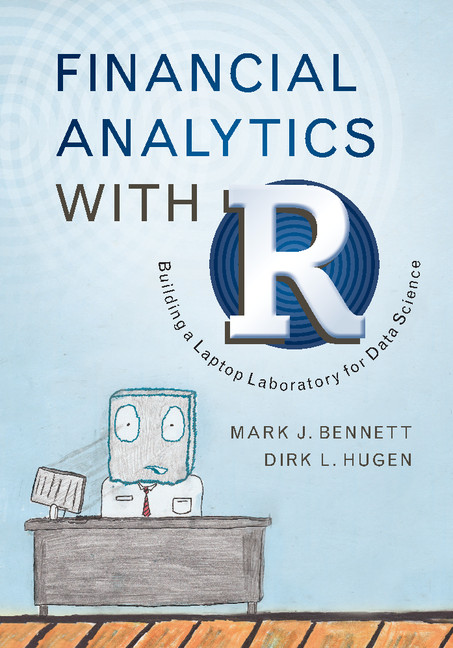
Financial Analytics with R
Looking for an examination copy?
If you are interested in the title for your course we can consider offering an examination copy. To register your interest please contact collegesales@cambridge.org providing details of the course you are teaching.
Are you innately curious about dynamically inter-operating financial markets? Since the crisis of 2008, there is a need for professionals with more understanding about statistics and data analysis, who can discuss the various risk metrics, particularly those involving extreme events. By providing a resource for training students and professionals in basic and sophisticated analytics, this book meets that need. It offers both the intuition and basic vocabulary as a step towards the financial, statistical, and algorithmic knowledge required to resolve the industry problems, and it depicts a systematic way of developing analytical programs for finance in the statistical language R. Build a hands-on laboratory and run many simulations. Explore the analytical fringes of investments and risk management. Bennett and Hugen help profit-seeking investors and data science students sharpen their skills in many areas, including time-series, forecasting, portfolio selection, covariance clustering, prediction, and derivative securities.
- Contains an ideal blend of innovative research and practical applications
- Tackles relevant investor problems
- Provides a multi-disciplined approach, solving problems from both fundamental and non-traditional methods
Reviews & endorsements
"A very well-written text on financial analytics, focusing on developing statistical models and using simulation to better understand financial data. R is used throughout for examples, allowing the reader to use the text and code to actively engage in the financial market. It is simply the best text on this subject that I have seen. Highly recommended."
Joseph M. Hilbe, Arizona State University
'There’s a new source in town for those who want to learn R and it’s a good, old-fashioned book called Financial Analytics with R: Building a Laptop Laboratory for Data Science … it is a one-stop-shop for everything you need to know to use R for financial analysis. The book meaningfully combines an education on R with relevant problem-solving in financial analysis. [It] is thorough and contextualized with examples from extreme financial events in recent times such as the housing crisis and the Euro crisis. The code samples are relevant - think functions to compute the Sharpe ratio or to implement Bayesian reasoning - and answer many of the questions you might have while trying them out. This is a book that will make you a better practitioner/student/analyst/entrepreneur - whatever your goals may be.' Carrie Shaw, Quandl
'The book at hand is unusual in addressing beginners, and in treating R as a general number crunching tool. … It is also one of very few books on R really written for non-statistician non-programmers. … R seems a viable programming language for STEM students to learn, and learning a programming language seems a good idea for such students. This book appears to be the best option for accomplishing that.' Robert W. Hayden, Mathematical Association of America Reviews (www.maa.org)
Product details
- Published: September 2017
- Format: Adobe eBook Reader
- ISBN: 9781316777633
- Length: 0 pages
- Weight: 0kg
- Contains: 60 b/w illus. 100 colour illus. 40 exercises
- Availability: This ISBN is for an eBook version which is distributed on our behalf by a third party.






Table of Contents
- Preface
- Acknowledgements
- 1. Analytical thinking
- 2. The R language for statistical computing
- 3. Financial statistics
- 4. Financial securities
- 5. Dataset analytics and risk measurement
- 6. Time series analysis
- 7. The Sharpe ratio
- 8. Markowitz mean-variance optimization
- 9. Cluster analysis
- 10. Gauging the market sentiment
- 11. Simulating trading strategies
- 12. Data mining using fundamentals
- 13. Prediction using fundamentals
- 14. Binomial model for options
- 15. Black–Scholes model and option implied volatility
- Appendix. Probability distributions and statistical analysis
- Index.
- Show more



