

Across the Great Divide
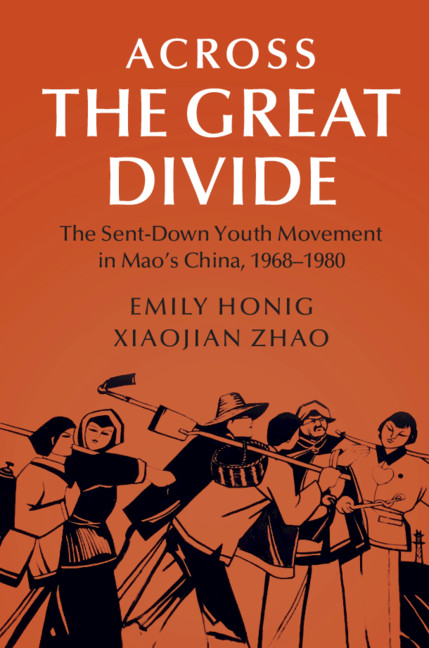
Across the Great Divide
Looking for an examination copy?
If you are interested in the title for your course we can consider offering an examination copy. To register your interest please contact collegesales@cambridge.org providing details of the course you are teaching.
The sent-down youth movement, a Maoist project that relocated urban youth to remote rural areas for 're-education', is often viewed as a defining feature of China's Cultural Revolution and emblematic of the intense suffering and hardship of the period. Drawing on rich archival research focused on Shanghai's youth in village settlements in remote regions, this history of the movement pays particular attention to how it was informed by and affected the critical issue of urban-rural relations in the People's Republic of China. It highlights divisions, as well as connections, created by the movement, particularly the conflicts and collaborations between urban and rural officials. Instead of chronicling a story of victims of a monolithic state, Honig and Zhao show how participants in the movement - the sent-down youth, their parents, and local government officials - disregarded, circumvented, and manipulated state policy, ultimately undermining a decade-long Maoist project.
- Presents highly original research based on new material from local archives
- Integrates a rural perspective into the history of the sent-down youth movement
- Questions received narratives privileging the voices of urban youth
Reviews & endorsements
'A wonderfully nuanced and insightful study of China’s monumental Cultural Revolution campaign that sent millions of urban youths to the remote countryside. Based on a wide array of rich archival and interview sources, this is a first-rate work of scholarship that is also eminently readable. Highly recommended for academic and general audiences alike.' Elizabeth J. Perry, Harvard University, Massachusetts
‘Across the Great Divide changes our understanding of the sent-down movement and Mao’s China. Focusing on Shanghai youth sent to villages, the book documents not only their experiences, but also the connections and conflicts between them and villagers and between rural and urban officials and parents. The result is a remarkable new history.’ Guobin Yang, University of Pennsylvania
‘This well-researched volume by Honig (Univ. of California, Santa Cruz) and Zhao (Univ. of California, Santa Barbara) seeks to probe how China's sent-down youth movement of 1968-80 was informed by and affected relations between state and society, and between city and countryside.’ S. K. Ma, Choice
‘Across the Great Divide will be of interest to not only scholars of modern China but also to a wider audience interested in understanding the dynamics characterizing one of the greatest social experiments of the twentieth century. Individual chapters will serve well as assigned readings for undergraduate courses, offering local perspectives on what the sent-down youth movement actually meant in practice.’ Justin Wu, Pacific Affairs
Product details
- Published: November 2019
- Format: Paperback
- ISBN: 9781108712491
- Length: 224 pages
- Dimensions: 228 × 152 × 12 mm
- Weight: 0.37kg
- Contains: 11 b/w illus.
- Availability: Temporarily unavailable - available from TBC



Table of Contents
- Introduction
- 1. Farewell to the Huangpu River
- 2. Not all quiet on the rural front
- 3. The unplanned economy
- 4. Inappropriate intimacies
- 5. Urban outposts in rural China
- 6. Things fall apart
- 7. Epilogue.
- Show more
