

Paradoxes of Inequality in Renaissance Italy
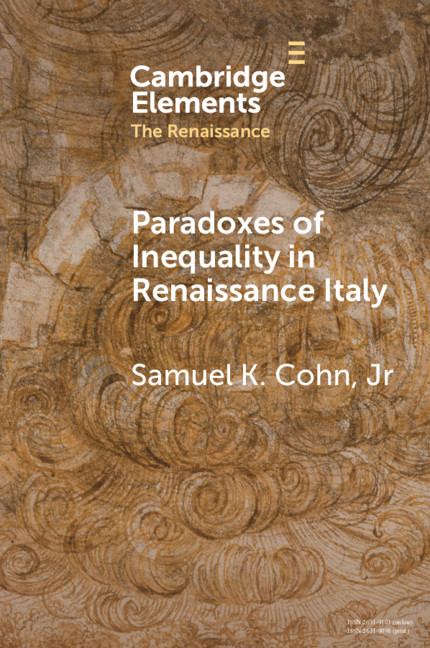
Paradoxes of Inequality in Renaissance Italy
Looking for an examination copy?
If you are interested in the title for your course we can consider offering an examination copy. To register your interest please contact collegesales@cambridge.org providing details of the course you are teaching.
This Element explores the longest spell that can be computed from quantifiable fiscal records when the gap between rich and poor narrowed. It was the post-Black-Death century, c. 1375 to c. 1475. Paradoxically, with economic equality and prosperity on the rise, peasants, artisans and shopkeepers suffered losses in political representation and status within cultural spheres. Threatened by growing economic equality after the Black Death, elites preserved and then enhanced their political, social, and cultural distinction predominantly through noneconomic means and within political and cultural spheres. By investigating the interactions between three 'elements'-economics, politics, and culture-this Element presents new facets in the emergence of early Renaissance society in Italy.
Product details
- Published: August 2021
- Format: Paperback
- ISBN: 9781108970389
- Length: 90 pages
- Dimensions: 229 × 153 × 6 mm
- Weight: 0.146kg
- Availability: Available



.jpg)
.jpg)
Table of Contents
- 1. Economic Equality and Prosperity in the Post-Black Death Century
- 2. The Paradox of Political Inequality
- 3. Cultural Inequality.
- Show more



