

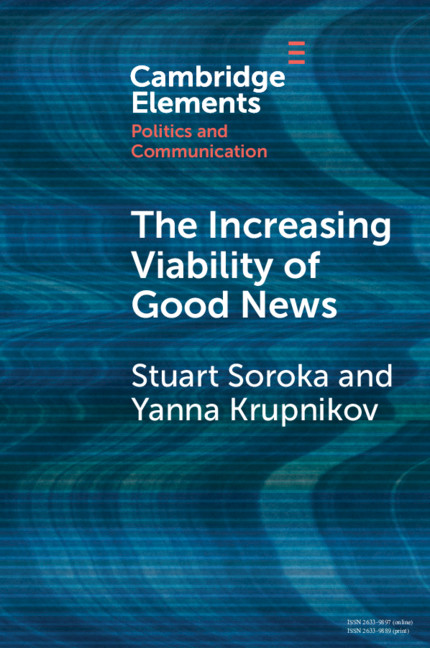
The Increasing Viability of Good News
The Increasing Viability of Good News
Looking for an examination copy?
If you are interested in the title for your course we can consider offering an examination copy. To register your interest please contact collegesales@cambridge.org providing details of the course you are teaching.
In spite of what appears to be the increasingly negative tone of media coverage, this Element suggests that the prevalence of positive news is likely to increase, for three reasons: (1) valence-based asymmetries vary over time, (2) valence-based asymmetries vary across individuals, and (3) technology facilitates diverse news platforms catering to diverse preferences. Each of these claims is examined in detail here, based on analyses of prior and/or novel data on media content, psychophysiological responses, and survey-based experiments. Results are considered as they relate to our understanding of media gatekeeping, political communication, and political psychology, and also as actionable findings for producers of media content, communications platforms, and media consumers.
Product details
- Published: August 2021
- Format: Paperback
- ISBN: 9781108987080
- Length: 64 pages
- Dimensions: 228 × 151 × 4 mm
- Weight: 0.11kg
- Availability: Available









Table of Contents
- 1. Introduction
- 2. The Valence of News Coverage
- 3. The Argument
- 4. Discussion
- Bibliography.
- Show more



