

Economic Principles of Commodity Taxation
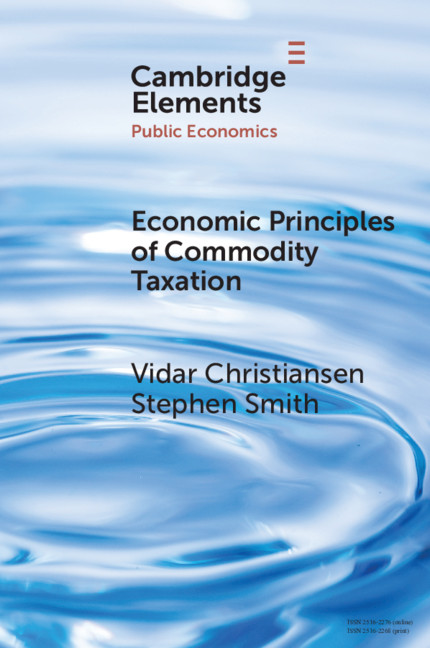
Economic Principles of Commodity Taxation
Looking for an examination copy?
If you are interested in the title for your course we can consider offering an examination copy. To register your interest please contact collegesales@cambridge.org providing details of the course you are teaching.
The authors provide a broad overview of economic aspects of commodity taxation, focussing in particular on theory and on policy applications in OECD countries. Some major papers in public economics have discussed whether these taxes should be levied at a uniform rate, or whether different commodities should be taxed differently, for reasons of either equity or efficiency. The authors begin with this question, and then discuss further issues, including the economic incidence of commodity taxes, the properties of the VAT, the taxation of financial services, the international aspects of commodity taxation, and environmental and health policy aspects.
Product details
- Published: April 2021
- Format: Paperback
- ISBN: 9781009002028
- Length: 88 pages
- Dimensions: 229 × 151 × 5 mm
- Weight: 0.15kg
- Availability: Available





Table of Contents
- 1. Introduction and overview
- 2. The optimal structure of commodity taxes
- 3. Commodity tax incidence
- 4. Economic aspects of the VAT
- 5. VAT and financial services
- 6. International aspects of indirect taxation
- 7. Using indirect taxes to achieve changes in behaviour
- 8. Some further issues
- 9. Directions for future research.
- Show more



