

Heiner Goebbels and Curatorial Composing after Cage
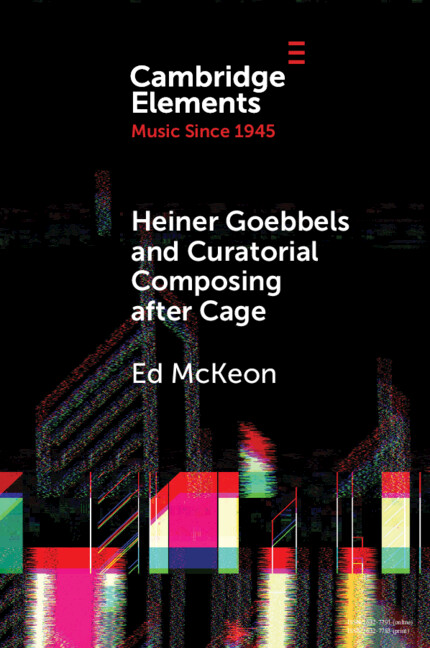
Heiner Goebbels and Curatorial Composing after Cage
Looking for an examination copy?
If you are interested in the title for your course we can consider offering an examination copy. To register your interest please contact collegesales@cambridge.org providing details of the course you are teaching.
This Element introduces the notion of curatorial composing to account for certain musical practices that emerged from the 1960s as the founding concepts of music as an art – instituted in the modern era – were systematically dismantled. It raises the key question of how musical value and authority might be produced without recourse to an external principle, origin, transcendental framework, or other foundation. It argues that these practices do not dismiss the issue of value or simply relativise it but shift the paradigm to a curatorial concern for composing public encounters and staging events. The Element shows that Lydia Goehr's elaboration of the work-concept provides a framework that was transformed by John Cage in his work from 0'00” (1962) onwards. The Element then introduces Heiner Goebbels' practice and focus on his role as Artistic Director of the Ruhrtriennale (2012–14), which it argues was an extension of his curatorial composing.
Reviews & endorsements
‘I'm convinced by much of McKeon's argument, and his discussion is insightful. … a rich resource that packs a lot into its 75 pages.' Andy Hamilton, The Wire
‘… presents a compelling case for curatorial composing as a method and ethics of music curating. … McKeon's analyses of Cage and Goebbels, along with the rich philosophical references he weaves through his reflections, are inspiring.’ Heloisa Amaral, Journal of Sonic Studies
‘McKeon’s reconstruction of Goebbels’s aesthetic practices and ideas is highly compelling and illuminating. The sheer amount and quality of the material that he has put together, the countless articles, interviews, and even personal communications by and with Goebbels, prove a treasure trove for rewarding observations on a lifespan’s worth of aesthetic work and thought.’ Matthias J. Tögel, TURBA
Product details
- Published: November 2022
- Format: Adobe eBook Reader
- ISBN: 9781009337595
- Length: 0 pages
- Availability: This ISBN is for an eBook version which is distributed on our behalf by a third party.


Table of Contents
- 1. Musical elements
- 2. The work-concept and its limits
- 3. Variable time: cage after Schoenberg
- 4. Heiner Goebbels: questioning authority
- 5. Spaces of appearance
- 6. After words
- References.
- Show more



