Efficient Parallel Algorithms
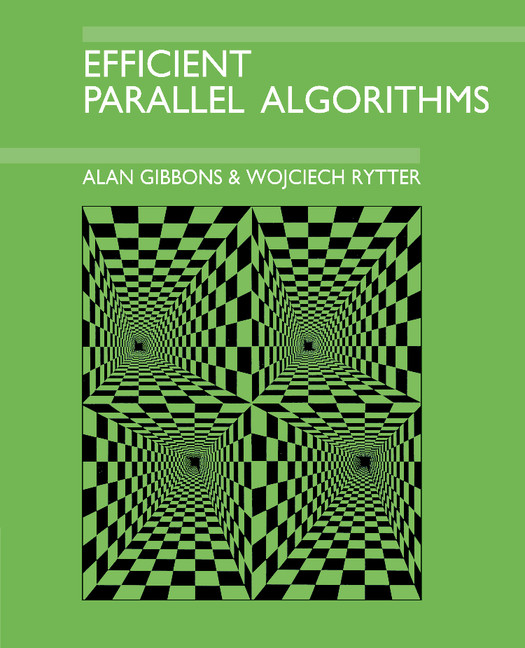
This is an introduction to the field of efficient parallel algorithms and to the techniques for efficient parallelisation. It is self-contained and presumes no special knowledge of parallel computers or particular mathematics. The book emphasises designing algorithms within the timeless and abstracted context of a high-level programming language rather than within highly specific computer architectures. This is an approach which concentrates on the essence of algorithmic theory, determining and taking advantage of the inherently parallel nature of certain types of problem. The authors present regularly-used techniques and a range of algorithms which includes some of the more celebrated and well-known. Efficient Parallel Algorithms is targeted at non-specialists who are considering entering the field of parallel algorithms. It will be particularly useful for courses aimed at advanced undergraduate or new postgraduate students of computer science and mathematics.
Product details
- Published: No date available
- Format: Hardback
- ISBN: 9780521345859
- Length: 272 pages
- Dimensions: 247 × 174 mm
- Weight: 0.65kg
Often bought together
Efficient Algorithms for Listing Combinatorial Structures
Format: Hardback
Information Dispersal and Parallel Computation
Format: Hardback
Algorithm Design with Haskell
Format: Hardback
Algorithmic Graph Theory
Format: Hardback
Often bought together
Related Journals
Combinatorics, Probability and Computing
Format: Journal
Published bimonthly, Combinatorics, Probability & Computing is devoted to the three areas of combinatorics, probability theory and theoretical computer science. Topics covered include classical and algebraic graph theory, extremal set theory, matroid theory, probabilistic methods and random combinatorial structures; combinatorial probability and limit theorems for random combinatorial structures; the theory of algorithms (including complexity theory), randomised algorithms, probabilistic analysis of algorithms, computational learning theory and optimisation.
Mathematical Structures in Computer Science
Format: Journal
Mathematical Structures in Computer Science is a journal of theoretical computer science which focuses on the application of ideas from the structural side of mathematics and mathematical logic to computer science. The journal aims to bridge the gap between theoretical contributions and software design, publishing original papers of a high standard and broad surveys with original perspectives in all areas of computing, provided that ideas or results from logic, algebra, geometry, category theory or other areas of logic and mathematics form a basis for the work. The journal welcomes applications to computing based on the use of specific mathematical structures (e.g. topological and order-theoretic structures) as well as on proof-theoretic notions or results. The journal will also accept contributions in new interdisciplinary fields bridging computer science, quantum physics, mathematics and information theory. In particular, papers on quantum information processing and communication, as well as on the related issues in quantum language design will be considered. The journal is also interested in papers on computational modelling of epigenetics phenomena, protein-protein interaction, stochasticity in molecular cascades. Mathematical approches to System Biology will be welcomed, within the broad frame of post-genomic views of embryogenesis and evolution.
Related Journals
Also by this Author
200 Problems on Languages, Automata, and Computation
Wojciech Rytter (+1 other)
Format:Adobe eBook Reader
Also by this Author
Table of Contents
- Preface
- 1. Introduction
- 2. Graph algorithms
- 3. Expression evaluation
- 4. Parallel recognition and parsing of context-free languages
- 5. Fast parallel sorting
- 6. Parallel string matching
- 7. P-completeness: hardly parallelisable problems
- Index.
- Show more

Authors
Alan Gibbons , King's College London
Wojciech Rytter , Uniwersytet Warszawski, Poland
Browse by related subject
- Algorithmics, complexity, computer algebra and computational geometry
- Artificial intelligence and natural language processing
- Communications, information theory and security
- Computational biology and bioinformatics
- Computer graphics, image processing and robotics
- Computer hardware, architecture and distributed computing
- Computing and society
- Computing: general interest
- Cryptography, cryptology and coding
- Distributed, networked and mobile computing
- IT management and ecommerce
- Knowledge management, databases and data mining
- Pattern recognition and machine learning
- Programming languages and applied logic
- Scientific computing, scientific software
- Software engineering and development