To save content items to your account,
please confirm that you agree to abide by our usage policies.
If this is the first time you use this feature, you will be asked to authorise Cambridge Core to connect with your account.
Find out more about saving content to .
To save content items to your Kindle, first ensure no-reply@cambridge.org
is added to your Approved Personal Document E-mail List under your Personal Document Settings
on the Manage Your Content and Devices page of your Amazon account. Then enter the ‘name’ part
of your Kindle email address below.
Find out more about saving to your Kindle.
Note you can select to save to either the @free.kindle.com or @kindle.com variations.
‘@free.kindle.com’ emails are free but can only be saved to your device when it is connected to wi-fi.
‘@kindle.com’ emails can be delivered even when you are not connected to wi-fi, but note that service fees apply.
Bystander cardiopulmonary resuscitation (CPR) has been shown to be associated with increased rates of survival from non-traumatic out-of-hospital cardiac arrest (OHCA). GoodSAM is a platform integrated into the computer-assisted dispatch system. The software allows the telecommunicator to send a link to the caller’s smart phone. Once activated, the telecommunicator can see and hear the patient, and obtain breathing and heart rates using the camera and microphone on the caller’s phone. The telecommunicator can use the platform to identify cardiac arrest and provide real-time compression feedback. It was hypothesized that telecommunicator use of video telecommunication would be associated with increased rates of pre-arrival CPR.
Methods:
This was a retrospective review of all cardiac arrest resuscitations performed from July 2021 through February 2022 in the San Antonio Fire Department (SAFD) Emergency Medical Services (EMS) system – the seventh largest city in the United States. Data source was the Office of the EMS Medical Director (OMD) Cardiac Arrest Registry. Inclusion criteria included cardiac arrests for which resuscitation was attempted. Exclusion criteria were cardiac arrest was witnessed by EMS personnel, or missing data. Dataset included: location of arrest, presumed etiology of the arrest, if dispatch CPR instructions were given; caller compliance; type of CPR performed; who witnessed the arrest; and who performed the CPR prior to EMS. Patients were dichotomized as to whether video telecommunication was used by the paramedic telecommunicator. A case was recorded as having received pre-arrival CPR if the initial CPR was performed by anyone other than the responding unit.
Results:
A total of 779 cases were included in the study. Primary outcome, in the cases where video telecommunication was utilized, 46/74 (62%) received pre-arrival CPR, versus 324/705 (46%) without the use of video telecommunication, with an overall difference of 16.2% (95% CI, 4.6% to 27.9%; P = .008). When using video telecommunication, a larger proportion of the persons performing pre-arrival CPR were family members when compared to the cases where video telecommunication was not used (35% versus 17%).
Conclusion:
Using video telecommunication to perform paramedic clinical dispatch telemedicine was associated with an increased rate of pre-arrival CPR. Further research will be required to show outcome-related results to determine if dispatch video and audio telemedicine can be used to increase survival in patients suffering OHCA.
Precision agriculture technology (PAT) is often viewed as a potential driver of future efficiency gains in farming. Using within-farm variation from an unbalanced panel of Kansas farms, this study examines the impact of PAT bundles on efficiency in generating gross revenue. On average, we find little evidence that these technologies improve efficiency. However, among less efficient farms, several bundles are linked to notable efficiency gains, underscoring the importance of accounting for farm heterogeneity.
This report outlines the workflow, challenges, and key roles involved in operationalizing a complex, disruptive, acute clinical trial protocol requiring multidisciplinary collaboration. Yale University School of Medicine and the Neuroscience Intensive Care Unit (NICU) at Yale New Haven Hospital (YNHH) leverage interdisciplinary collaboration to successfully enroll patients into complex clinical trials, including the Biomarker and Edema Attenuation in IntraCerebral Hemorrhage (BEACH) trial (ClinicalTrials.gov identifier: NCT05020535). Successful execution of the BEACH trial relies on five key domains: ensuring patient safety, optimizing screening and enrollment, acquiring pharmacokinetics, identifying signals of efficacy, and adapting to operational challenges. These domains require precise coordination, communication, and adaptability within dynamic patient care environments. By streamlining workflows, all members of the care delivery team and the research team maximize efficiency and optimize patient enrollment while upholding the highest standards of ethical research and patient care. Implementation of the BEACH trial at the Yale research center exemplifies the critical role of interdisciplinary collaboration in clinical research. By integrating research into patient care, the team improves trial efficiency and contributes to innovative treatment strategies for intracerebral hemorrhage. Lessons learned can inform best practices for future acute trials and improve patient outcomes.
Cognitive behavioural therapists and practitioners often feel uncertain about how to treat post-traumatic stress disorder (PTSD) following rape and sexual assault. There are many myths and rumours about what you should and should not do. All too frequently, this uncertainty results in therapists avoiding doing trauma-focused work with these clients. Whilst understandable, this means that the survivor continues to re-experience the rape as flashbacks and/or nightmares. This article outlines an evidence-based cognitive behavioural therapy (CBT) approach to treating PTSD following a rape in adulthood. It aims to be a practical, ‘how to’ guide for therapists, drawing on the authors’ decades of experience in this area. We have included film links to demonstrate how to undertake each step of the treatment pathway. Our aim is for CBT practitioners to feel more confident in delivering effective trauma-focused therapy to this client group. We consider how to assess and formulate PTSD following a rape in adulthood, then how to deliver cognitive therapy for PTSD (CT-PTSD; Ehlers and Clark, 2000). We will cover both client and therapist factors when working with memories of rape, as well as legal, social, cultural and interpersonal considerations.
Key learning aims
To understand the importance of providing effective, trauma-focused therapy for survivors of rape in adulthood who are experiencing symptoms of PTSD.
To be able to assess, formulate and treat PTSD following a rape in adulthood.
How to manage the dissociation common in this client group.
To be able to select and choose appropriate cognitive, behavioural and imagery techniques to help with feelings of shame, responsibility, anger, disgust, contamination and mistrust.
For therapists to learn how best to support their own ability to cope with working in a trauma-focused way with survivors of rape and sexual violence.
Increased interest in suffering has given rise to different accounts of what suffering is. This paper focuses the debate between experientialists and non-experientialists about suffering. The former hold that suffering is necessarily experiential—for instance, because it is necessarily unpleasant or painful; the latter deny this—for instance, because one can suffer when and because one’s objective properties are damaged, even if one does not experience this. After surveying how the two accounts fare on a range of issues, the paper presents a decisive argument in favor of experientialism. The central claim is that non-experientialist accounts cannot accommodate cases of suffering that are virtuous and that directly contribute to some objective good.
Determining a reliable method to detect life on another planet is an essential first step in the pursuit of discovering extraterrestrial life. Polyhydroxyalkanoates (PHAs), bioplastic polymers created by microorganisms, are strong candidates for defining the presence of extraterrestrial life due to their water insolubility, strong ultraviolet resistance, high melting points and high crystallinity, amongst other qualities. PHAs are abundant on Earth, and their chemical properties can easily be distinguished from non-biological matter. Their widespread distribution and conferred resistance to astrobiologically relevant extreme environments render PHAs highly favourable candidates for astrobiological detection. Integrating detection of PHA biosignatures into current and future life-detection instruments would be useful for the planetary search for life. PHAs are analysed and characterized in laboratories by gas chromatography-mass spectrometry, infrared spectroscopy, Raman spectroscopy and immunoassay analysis in addition to other methods. We outline a path forward to integrate PHA detection in astrobiology missions to aid the search for extraterrestrial life.
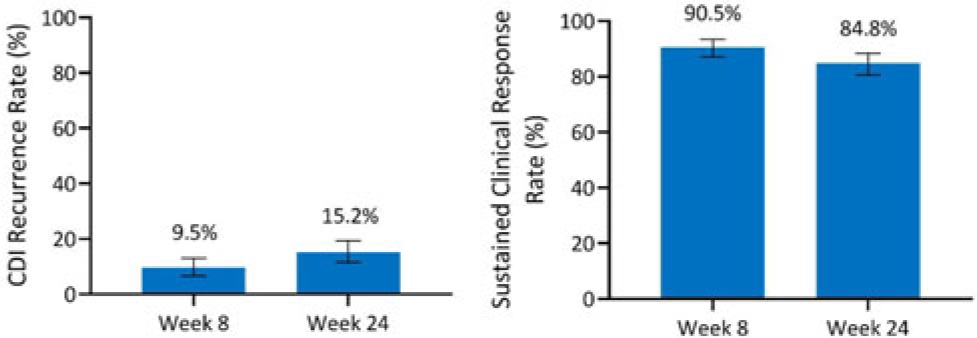
Background: Antibiotics alone are often insufficient to treat recurrent C. difficile infection (rCDI) because they have no activity against C. difficile spores that germinate within a disrupted microbiome. SER-109, an investigational, oral, microbiome therapeutic comprised of purified Firmicutes spores, was designed to reduce rCDI through microbiome repair. We report an integrated efficacy analysis through week 24 for SER-109 from phase 3 studies, ECOSPOR III and ECOSPOR IV. Methods: ECOSPOR III was a randomized, placebo-controlled phase 3 trial conducted at 56 US or Canadian sites that included 182 participants with ≥2 CDI recurrences, confirmed via toxin EIA testing. Participants were stratified by age (<65 years or ≥65 years) and antibiotic regimen (vancomycin, fidaxomicin) and were randomized 1:1 to placebo or SER-109 groups. ECOSPOR IV was an open-label, single-arm study conducted at 72 US or Canadian sites including 263 participants with rCDI enrolled in 2 cohorts: (1) rollover participants from ECOSPOR III who experienced on-study recurrence diagnosed by toxin EIA (n = 29) and (2) participants with ≥1 CDI recurrence (diagnosed by PCR or toxin EIA), inclusive of the current episode (n = 234). In both studies, the investigational product was administered orally as 4 capsules over 3 consecutive days following symptom resolution after standard-of-care antibiotics. The primary efficacy end point was rCDI (recurrent toxin-positive diarrhea requiring treatment) through week 8. Other end points included CDI recurrence rates and safety through 24 weeks. Results: These 349 participants received at least 1 dose of SER-109 in ECOSPOR III or ECOSPOR IV (mean age 64.2; 68.8% female). Overall, 77 participants (22.1%) enrolled with their first CDI recurrence. Four participants received blinded SER-109 in ECOSPOR III followed by a second dose of open-label SER-109 in ECOSPOR IV. Overall, the proportion of participants who received any dose of SER-109 with rCDI at week 8 was 9.5% (33 of 349; 95% CI, 6.6 %–13.0%), and the CDI recurrence rate remained low through 24 weeks (15.2%, 53 of 349; 95% CI, 11.6%–19.4%), corresponding to sustained clinical response rates of 90.5% (95% CI, 87.0%–93.4%) and 84.8% (95% CI, 80.6%–88.4%), respectively (Fig. 1). Most rollover participants (25 of 29, 86.2%) were from the placebo arm; 13.8% had rCDI by week 8. Conclusions: In this integrated analysis, the rates of rCDI were low and durable in participants who received the investigational microbiome therapeutic SER-109, with sustained clinical response rates of 90.5% and 84.8% at weeks 8 and 24, respectively. These data further support the potential benefit of microbiome repair with SER-109 following antibiotics for rCDI to prevent recurrence in high-risk patients.
Financial support: This study was funded by Seres Therapeutics.
We use a dynamic model of the U.S. apple industry separated into organic and conventional production to better measure the impacts of pest or disease outbreaks on producers and consumers, along with an equilibrium displacement model to simulate welfare effects from various shocks compared to a baseline. Our results show that the impacts of the outbreaks differ between organic and conventional production methods. Growers’ and consumers’ responses to shocks differ widely across the industry. Farmers and policy makers should use these findings to appropriately respond to different shocks and production methods.
The Hierarchical Taxonomy of Psychopathology (HiTOP) has emerged out of the quantitative approach to psychiatric nosology. This approach identifies psychopathology constructs based on patterns of co-variation among signs and symptoms. The initial HiTOP model, which was published in 2017, is based on a large literature that spans decades of research. HiTOP is a living model that undergoes revision as new data become available. Here we discuss advantages and practical considerations of using this system in psychiatric practice and research. We especially highlight limitations of HiTOP and ongoing efforts to address them. We describe differences and similarities between HiTOP and existing diagnostic systems. Next, we review the types of evidence that informed development of HiTOP, including populations in which it has been studied and data on its validity. The paper also describes how HiTOP can facilitate research on genetic and environmental causes of psychopathology as well as the search for neurobiologic mechanisms and novel treatments. Furthermore, we consider implications for public health programs and prevention of mental disorders. We also review data on clinical utility and illustrate clinical application of HiTOP. Importantly, the model is based on measures and practices that are already used widely in clinical settings. HiTOP offers a way to organize and formalize these techniques. This model already can contribute to progress in psychiatry and complement traditional nosologies. Moreover, HiTOP seeks to facilitate research on linkages between phenotypes and biological processes, which may enable construction of a system that encompasses both biomarkers and precise clinical description.
Background: Although exposure-based therapy is a well-established, effective treatment for post-traumatic stress disorder (PTSD), some practitioners report reluctance to implement it due to concerns that it may exacerbate symptoms of PTSD and commonly comorbid disorders, such as substance use disorders (SUD).
Aim: This study compared the exacerbation of psychological symptoms among participants with comorbid PTSD and SUD who received either SUD treatment alone or SUD treatment integrated with exposure therapy for PTSD.
Method: Participants (N = 71) were treatment-seeking, military Veterans with comorbid PTSD and SUD who were randomized to 12 individual sessions of either (1) an integrated, exposure-based treatment (Concurrent Treatment of PTSD and Substance Use Disorders using Prolonged Exposure; COPE); or (2) a non-exposure-based, SUD-only treatment (Relapse Prevention; RP). We examined between-group differences in the frequency of statistically reliable exacerbations of PTSD, SUD and depression symptoms experienced during treatment.
Results: At each of the 12 sessions, symptom exacerbation was minimal and generally equally likely in either treatment group. However, an analysis of treatment completers suggests that RP participants experienced slightly more exacerbations of PTSD symptoms during the course of treatment.
Conclusions: This study is the first to investigate symptom exacerbation throughout trauma-focused exposure therapy for individuals with comorbid PTSD and SUD. Results add to a growing literature which suggests that trauma-focused, exposure-based therapy does not increase the risk of symptom exacerbation relative to non-exposure-based therapy.
This study examined differences in learning outcomes among newborn intensive care unit (NICU) workers who underwent virtual reality simulation (VRS) emergency evacuation training versus those who received web-based clinical updates (CU). Learning outcomes included a) knowledge gained, b) confidence with evacuation, and c) performance in a live evacuation exercise.
Methods
A longitudinal, mixed-method, quasi-experimental design was implemented utilizing a sample of NICU workers randomly assigned to VRS training or CUs. Four VRS scenarios were created that augmented neonate evacuation training materials. Learning was measured using cognitive assessments, self-efficacy questionnaire (baseline, 0, 4, 8, 12 months), and performance in a live drill (baseline, 12 months). Data were collected following training and analyzed using mixed model analysis. Focus groups captured VRS participant experiences.
Results
The VRS and CU groups did not statistically differ based upon the scores on the Cognitive Assessment or perceived self-efficacy. The virtual reality group performance in the live exercise was statistically (P<.0001) and clinically (effect size of 1.71) better than that of the CU group.
Conclusions
Training using VRS is effective in promoting positive performance outcomes and should be included as a method for disaster training. VRS can allow an organization to train, test, and identify gaps in current emergency operation plans. In the unique case of disasters, which are low-volume and high-risk events, the participant can have access to an environment without endangering themselves or clients. (Disaster Med Public Health Preparedness. 2019;13:301–308)
Newborn male circumcision is a minor surgical procedure that has generated significant controversy. Accumulating evidence supports significant health benefits, most notably reductions in urinary tract infections, acquisition of HIV and a number of other sexually transmitted infections, penile cancer, phimosis, paraphimosis, balanitis and lichen sclerosis. While circumcision, like any surgical procedure, has risks for complications, they occur in less than 1 in 500 infants circumcised and most are minor and require minimal intervention. The CDC and the American Academy of Pediatrics (AAP) believe that health benefits of circumcision outweigh the risks. For this reason, the AAP believes that parents should be allowed to make the decision concerning circumcision of their male infants after receiving non-biased information on health risks and health benefits.
Sauropod dinosaurs are rare in the Cretaceous North American fossil record in general and are absent from that record for most of the Late Cretaceous. Sonorasaurus thompsoni from the Turney Ranch Formation of the Bisbee Group of Arizona, USA, potentially represents one of the youngest sauropods before their ca. 30-million-year-long hiatus from the record. The anatomy of Sonorasaurus has only been briefly described, its taxonomic validity has been questioned, several hypotheses have been proposed regarding its phylogenetic relationships, and its life history, geologic age, and reported paleoenvironment are ambiguous.
Herein we assess the systematics, paleoenvironment, life history, and geologic age of Sonorasaurus based on firsthand observation, bone histology, and fieldwork in the holotypic quarry and environs. The validity of S. thompsoni is substantiated by autapomorphies. Cladistic analysis firmly places it within the Brachiosauridae, in contrast to results of some recent analyses. Bone histology suggests that the only known exemplar of Sonorasaurus grew slowly and sporadically compared to other sauropods and was approaching its adult size. In contrast with previous assessments of a coastal/estuarine paleoenvironment for the Turney Ranch Formation, our sedimentological and plant macrofossil data indicate that Sonorasaurus lived in a semiarid, low relief evergreen woodland that received highly variable (perhaps seasonal) precipitation. We obtained detrital zircons from the holotypic quarry for U-Pb dating, which only yielded Barremian-aged and older grains, whereas other radiometric and biostratigraphic data suggest that the sediments at the quarry were deposited near the Albian-Cenomanian boundary.
Sonorasaurus is taxonomically valid, represents one of the geologically youngest brachiosaurid sauropods, and inhabited a harsh inland evergreen-dominated woodland environment that limited its growth. A review of other Bisbee Group dinosaurs suggests that its fauna, although poorly sampled, exhibits broad similarity to those from coeval North American horizons, reinforcing the apparent faunal homogeneity at the time.
We investigate functorial properties of Putnam’s homology theory for Smale spaces. Our analysis shows that the addition of a conjugacy condition is necessary to ensure functoriality. Several examples are discussed that elucidate the need for our additional hypotheses. Our second main result is a natural generalization of Putnam’s Pullback Lemma from shifts of finite type to non-wandering Smale spaces.
Contemporary research on prehispanic Maya landscapes has focused on caves as core features of the cultural geography. Investigations within a number of large caves have suggested that they served as the loci for important rituals, legitimized inhabitants’ claims to their territory, and helped establish the authority of a site’s ruling elite. The ubiquity and centrality of caves in the Maya worldview raises questions about what happened in regions where large caves did not naturally form. Recent investigations at the site of Maax Na in northern Belize suggest that small caves, despite their diminutive size, still functioned to establish legitimacy and uphold power. The results serve to demonstrate the pervasive power of key ideological concepts in shaping the cultural landscape and indicate the need to take these into account in documenting landmarks at Maya sites, as even the less imposing ones may have been important to their inhabitants.
Since the 1990s, scholarly accounts of globalization and its consequences have become prevalent throughout the social sciences (see Brady et al. 2007 for a review). While some view globalization as a centuries-long process of world system integration (Sklair 2002), others focus on recent changes in the last several decades. Although conceptualizations of globalization vary widely, they share a common insight that many phenomena previously centered in the local, sub-national, or national levels are increasingly interconnected on a global scale. Globalization implies increasing interpenetration and interdependency among societies, cultures, and peoples of the world often accompanied with a concern that the autonomy and sovereignty of the local setting is being diminished.
The changes created by globalization resemble the transformations discussed by those who advance social structures of accumulation (SSA) theory. Various scholars in this tradition place primary emphasis on the emergence of finance capital, neoliberalism, or other manifestations of globalization as the primary face of the new SSA. While having made numerous advances in SSA theory (Kotz, McDonough, and Reich 1994), we contend that SSA scholarship has strayed from Gordon, Edwards, and Reich's ([GER] 1982) central premise that the transformation of the labor process is a defining feature of each SSA (Wallace and Brady 2001). With the aim of restoring the centrality of the labor process, we extend the SSA approach in three ways.
Citizens do not choose sides on issues like busing or abortion whimsically. They have reasons for their preferences – certainly they can give reasons for them. But how is this possible? Citizens as a rule pay little attention to politics, indeed take only a modest interest in it even during election campaigns when their interest in politics is at its height. And since they pay little attention to politics, it is hardly surprising that they know little about it. Many, in fact, are quite ignorant of basic facts of political life – such as the identity of the party that controls Congress or indeed the name of the congressman who represents them. Which, of course, raises a question of some interest: how do citizens figure out what they think about political issues, given how little they commonly know about them?
