


498 results
Enhancing Selection of Alcohol Consumption Associated Genes by Random Forest
-
- Journal:
- British Journal of Nutrition / Accepted manuscript
- Published online by Cambridge University Press:
- 12 April 2024, pp. 1-24
-
- Article
-
- You have access
- Export citation
Impaired topology and connectivity of grey matter structural networks in major depressive disorder: evidence from a multi-site neuroimaging data-set
-
- Journal:
- The British Journal of Psychiatry / Volume 224 / Issue 5 / May 2024
- Published online by Cambridge University Press:
- 11 April 2024, pp. 170-178
- Print publication:
- May 2024
-
- Article
-
- You have access
- Open access
- HTML
- Export citation
Relationship between syncopal symptoms and head-up tilt test modes
-
- Journal:
- Cardiology in the Young , First View
- Published online by Cambridge University Press:
- 05 April 2024, pp. 1-6
-
- Article
- Export citation
The role of deubiquitinases in cardiac disease
-
- Journal:
- Expert Reviews in Molecular Medicine / Volume 26 / 2024
- Published online by Cambridge University Press:
- 25 March 2024, e3
-
- Article
-
- You have access
- Open access
- HTML
- Export citation
Effect of gender identity on the association between gender dysphoria and suicidality via appearance anxiety among transgender and gender-diverse young people: moderated mediation study
-
- Journal:
- BJPsych Open / Volume 10 / Issue 2 / March 2024
- Published online by Cambridge University Press:
- 14 March 2024, e66
-
- Article
-
- You have access
- Open access
- HTML
- Export citation
The conditional Lyapunov exponents and synchronisation of rotating turbulent flows
-
- Journal:
- Journal of Fluid Mechanics / Volume 983 / 25 March 2024
- Published online by Cambridge University Press:
- 12 March 2024, A1
-
- Article
-
- You have access
- Open access
- HTML
- Export citation
-
The synchronisation between rotating turbulent flows in periodic boxes is investigated numerically. The flows are coupled via a master–slave coupling, taking the Fourier modes with wavenumber below a given value $k_m$ as the master modes. It is found that synchronisation happens when $k_m$ exceeds a threshold value $k_c$, and $k_c$ depends strongly on the forcing scheme. In rotating Kolmogorov flows, $k_c\eta$ does not change with rotation in the range of rotation rates considered, $\eta$ being the Kolmogorov length scale. Even though the energy spectrum has a steeper slope, the value of $k_c\eta$ is the same as that found in isotropic turbulence. In flows driven by a forcing term maintaining constant energy injection rate, synchronisation becomes easier when rotation is stronger. Here, $k_c\eta$ decreases with rotation, and it is reduced significantly for strong rotations when the slope of the energy spectrum approaches $-3$. It is shown that the conditional Lyapunov exponent for a given $k_m$ is reduced by rotation in the flows driven by the second type of forcing, but it increases mildly with rotation for the Kolmogorov flows. The local conditional Lyapunov exponents fluctuate more strongly as rotation is increased, although synchronisation occurs as long as the average conditional Lyapunov exponents are negative. We also look for the relationship between $k_c$ and the energy spectra of the Lyapunov vectors. We find that the spectra always seem to peak at approximately $k_c$, and synchronisation fails when the energy spectra of the conditional Lyapunov vectors have a local maximum in the slaved modes.


Incidence of mental health diagnoses during the COVID-19 pandemic: a multinational network study
-
- Journal:
- Epidemiology and Psychiatric Sciences / Volume 33 / 2024
- Published online by Cambridge University Press:
- 04 March 2024, e9
-
- Article
-
- You have access
- Open access
- HTML
- Export citation
Enhanced heat transfer and reduced flow reversals in turbulent thermal convection with an obstructed centre
-
- Journal:
- Journal of Fluid Mechanics / Volume 981 / 25 February 2024
- Published online by Cambridge University Press:
- 21 February 2024, A16
-
- Article
- Export citation
-
We report an experimental study about the effect of an obstructed centre on heat transport and flow reversal by inserting an adiabatic cylinder at the centre of a quasi-two-dimensional Rayleigh–Bénard convection cell. The experiments are carried out in a Rayleigh number ( $Ra$) range of $2\times 10^7 \leq Ra \leq 2\times 10^9$ and at a Prandtl number ( $Pr$) of $5.7$. It is found that for low $Ra$, the obstructed centre leads to a heat transfer enhancement of up to 21 $\%$, while as $Ra$ increases, the magnitude of the heat transfer enhancement decreases and the heat transfer efficiency ( $Nu$) eventually converges to that of the unobstructed normal cell. Particle image velocimetry measurements show that the heat transfer enhancement originates from the change in flow topology due to the presence of the cylindrical obstruction. In the low- $Ra$ regime the presence of the obstruction promotes the transition of the flow topology from the four-roll state to the abnormal single-roll state then to the normal single-roll state with increasing obstruction size. While in the high- $Ra$ regime, the flow is always in the single-roll state regardless of the obstruction size, although the flow becomes more coherent with the size of the obstruction. We also found that in the presence of the cylindrical obstruction, the stability of the corner vortices is significantly reduced, leading to a large reduction in the frequency of flow reversals.


Experimental electron density distribution of KZnB3O6 constructed by maximum-entropy method
-
- Journal:
- Powder Diffraction / Volume 38 / Issue 4 / December 2023
- Published online by Cambridge University Press:
- 08 February 2024, pp. 233-239
-
- Article
-
- You have access
- HTML
- Export citation
Effect of Viscosity on Stopping Power for a Charged Particle Moving above Two-Dimensional Electron Gas
-
- Journal:
- Laser and Particle Beams / Volume 2022 / 2022
- Published online by Cambridge University Press:
- 01 January 2024, e19
-
- Article
-
- You have access
- Open access
- HTML
- Export citation
Competitive Adsorption of Uranyl and Toxic Trace Metal Ions at MFe2O4-montmorillonite (M = Mn, Fe, Zn, Co, or Ni) Interfaces
-
- Journal:
- Clays and Clay Minerals / Volume 67 / Issue 4 / August 2019
- Published online by Cambridge University Press:
- 01 January 2024, pp. 291-305
-
- Article
- Export citation
-
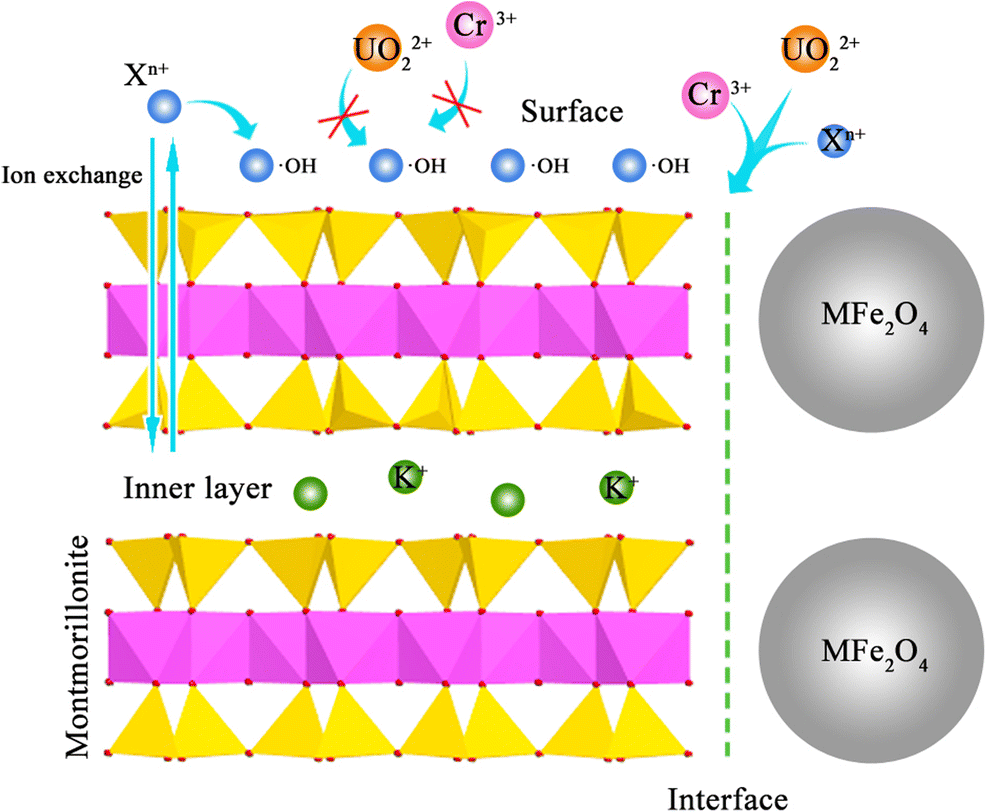
Adsorption of uranyl (UO22+) ions to mineral surfaces is a potentially effective method for removing this hazardous metal from water, but other toxic trace metal ions (Xn+: Rb+, Sr2+, Cr3+, Mn2+, Ni2+, Zn2+, Cd2+) in uraniferous wastewaters compete with UO22+ for adsorption sites and thus may diminish the capacity of adsorbents to sequester UO22+. A better understanding of competitive adsorption among these metal ions and the development of better adsorbents are, therefore, of critical importance. The purpose of the present study was to synthesize and characterize magnetic adsorbents, consisting of MFe2O4 (M = Mn, Fe, Zn, Co, or Ni) nanoparticles synthesized on montmorillonite (Mnt) edge sites, and to investigate their use as adsorbents for UO22+, including competitive adsorption with trace metal ions. Selective adsorption was studied using Langmuir, Freundlich, and Dubinin-Radushkevich isotherms, and the results showed that Xn+ ions were adsorbed primarily on MFe2O4-montmorillonite surfaces, and the UO22+ ions were adsorbed on the interfaces between montmorillonite edge surfaces and MFe2O4 nanoparticles. Using the Freundlich model, the interface adsorption capacity of UO22+ reached 25.1 mg·g–1 in mixed solution. Further, the UO22+ and Cr3+ ions had a redox reaction on the interfaces with synergistic adsorption. Herein, the adsorption capacity of Cr3+ was 60.2 mg·g–1 using the Freundlich isotherm. The results demonstrated that the MFe2O4-montmorillonite with highly selective adsorption of UO22+ ions is applicable to UO22+ treatment in the presence of toxic trace metal ions.
Graphical abstract
Enhanced Flame-Retardant Capacity of Natural Rubber/Organo-Montmorillonite and Hyper-Branched Organo-Montmorillonite Composites
-
- Journal:
- Clays and Clay Minerals / Volume 59 / Issue 5 / October 2011
- Published online by Cambridge University Press:
- 01 January 2024, pp. 446-458
-
- Article
- Export citation
The Properties of Clay Minerals in Soil Particles from Two Ultisols, China
-
- Journal:
- Clays and Clay Minerals / Volume 65 / Issue 4 / August 2017
- Published online by Cambridge University Press:
- 01 January 2024, pp. 273-285
-
- Article
- Export citation
Overexpressed Histocompatibility Minor 13 was Associated with Liver Hepatocellular Carcinoma Progression and Prognosis
-
- Journal:
- Genetics Research / Volume 2022 / 2022
- Published online by Cambridge University Press:
- 01 January 2024, e23
-
- Article
-
- You have access
- Open access
- HTML
- Export citation
Bioinformatics Analysis of miRNAs Targeting TRAF5 in DLBCL Involving in NF-κB Signaling Pathway and Affecting the Apoptosis and Signal Transduction
-
- Journal:
- Genetics Research / Volume 2022 / 2022
- Published online by Cambridge University Press:
- 01 January 2024, e4
-
- Article
-
- You have access
- Open access
- HTML
- Export citation
6 Why Do Cultures Affect Facial Emotion Perception? - A Systematic Review
-
- Journal:
- Journal of the International Neuropsychological Society / Volume 29 / Issue s1 / November 2023
- Published online by Cambridge University Press:
- 21 December 2023, p. 520
-
- Article
-
- You have access
- Export citation
The egg ribonuclease SjCP1412 accelerates liver fibrosis caused by Schistosoma japonicum infection involving damage-associated molecular patterns (DAMPs)
-
- Journal:
- Parasitology / Volume 151 / Issue 3 / March 2024
- Published online by Cambridge University Press:
- 18 December 2023, pp. 260-270
-
- Article
-
- You have access
- Open access
- HTML
- Export citation
OP62 Development Of The Oral Health Risk Adjustment Model To Predict The Outpatient Dental Expenditure In Children With Autism
-
- Journal:
- International Journal of Technology Assessment in Health Care / Volume 39 / Issue S1 / December 2023
- Published online by Cambridge University Press:
- 14 December 2023, pp. S17-S18
-
- Article
-
- You have access
- Export citation
OP13 Cost-Effectiveness Analysis Of Sintilimab Plus Chemotherapy For The First-Line Treatment Of Non-Squamous Non-Small Cell Lung Cancer: Societal Perspective
-
- Journal:
- International Journal of Technology Assessment in Health Care / Volume 39 / Issue S1 / December 2023
- Published online by Cambridge University Press:
- 14 December 2023, pp. S4-S5
-
- Article
-
- You have access
- Export citation
Design and analysis of an energy selective rasorber – CORRIGENDUM
-
- Journal:
- International Journal of Microwave and Wireless Technologies , First View
- Published online by Cambridge University Press:
- 16 November 2023, p. 1
-
- Article
-
- You have access
- HTML
- Export citation
