

Assessing interactions between wild host plants and stemborer species in East Africa
17 February 2026
Last update: 17/02/26 12:27


Understanding Stemborers Beyond the Field
Across tropical and subtropical regions, stemborers remain among the most damaging pests of cereal crops. Although they are best known for attacking maize and sorghum, this study demonstrates that their ecology extends far beyond cultivated fields. These insects are especially challenging to manage because they spend most of their lives hidden inside plant stems, where pesticides and other conventional treatments cannot reach them, leaving farmers with very limited control options. By examining diverse landscapes and plant communities, the research reveals how stemborer populations persist, shift, and adapt within broader agroecosystems-insights that are increasingly important as climate and land-use patterns change globally.
Wild Plants as Hidden Pest Reservoirs
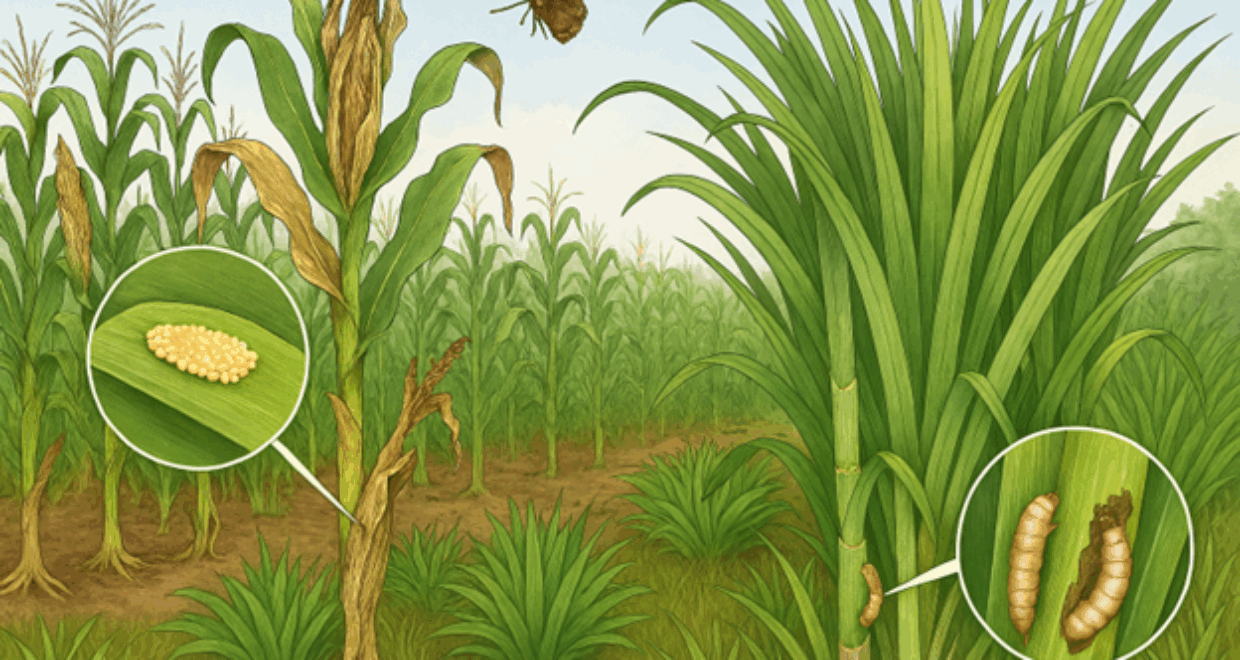
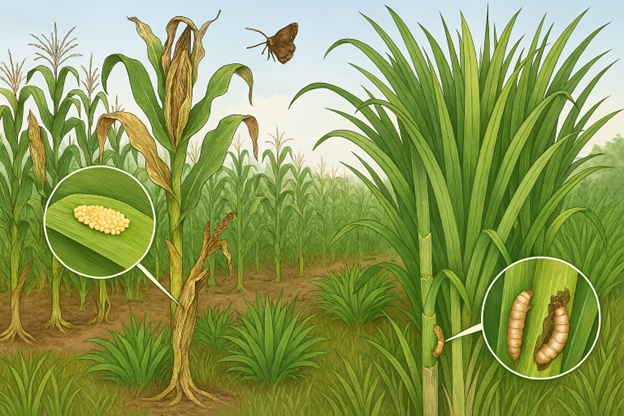
A major finding is that more than half of all stemborers collected were not inside crops but in the surrounding wild and fodder vegetation. This highlights an often overlooked reality: natural and semi‑natural plants form key refuges that sustain pest populations across seasons. Among these, Pennisetum purpureum (Napier grass) emerged as a particularly important host, supporting nearly 43% of all individuals recorded. Because this grass is widely cultivated across the tropics for livestock feed, its ecological role extends far beyond fodder production.
Landscape Gradients Shape Pest Communities
The study also shows how altitude and local climate structure stemborer communities. Different species dominate in warm lowlands, moderate mid‑altitudes, and cooler highland ecosystems. Such patterns are not unique to one country—similar gradients occur throughout Africa, Asia, and Latin America—where stemborers respond sensitively to temperature, vegetation composition, and farming practices. The research also notes emerging signs of habitat expansion in species such as Busseola fusca and Chilo partellus, changes that align with broader global shifts linked to warming climates and agricultural intensification.
Seasonal Persistence and Off‑Season Survival
Perhaps most striking is the discovery that stemborer abundance peaks during the dry season, long before crops are planted. This indicates that year‑round persistence is driven not by maize availability but by the vegetation mosaic surrounding farms. Such dynamics are relevant throughout the tropics, where off‑season survival strongly influences planting‑season pest outbreaks and shapes long‑term management challenges.
Toward Landscape‑Aware Pest Management
By connecting crop pests to broader ecological systems, the study emphasizes the value of integrating surrounding vegetation into pest management strategies. Fodder grasses, wild plants, and field margins are more than background elements-they shape pest pressure, influence crop vulnerability, and contribute to ecological resilience. These insights support global efforts to design more sustainable systems, including smarter arrangements of fodder grasses, climate‑resilient intercropping, and landscape‑level push–pull approaches.
Overall, this work underscores a universal principle: successful pest management requires understanding not only the crop but the entire ecological neighborhood in which it grows. As tropical agriculture faces increasing pressures, such ecosystem‑level knowledge will be crucial for safeguarding food production, biodiversity, and the resilience of farming communities worldwide.
The paper Assessing interactions between wild host plants and stemborer species in East Africa by Elie Ntirenganya of Journal of Tropical Ecology and is available open access.

Journal of Tropical Ecology aims to address topics of general relevance and significance to tropical ecology. This includes sub-disciplines of ecology, such as conservation biology, evolutionary ecology, marine ecology, microbial ecology, molecular ecology, quantitative ecology, etc. Studies in the field the field of tropical medicine, specifically where it involves ecological surroundings (e.g. zoonotic or vector-borne disease ecology), are also suitable. We also welcome methods papers, provided that the techniques are well described and are of broad general utility.
Related Posts

Where Physical and Digital Worlds Collide
In this blog for Data-Centric Engineering, Paul Clarke (Chief Technology Officer at Ocado) documents Ocado’s journey with building synthetic models of its business, its platforms and its underlying technologies, including the use of simulations, emulations, visualisations and digital twins. He explores the potential benefits of digital twins, including the opportunities for creating digital twins at […]

International Women’s Day 2020: Influential women in STEM
International Women’s Day 2020 falls on Sunday, 8th March this year. In the run up to this date, each week day we’ll be highlighting one woman whose accomplishments in science, technology, engineering and/or mathematics not only elevated their fields but also took us one step closer to a gender-equal world. We hope you’ll join us […]

Elephants, Kings, and Comparison, a Conversation with Tom Trautmann
We invited Trautmann to tell us why he writes about Indian war elephants, and how. He touched on several topics in the process: the value of analytical accidents, the recovery of lost knowledge systems, and the power and pluralism of human logics.

Wisconsin’s Response to the Coronavirus Pandemic – Now updated
From time to time, until the crisis has passed, the HEPL blog series authors will be given the opportunity to provide short updates on their country/region’s continuing response to this worldwide catastrophe and their further reflections on those responses. Each update will be labelled accordingly with the original response at the bottom of each post. […]


 ;
;


