

A fragment of Aristotle’s lost Eudemus in Tertullian’s De Anima
Aristotle is certainly one of the most foundational, influential, and therefore heavily commented on and thoroughly studied figures in the history of philosophy.…


Aristotle is certainly one of the most foundational, influential, and therefore heavily commented on and thoroughly studied figures in the history of philosophy.…

Can babies have honour? Can they be recognised as agents? And can they take part in dynamics of recognition? If we consider ancient Greek sources, both literary and philosophical, we can get a positive answer to these questions – an answer that strikingly converges with what developmental scientists tell us about babies’ psychology.…
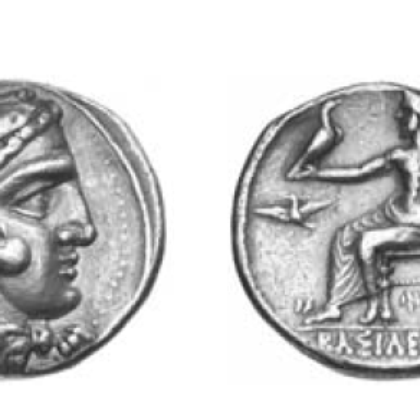
Once upon a time in Paphos, so tells Plutarch (Mor. 340d), Alexander the Great decided that the reigning king was unjust and wicked, and removed him from his throne.…

This text is identified as my own by the name placed above it, which seems sensible enough. Marking ownership was one of the earliest uses to which the ancient Greeks put their alphabet—which was to spawn among others the alphabet in which this text is written—but they had a strikingly different way of doing so. ‘I am the kylix of Korax’, declares an eighth-century BCE wine-drinking cup from Rhodes; ‘I am the lekythos of Tataie—whosoever steals me will go blind’, threatens a seventh-century oil flask from Cumae; ‘I am the remembrance of Ergotimos’, announces a shelf of Attic rock from the sixth century.

Two thousand four hundred years ago, a seven-year-old girl in Athens, whose parents had died, was taken by her legal guardian to the island of Lemnos.…
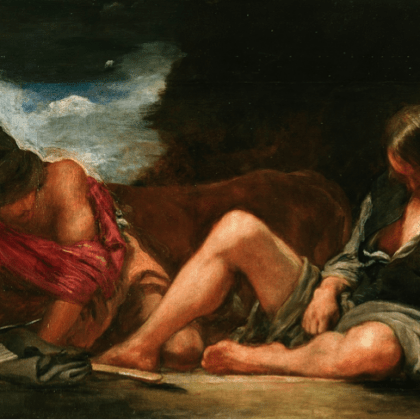
Napoleon once said that ‘there are only two powers in the world, the sword and the spirit’ and that ‘in the long run the sword will always be conquered by the spirit.’ The results of this study, which delves into the etymology and phraseology of Greek terms belonging to the semantic sphere of power, agree with the Emperor’s perspective.

Codex Climaci Rescriptus is worth knowing about. It is the only surviving Greek witness to Hipparchus’s previously lost star catalogue, is over seven centuries earlier than the next surviving witness of Eratosthenes, and is the earliest witness to parts of Aratus’s Phaenomena.…

When only four words of a poet’s entire output in a specific genre survive to the present day, is there really anything of substance that we can say about this poetry on the basis of such slender remains?…
Valerius Flaccus’ Argonautica breaks off at a crucial and tantalising moment on the island of Peuce at the mouth of the Hister (Danube). With Medea’s assistance, Jason has managed to obtain the golden fleece and the Argonauts have departed Colchis for Greece with Medea in tow.
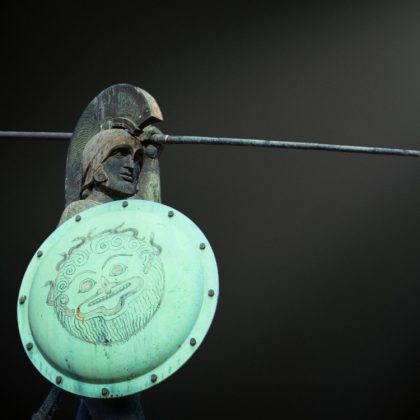
2500 years ago this year a massive Persian force descended into Greece. How massive we cannot say. Ancient figures for Persian numbers are wildly exaggerated from the very start.…

What is the Beautiful? In Plato’s Hippias Major, Socrates and the sophist Hippias set out to answer this question. Along the way, they evaluate such answers as ‘the appropriate’, ‘the beneficial’, ‘gold’, and even ‘burying your parents’.…

Pity me, pitiable in many ways, I who am crying out, weeping like a girl, and no one can say he saw this man do such a thing before, but though racked with torments I never would lament!…

'On collaboration and a new analysis of Sappho' - Patricia Rosenmeyer and Giuliana Ragusa describe their research, 'A DELICATE BRIDEGROOM: HABROSUNĒ IN SAPPHO, FR. 115V'.
The English language contains a wealth of insults and terms of abuse. Personal insults attack the core and immutable aspects of a person, such as their race, ethnicity, appearance, age, or a disability.…


Even though findings from genetics and other sciences unequivocally refute biological conceptions of race, this erroneous viewpoint remains widespread among the general public.…

The March article of Muses – the arts blog from BJPsych International is the first blog of the series. The blog is written by Dr Dami Ajayi, Specialty Doctor, Barnet Enfield and Haringey Mental Health NHS Foundation Trust and Trainee/Blog Editor, BJPsych International.…

Some disability-related names have dropped out of usage, because they are now considered to be offensive due to their origins. Down Syndrome (Trisomy 21) is one example.…

For over a century, the giant stone jars of northern Laos have remained one of Southeast Asia’s great archaeological mysteries. Scattered across remote ridgelines and forests on the Plain of Jars, these massive megalithic vessels have sparked debate over their true purpose: storage containers, symbolic monuments, or part of a complex mortuary tradition?…

The paper “The role of premenstrual syndrome in hedonic hunger and food craving during the menstrual cycle“, published in Journal of Nutritional Science, has been chosen as the latest Editorial Highlight and is freely available to download for one month.…

The Paper of the Month for March is ‘Impact of omega-3 fatty acid supplementation on clinical manifestations in autism spectrum disorders: an umbrella review of meta-analyses“.…
How long will humankind survive? Besides the fact that we have been able to eliminate ourselves with nuclear weapons for decades, even without a third world war, the challenge to take care of the resources of our planet remains; we need to use them in a way that our children and their children can have a place on Earth as well. In this blog post Andreas Losch discusses his recent review article in the International Journal of Astrobiology, The need of an ethics of planetary sustainability


It is an article of faith among ordinary Filipinos that American troops will die with Filipino troops defending Philippine claims to the Spratly Islands in the South China Sea (SCS).…

Q&A with Editor-in-Chief of the Precision Medicine Journal, Dame Anna Dominiczak, for International day of Women and Girls in Science

More and more research is finding inflammation as a potential contributing factor towards to the development of various mental illnesses. A systematic review was conducted to determine the association between parasitic infection and mental illnesses in various African populations. Two parasite groups were evaluated; helminths and protozoans, and four mental illness classifications; depressive disorders, anxiety disorders, schizotypal disorders and unspecified mental illnesses.
This is the first post in our new series: “Conversations with Authors.” For our inaugural post, we asked Dr. Vesla Weaver to meet (virtually) with Dr.…
The March article of Muses – the arts blog from BJPsych International is the first blog of the series. The blog is written by Dr Dami Ajayi, Specialty Doctor, Barnet Enfield and Haringey Mental Health NHS Foundation Trust and Trainee/Blog Editor, BJPsych International.…

The English language contains a wealth of insults and terms of abuse. Personal insults attack the core and immutable aspects of a person, such as their race, ethnicity, appearance, age, or a disability.…


Listen to @BBCRadio4's Start the Week, featuring @NineDotsPrize winner @jkkusiak, talking about her book, 'Radically Legal'. Learn how a group of ordinary people inspired the book when they reclaimed over 240,000 apartments back from corporate landlords 🔗

Start the Week - ‘Left behind’, but not forgotten - BBC Sounds
Tom Sutcliffe with Paul Collier, Joanna Kusiak and Matthew Xia.
cup.org
Sparking curiosity from geopolitics in Japan to the cultural implications of AI!
Explore the seven new titles we are welcoming to Cambridge and the seven #OpenAccess titles we are launching in 2025 🚀 🔗 https://cup.org/3yhAuAx
Our Flip it Open programme has published titles from authors @GibbsSpike, @liederfollower and Inés Valdez!
Discover how we are funding the publication of #OpenAccess books without changing purchasing habits 🔗 https://cup.org/4diDHii


 ;
;


