EJAM

(25) rss icon
How Crime Responds to Deterrence: A Modeling Perspective

Modelling and understanding how crime responds to deterrence is an interesting yet ambitious undertaking. Crime is shaped by a web of social environments, economic incentives, institutional structures, and individual decision-making. Any formal model, no matter how sophisticated, must necessarily simplify this reality to make the problem analytically tractable

Read more

The secrets of espresso brewing

During the brewing process of an espresso, hot water flows through a cylindrical filter that is densely packed with coffee grounds. Along the way, chemicals are extracted such that the liquid leaving the filter is not pure water anymore, but espresso. The concentration of dissolved chemicals in the liquid that comes out of the machine is the quantity of interest in a wide range of mathematical models for espresso brewing.

Read more

Magnetic fields and imaging technologies

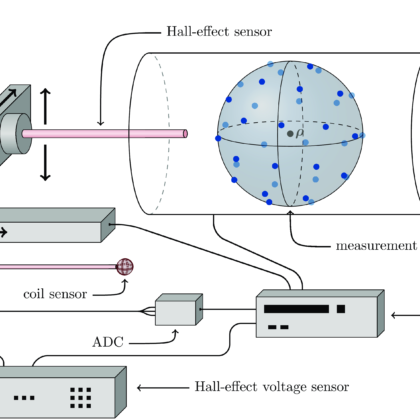
Magnetic fields are at the core of many imaging technologies. A widely known modality is MRI, a standard procedure in medical imaging, which is however limited by a long scanning time and the ability to only image anatomical regions containing sufficient amounts of water. The more recent magnetic particle imaging (MPI) instead promises functional images of the dynamics of nanoparticle tracers with high temporal resolution.

Read more

The latest research in training modern machine learning models: ‘A deterministic modification of gradient descent that avoids saddle points

Machine learning models, particularly those based on deep neural networks, have revolutionized the fields of data analysis, image recognition, and natural language processing. A key factor in the training of these models is the use of variants of gradient descent algorithms, which optimize model parameters by minimizing a loss function. However, the training optimization problem for neural networks is highly non-convex, presenting unique challenges.

Read more

The PageRank algorithm analysed by EJAM

The PageRank algorithm was developed by Google co-founder Larry Page, and first introduced in 1998. It is based on the idea that a website’s importance can be measured by the number of other websites that link to it. Here, EJAM researchers study the PageRank algorithm.

Read more

John Ockendon Prize 2022 winner announced

The John Ockendon Prize launched in 2016 and is named after the founding editor of the European Journal of Applied Mathematics. This award recognises researchers for their contribution to applied mathematical research. In this article, Journal Editor Martin Burger discusses the 2022 winning paper.

Read more

Singular perturbations in noisy dynamical systems

The lead article for Issue 4, Voume 29 from the European Journal of Applied Mathematics is Professor Bernard J. Matkowsky’s personalized survey-style article on the theory and application of ‘Singular perturbation methods to noisy dynamical systems’ in the limit of small noise.…

Read more

How partial differential equations can unravel information in data

The advance of data science and the solution of big data questions rely heavily on fundamental mathematical techniques. We are surrounded by technology that collects, transmits and manipulates data on an immense scale; the key is the application and development of advanced mathematics for the efficient gathering and manipulation of ‘data’–values of qualitative or quantitative variables–and efficient extraction of ‘information’–the content and meaning present in data.…

Read more

John Ockendon Prize 2016: Winner Announced

The European Journal of Applied Mathematics and Cambridge University Press are pleased to award the 2016 John Ockendon Prize to S. J Chapman and S. E McBurnie for their winning article ‘Integral constraints in multiple-scales problems’ published in EJAM’s Special Anniversary Issue, October 2015.

Read more