

Parasite Interaction – Studying their role in cestode biology and host

30 September 2022
Last update: 22/11/22 11:09


The latest Paper of the Month for Parasitology is “Cell repertoire and proliferation of germinative cells of the model cestode Mesocestoides corti” and is freely available for one month.
Cestodes are parasitic flatworms responsible for various zoonoses of great public health concern. While the most relevant species are difficult to maintain in the laboratory, Mesocestoides corti has emerged as a model to study cestode biology, since large amounts of worms can be obtained from experimentally infected mice, and adult stage development can be induced in culture conditions.
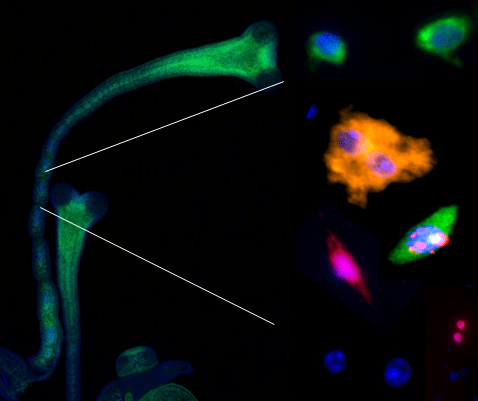
Cestodes show a remarkable proliferative capability, essential for their lifestyle, that sustains the constant growth and differentiation of segments present in the adult stage. It is believed that a particular population of undifferentiated stem cells, the so-called germinative cells, are the only cells that can proliferate and are responsible for cell renewal, growth, tissue repair and regeneration.
We have previously determined the localization of germinative cells in M. corti and characterized several molecular markers. These cells are present only in the larvae parenchyma, and during development of the adult stage they concentrate in the genital primordia, similar to that observed in free-living flatworms. Once we determined the localization and molecular characteristics of germinative cells in the whole organism, we continued their characterization in isolated cells in S and G2/M phases of the cell cycle.
Knowing the precise role of these and other cells in cestode biology will allow new intervention strategies aiming to control diseases caused by cestodes. With this goal, it is of interest to characterize all cell types and study their role in cestode biology and host – parasite interaction, along with their properties to be used as a strategy against cestode parasites.
Future characterization of these cells requires improved methods for culture and study gene expression during development, such as the ones described in this article. We present the repertoire of cell types of M. corti and show that cells with proliferative capacity can be cultured in vitro for short periods. Besides, we analyze putative molecular markers by in situ hybridization in the cestode M. corti.
The paper “Cell repertoire and proliferation of germinative cells of the model cestode Mesocestoides corti” by, María Fernanda Domínguez, Alicia Costábile, Uriel Koziol, Matías Preza, Klaus Brehm, José F. Tort and Estela Castillo, published in Parasitology, and is freely available for one month.
Credit: Images from our laboratory. On the left, a segmented worm showing the presence of a specific messenger RNA in its reproductive organs. On the right, some of the cell-types present at the parasite that we were able to characterize.
Related Posts

Toxoplasma gondii: one species with several genotypes; but do these induce differences in the host’s immune response?
The latest Paper of the Month for Parasitology is “Early immune responses and parasite tissue distribution in mice experimentally infected with oocysts of either archetypal or non-archetypal genotypes of Toxoplasma gondii“ Toxoplasmosis is a well-known disease caused by the single celled parasite called Toxoplasma gondii, which is found worldwide. The infective form of the microorganism is spread in […]

Schistosomiasis then and now; what has changed in the last 100 years?
Centennial Reflections – a distinguished parasitologist reflects on a paper published in their field in Parasitology 100 years ago A paper entitled “Bilharziasis in Natal”, published in Parasitology in 1918 by Dr F. G. Cawston, provides a window on the state of knowledge at the time (Cawston, 1918). He was a British physician and zoologist […]

International Women’s Day 2020: Influential women in STEM
International Women’s Day 2020 falls on Sunday, 8th March this year. In the run up to this date, each week day we’ll be highlighting one woman whose accomplishments in science, technology, engineering and/or mathematics not only elevated their fields but also took us one step closer to a gender-equal world. We hope you’ll join us […]

Where Physical and Digital Worlds Collide
In this blog for Data-Centric Engineering, Paul Clarke (Chief Technology Officer at Ocado) documents Ocado’s journey with building synthetic models of its business, its platforms and its underlying technologies, including the use of simulations, emulations, visualisations and digital twins. He explores the potential benefits of digital twins, including the opportunities for creating digital twins at […]


 ;
;


