

Future climate scenarios affect sugar and non-protein nitrogen content in orchard grass

7 July 2021
Last update: 15/07/21 11:14


The paper “The effect of increased temperature and CO2 air enrichment on the nutritive value of orchard grass (Dactylis glomerata) in permanent grassland“, published in The Journal of Agricultural Science, has been chosen as the latest Editorial Highlight and is freely available to download for one month.

Permanent grasslands in the Alpine region in Austria vary from intensively managed plant communities, with few numbers of species and up to six cuts per year, to species-rich communities that are used extensively, with local variations depending on soil type and drainage.
However, climate is changing, affecting plant growth patterns, and this affects forage quality. On the one hand, climate change may influence future management strategies to keep grassland productive. This means that grassland should be harvested to maintain optimal dry matter (DM) yield but also at an acceptable energy content (metabolizable energy content in harvested above-ground biomass, expressed as MJ or GJ/ha). On the other hand, carbohydrates and especially water-soluble carbohydrates (WSC) are influenced intrinsically by weather fluctuations and may affect rumen efficiency in terms of microbial N conversion of animals on forage-based diets. Therefore, in designing forage-based systems for sustainable ruminant production under climate change, maintaining high levels of energy content in forage is of primary concern. In the rumen, an abundant supply of readily available energy as WSC is counteracted by high non-protein nitrogen (NPN) proportion, resulting in efficient microbial growth and consequently efficient N utilization in ruminants. However, the simultaneous effect of future climate scenarios on plant WSC and NPN content has not been evaluated with a focus on ruminant nutrition. A general outcome of forage-based ruminant nutrition is asynchrony of energy and N; however, in concentrate-fed animals such dietary synchrony is rarely problematic because feed composition is managed much more easily by supplementation.
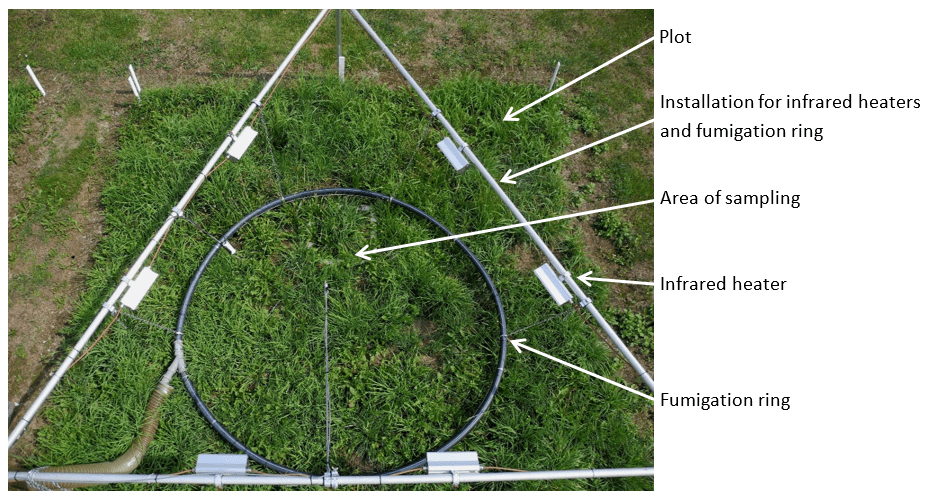
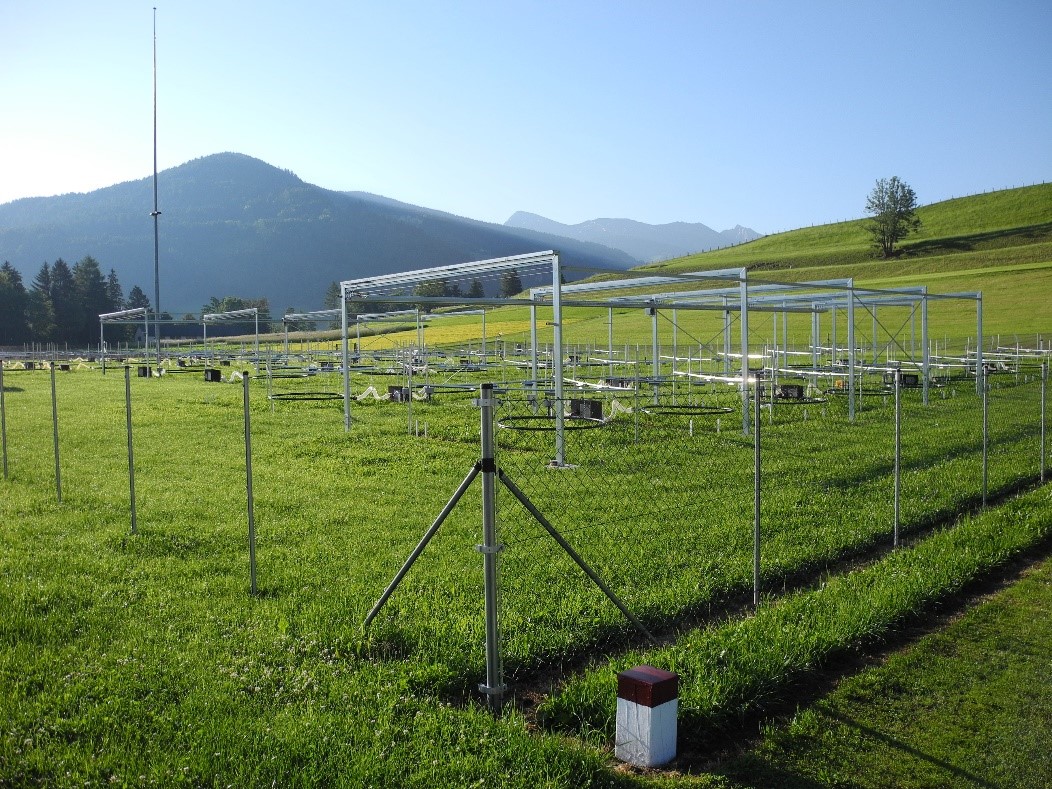
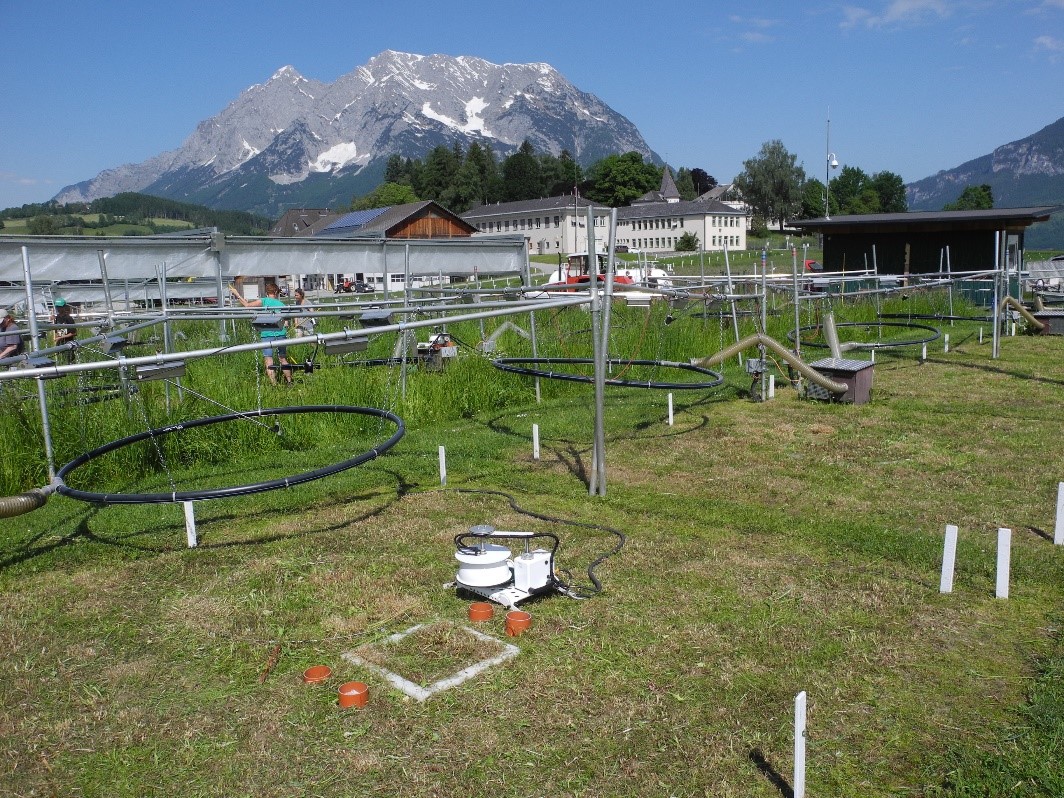
We expect that being able to predict the response of forage crops to increased temperature and enhanced CO2 concentration will help to achieve highest nutritive value in terms of synchronized WSC & NPN contents in harvested forage. Therefore, in order to simulate probable future climate conditions, the present study included treatments with increased temperature (+ 3 °C) and higher CO2 levels (+ 300 ppm) as well as ambient climate conditions. In three successive years, plots were sampled in a 3-cut system.
For the present study, the combination of increased temperature and enhanced CO2 led to an increased and accelerated conversion of NPN into complex protein compounds and accounted for increased proportions of WSC, the latter being connected to an increased ME content. However, the height and weight of plants decreased under elevated temperature and CO2, which means a decline in biomass production in plant communities with orchard grass is likely to occur in future scenarios.
For more information (in German):
https://raumberg-gumpenstein.at/projekte/projekt-climgrasseco-ii-auswirkungen-des-klimawandels-auf-die-produktivitaet-und-biogeochemie-des-oekosystems-dauergruenland.html
Photo credits: HBLFA Raumberg-Gumpenstein
The Journal of Agricultural Science Editorial Highlights are selected by the Editor-in-Chief and are freely available for one month. View the recent selections here.
Related Posts

International Women’s Day 2020: Influential women in STEM
International Women’s Day 2020 falls on Sunday, 8th March this year. In the run up to this date, each week day we’ll be highlighting one woman whose accomplishments in science, technology, engineering and/or mathematics not only elevated their fields but also took us one step closer to a gender-equal world. We hope you’ll join us […]

Where Physical and Digital Worlds Collide
In this blog for Data-Centric Engineering, Paul Clarke (Chief Technology Officer at Ocado) documents Ocado’s journey with building synthetic models of its business, its platforms and its underlying technologies, including the use of simulations, emulations, visualisations and digital twins. He explores the potential benefits of digital twins, including the opportunities for creating digital twins at […]

Wisconsin’s Response to the Coronavirus Pandemic – Now updated
From time to time, until the crisis has passed, the HEPL blog series authors will be given the opportunity to provide short updates on their country/region’s continuing response to this worldwide catastrophe and their further reflections on those responses. Each update will be labelled accordingly with the original response at the bottom of each post. […]
Austria’s Response to the Coronavirus Pandemic – Now updated
From time to time, until the crisis has passed, the HEPL blog series authors will be given the opportunity to provide short updates on their country/region’s continuing response to this worldwide catastrophe and their further reflections on those responses. Each update will be labelled accordingly with the original response at the bottom of each post. […]


 ;
;


