

Rethinking Neanderthal Art: What if it wasn’t about the brain, but about connection?

27 October 2025
Last update: 24/04/26 17:36


For decades, scientists have debated why Neanderthals didn’t seem to make much art. The usual answer? They just weren’t as cognitively advanced as us. According to this view, only Homo sapiens had the unique “spark” of creativity that led to symbolic thinking, artistic expression, and eventually our dominance as a species.
But what if that story is incomplete—or even wrong?
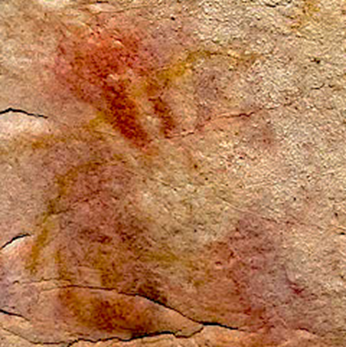
Recent research suggests that the differences between Neanderthals and early modern humans may have had less to do with brainpower and more to do with society, especially since both human groups had similar brain sizes. When we look at the archaeological record—traces of pigment use, body ornaments, engravings, and simple paintings—we see that both species engaged in similar practices. These early forms of art weren’t only about aesthetics or symbolism as we understand them today. Instead, they were probably social tools: ways to communicate, signal belonging, or explore identity within small, scattered groups.
To understand this shift, it helps to remember that our concept of “art” is relatively modern. During the European Renaissance, art became associated with intellect and “advanced culture.” When explorers and missionaries encountered Indigenous peoples in the Americas, they often used artistic skill—or its perceived absence—as a test of humanity. In some sense, we’ve inherited this bias: assuming that making art is a sign of higher thinking. The same logic has shaped the way we judge our ancient relatives.
Yet, as anthropologists point out, cultural and social context matter enormously. In small, low-density populations like those of the Neanderthals, the social pressures that drive the cultural evolution of art—such as group competition, identity marking, or the need to maintain traditions—would not have been high. Their “ad hoc” art might have served personal or immediate social purposes rather than developing into a shared, cumulative artistic tradition.
In contrast, as Homo sapiens populations grew, so did the need for social differentiation. Art became a way to communicate group identity, beliefs, and belonging. It wasn’t necessarily about superior cognition—it was about changing social worlds.
This perspective also encourages us to appreciate Neanderthals on their own terms. They were skilled woodworkers, pigment users, and creators of ritual spaces like Bruniquel Cave. Their practices may reveal a distinctive aesthetic sense—different from ours, but no less meaningful.
Ultimately, the story of early art may not be one of cognitive hierarchies, but of social complexity. By shifting our focus from “who was smarter” to “how they lived and connected,” we open the door to understanding multiple ways of being human. Neanderthals weren’t failed artists—they were participants in their own rich, evolving cultural worlds.
If art grows from connection rather than cognition, then creativity isn’t a human achievement, but a shared and diverse human story.
Read the article: ‘Art Beyond Cognition: Reframing Neanderthal art through social connectivity and cultural transmission by Larissa M. Straffon and Claudio Tennie published in Evolutionary Human Sciences.
Related Posts

Where Physical and Digital Worlds Collide
In this blog for Data-Centric Engineering, Paul Clarke (Chief Technology Officer at Ocado) documents Ocado’s journey with building synthetic models of its business, its platforms and its underlying technologies, including the use of simulations, emulations, visualisations and digital twins. He explores the potential benefits of digital twins, including the opportunities for creating digital twins at […]

Internet Shutdowns in Asia: Locating the Right to the Internet a Human Right Under International Human Rights Law
On May 2022, the United Nations Human Rights Council (UNHRC) published a report which documented that the majority of the internet shutdown was reported in Asia. Internet shutdown has become an instrument for many authoritarian governments to control the country and its citizens by suppressing dissenting voices, criticism of government policies, and censoring information. Bangladesh, […]

Elephants, Kings, and Comparison, a Conversation with Tom Trautmann
We invited Trautmann to tell us why he writes about Indian war elephants, and how. He touched on several topics in the process: the value of analytical accidents, the recovery of lost knowledge systems, and the power and pluralism of human logics.

International Women’s Day 2020: Influential women in STEM
International Women’s Day 2020 falls on Sunday, 8th March this year. In the run up to this date, each week day we’ll be highlighting one woman whose accomplishments in science, technology, engineering and/or mathematics not only elevated their fields but also took us one step closer to a gender-equal world. We hope you’ll join us […]


 ;
;


