

A Devonian pterygotid eurypterid playground in China
5 January 2026
Last update: 05/01/26 04:35


Pterygotids, known more commonly as ancient sea scorpions, were large apex predators of the Silurian-Devonian marine world. Their delicate skeletons, however, leave many questions about their morphology and ecology. Read how Maxwell Wang and colleagues use two eurypterid fossils from China to refine mouthpart nomenclature, hypothesise about feeding modes, and make conclusions about the ecology in the Xiaxishancun Formation.
“Early Devonian pterygotid eurypterids from Yunnan Province, China” by Wang and colleagues has been published in Journal of Paleontology, published by Cambridge University Press on behalf of the Paleontological Society.
Pterygotids (Eurypterida; Pterygotidae), known more commonly as ancient sea scorpions, were large apex predators of the Silurian-Devonian marine realm, and included some of the largest arthropods in Earth’s history, with some species reaching up to 2.5 meters in length. They are the only family of eurypterids to be found globally in marine deposits owing to their domination of the Mid-Palaeozoic seas. Most notably, their morphology includes large teslons (tail-like appendages) and chelicerae (pincers or claws). Pterygotids were therefore specialised predators with sharp vision from their compound eyes meaning they were actively seeking prey.
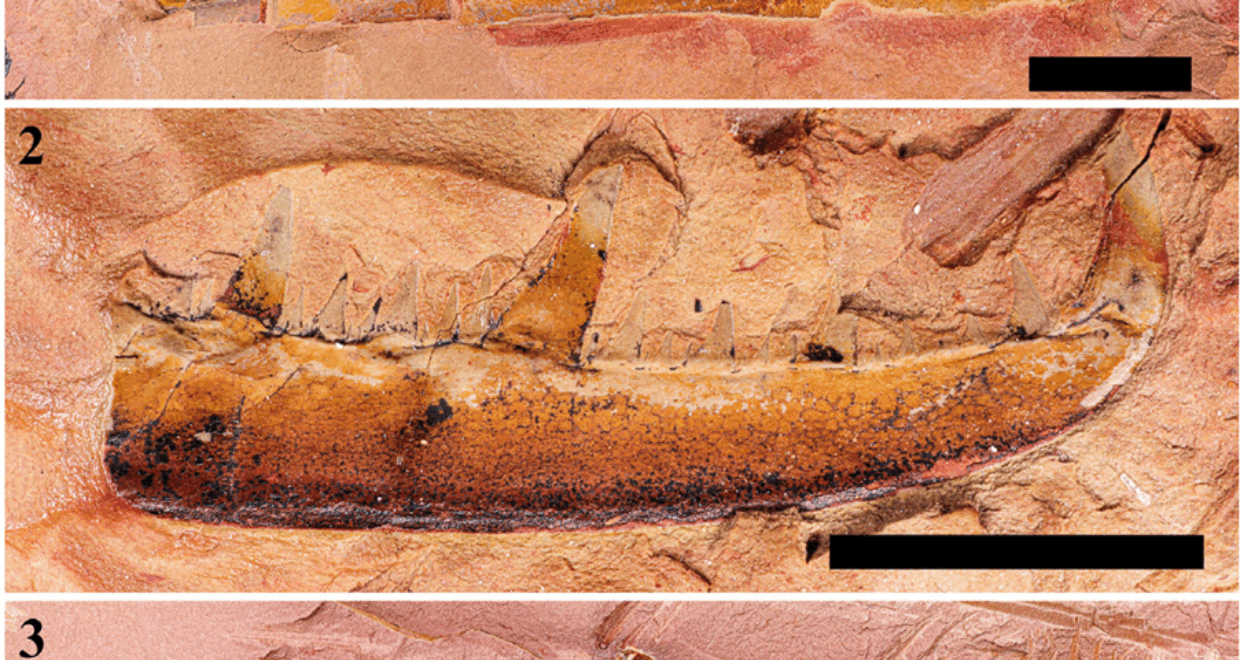
The Xiaxishancun Formation in Qujing City, Yunnan, China, offers an ideal location for studying eurypterids, with three species previously identified. In a new study by Maxwell Wang and colleagues from China and the UK, the researchers report new material of two species Erettopterus qujingensis and Pterygotus wanggaii. From these remarkable specimens, they refine the previously inconsistent nomenclature of the cheliceral denticals (teeth), as well as hypothesise about pterygotid feeding modes and ecology. The two species of pterygotids in the Xiaxishancun Formation occur with a higher proportion of juvenile-stage specimens. The authors interpret this association as representative of a breeding site and mass-molting site implying that Erettopterus qujingensis and Pterygotus wanggaii were permanent residents of the area.
The authors note that historically Pterygotus have been found in association with fossil fish such as osteostracans, bony, armoured fish, which suggests pteryogtids were preying on fish, whether actively or opportunistically. Biomechanically, pterygotid chelicerae were strong enough to handle heavily armoured prey. However, given the coexistence of Pterygotus wanggaii and Erettopterus qujingensis in the same deposit, were they competing for the same prey? As the authors describe, variations in cheliceral morphology between the two species indicates that Erettopterus qujingensis perhaps preferred less armoured prey, with its ‘sharper denticles and thinner cheliceral fingers’.
Wang and colleagues meaningfully speculate about pterygotid ecology in the Palaeozoic and their possible role in an evolutionary arms race that may have contributed to their vast size, robust appendages, and visual acuity.
“Early Devonian pterygotid eurypterids from Yunnan Province, China” by Wang et al. 2025 has been published in Journal of Paleontology, published by Cambridge University Press on behalf of the Paleontological Society.
The Paper “Early Devonian pterygotid eurypterids from Yunnan Province, China” by Maxwell Wang, Simon Braddy, Victoria Tang and Zhiheng Ma, published in Journal of Paleontology, is freely available for one month.
Related Posts

A Devonian pterygotid eurypterid playground in China.
Pterygotids (Eurypterida; Pterygotidae), known more commonly as ancient sea scorpions, were large apex predators of the Silurian-Devonian marine realm, and included some of the largest arthropods in Earth’s history, with some species reaching up to 2.5 meters in length. They are the only family of eurypterids to be found globally in marine deposits owing to their domination of the Mid-Palaeozoic seas.

Elephants, Kings, and Comparison, a Conversation with Tom Trautmann
We invited Trautmann to tell us why he writes about Indian war elephants, and how. He touched on several topics in the process: the value of analytical accidents, the recovery of lost knowledge systems, and the power and pluralism of human logics.

Bergamo’s Response to the Coronavirus Pandemic – Now updated
From time to time, until the crisis has passed, the HEPL blog series authors will be given the opportunity to provide short updates on their country/region’s continuing response to this worldwide catastrophe and their further reflections on those responses. Each update will be labelled accordingly with the original response at the bottom of each post. […]

Progress in Echinoderm Paleobiology: A New Special Issue of the Journal of Paleontology
A new special issue of the Journal of Paleontology, published on 12th June 2017, brings together a collection of 17 papers focused on different aspects of echinoderm paleobiology.


 ;
;


