

How Preemergent Herbicides May Be Driving Waterhemp Resistance
A new Weed Science Society of America research article highlights the need for stewardship to preserve PPO-inhibitor herbicides as an effective waterhemp control option


A new Weed Science Society of America research article highlights the need for stewardship to preserve PPO-inhibitor herbicides as an effective waterhemp control option

A recently published article in the journal Weed Science shows electric control technologies can eradicate weeds just as effectively as herbicides or mechanical methods, with minimal risks to the crop, soil or the environment.

New research from the University of Waterloo shows that a single, targeted herbicide application from a Remotely Piloted Aircraft System (RPAS) can suppress common reed invasions with more than 99% effectiveness.

Until now, not much was known about the influence that nozzle type and application volume have on weed control efficacy with remotely piloted aerial application systems (RPAASs). However, new research shows that RPAAS applications using low-drift nozzles at low spray volumes (1.0–1.5 gallons/acre) can achieve weed control levels comparable to ground sprayer applications at 10 gallons/acre in turf.

A strategy utilizing both preemergence (PRE) and postemergence (POST) herbicide treatments optimized weed control outcomes in early planted soybean. Researchers conducted their study in 2021 at three locations across Central Illinois.
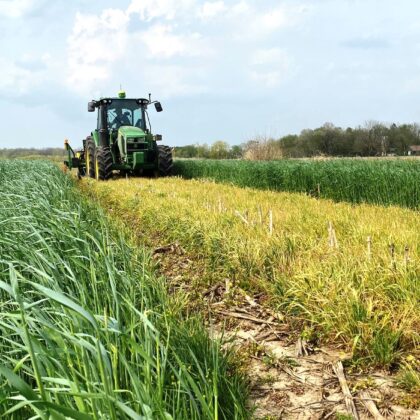
Recently published research in the journal Weed Science shows planting soybean into a green, living cover crop effectively suppresses two problematic Amaranthus weed species – waterhemp and Palmer amaranth – when integrated with pre-emergence (PRE) herbicides.

Black swallowwort is a difficult to control invasive vine that thrives in natural areas and perennial cropping systems in northeastern North America. To date, though, little is known about how the weed responds to mowing or to various herbicidal controls.
California’s commercial orchards produce a variety of crops valued by consumers – from stone fruit to almonds and walnuts. A successful harvest depends on the effective management of weeds that can interfere with irrigation lines, compete with crops for water, and impede sweepers and other harvesting equipment.

Downy brome is an annual winter grass that has invaded millions of acres of western rangelands and wildlands. It can outcompete native vegetation and can increase the frequency and severity of wildfires by leaving behind dense mats of litter at the end of its growing season.
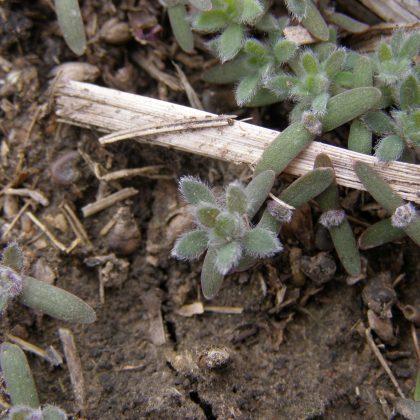
The latest issue of the journal Weed Science contains an article with intriguing new insights about the control of herbicide-resistant kochia, a weed that competes with both dryland and irrigated crops across the Great Plains states.…
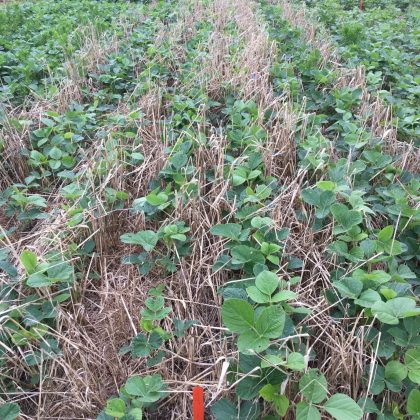
Fall-planted cover crops are frequently a component of integrated weed control programs in herbicide-resistant soybeans. But does it matter which cover crop is used?…

With the recent introduction of soybean and cotton traits resistant to synthetic auxin herbicides, farmers have new, much needed options for managing glyphosate-resistant broadleaf weeds. Researchers writing in the journal Weed Technology say use of the auxins isn’t without risk.
Q&A with Editor-in-Chief of the Precision Medicine Journal, Dame Anna Dominiczak, for International day of Women and Girls in Science


In this post Niva Golan-Nadir and Daniel Smith expand on their recent Politics and Religion article ‘From religious to secular perspectives of religion and state – tracing the American Blue law‘.…

How long will humankind survive? Besides the fact that we have been able to eliminate ourselves with nuclear weapons for decades, even without a third world war, the challenge to take care of the resources of our planet remains; we need to use them in a way that our children and their children can have a place on Earth as well. In this blog post Andreas Losch discusses his recent review article in the International Journal of Astrobiology, The need of an ethics of planetary sustainability

The English language contains a wealth of insults and terms of abuse. Personal insults attack the core and immutable aspects of a person, such as their race, ethnicity, appearance, age, or a disability.…

The March article of Muses – the arts blog from BJPsych International is the first blog of the series. The blog is written by Dr Dami Ajayi, Specialty Doctor, Barnet Enfield and Haringey Mental Health NHS Foundation Trust and Trainee/Blog Editor, BJPsych International.…

Some disability-related names have dropped out of usage, because they are now considered to be offensive due to their origins. Down Syndrome (Trisomy 21) is one example.…

Even though findings from genetics and other sciences unequivocally refute biological conceptions of race, this erroneous viewpoint remains widespread among the general public.…
How long will humankind survive? Besides the fact that we have been able to eliminate ourselves with nuclear weapons for decades, even without a third world war, the challenge to take care of the resources of our planet remains; we need to use them in a way that our children and their children can have a place on Earth as well. In this blog post Andreas Losch discusses his recent review article in the International Journal of Astrobiology, The need of an ethics of planetary sustainability


It is an article of faith among ordinary Filipinos that American troops will die with Filipino troops defending Philippine claims to the Spratly Islands in the South China Sea (SCS).…

Q&A with Editor-in-Chief of the Precision Medicine Journal, Dame Anna Dominiczak, for International day of Women and Girls in Science

More and more research is finding inflammation as a potential contributing factor towards to the development of various mental illnesses. A systematic review was conducted to determine the association between parasitic infection and mental illnesses in various African populations. Two parasite groups were evaluated; helminths and protozoans, and four mental illness classifications; depressive disorders, anxiety disorders, schizotypal disorders and unspecified mental illnesses.
This is the first post in our new series: “Conversations with Authors.” For our inaugural post, we asked Dr. Vesla Weaver to meet (virtually) with Dr.…
The March article of Muses – the arts blog from BJPsych International is the first blog of the series. The blog is written by Dr Dami Ajayi, Specialty Doctor, Barnet Enfield and Haringey Mental Health NHS Foundation Trust and Trainee/Blog Editor, BJPsych International.…
The English language contains a wealth of insults and terms of abuse. Personal insults attack the core and immutable aspects of a person, such as their race, ethnicity, appearance, age, or a disability.…


Listen to @BBCRadio4's Start the Week, featuring @NineDotsPrize winner @jkkusiak, talking about her book, 'Radically Legal'. Learn how a group of ordinary people inspired the book when they reclaimed over 240,000 apartments back from corporate landlords 🔗

Start the Week - ‘Left behind’, but not forgotten - BBC Sounds
Tom Sutcliffe with Paul Collier, Joanna Kusiak and Matthew Xia.
cup.org
Sparking curiosity from geopolitics in Japan to the cultural implications of AI!
Explore the seven new titles we are welcoming to Cambridge and the seven #OpenAccess titles we are launching in 2025 🚀 🔗 https://cup.org/3yhAuAx
Our Flip it Open programme has published titles from authors @GibbsSpike, @liederfollower and Inés Valdez!
Discover how we are funding the publication of #OpenAccess books without changing purchasing habits 🔗 https://cup.org/4diDHii


 ;
;


