

The need for sustainable exit strategies in land-related projects
When land-related projects fail or stall, local communities are often left with little to rely on and risk being left worse off than before.…


When land-related projects fail or stall, local communities are often left with little to rely on and risk being left worse off than before.…

Liberty and autonomy are cornerstones of modern society. They are also core to personhood and human flourishing. However, a large portion of the population is denied the right to make decisions on the basis of cognitive disability.…
The emerging interaction between public health and security policies in the EU raises a number of important questions of effectiveness and legitimacy.…

BREXIT. Multinational intellectual property agreements painfully difficult to negotiate and finalize. The Anti-Counterfeiting Trade Agreement languishing, with only one signatory. Suspension of most of the IP provisions in the revamped Trans Pacific Partnership Agreement.…

A new compendium has been published bringing together the WTO’s founding and new agreements, and its annexes, in a more comprehensive and manageable format.…
Great news for officials, practitioners and academics in the field of human rights and business: A website mapping National Action Plans (NAPs) on business and human rights globally and an updated Toolkit providing step-by-step guidance on how to develop a NAP is now available.…

EU Law Stories provides its readers with a “behind the scenes” look at how various actors influence legal decision-making within the Court of Justice of the European Union (CJEU).…
Freshfields’ coverage of the UN Forum on Business and Human Rights concludes with themes emerging from the third and final day of the conference, and overall reflections on the event as a whole.…
Freshfields’ coverage of the 2017 UN Forum on Business and Human Rights – offering global corporations, governments, NGOs, human rights activists and other stakeholders an annual platform to explore and discuss initiatives concerning the role of business with respect to human rights – continues with the following summary of notable perspectives provided by participants across the spectrum.…
In late November, members of Freshfields’ Global Business and Human Rights team attended and presented at the sixth UN Forum on Business and Human Rights in Geneva.…
During a panel discussion at the 6th annual UN Forum on Business and Human Rights, in Geneva, Switzerland, representatives of OECD Watch, Heineken, the Dutch NCP, and victims from the Democratic Republic of Congo (DRC) discussed the successful process towards remedy following business-related human rights abuses by Heineken.…
Last week, I took part in the United Nations Forum on Business and Human Rights. I reflected on how far we have come in terms of the positive progress we are making, together with our partners on the Malawi Tea 2020 programme, where we are seeing a range of improvements to peoples’ lives in tea communities.…
Companies are increasingly expected to engage on prominent public policy issues facing society. Such areas of public policy interfacing with business include migration and the global refugee crisis, LGBTI rights, freedom of expression and terrorism, climate change, white supremacy, and human rights in the global economy.…
This post originally featured in the Freshfields Bruckhaus Deringer blog on the 22nd November 2017. Adoption of national legislation in France scrutinizing corporate efforts through mandated disclosure regimes and requiring companies to establish and implement vigilance plans constituted a watershed moment in business and human rights law.…
Under the theme of “Realizing Access to Effective Remedy” the 2017 UN Forum on Business and Human Rights, will devote particular focus to the third pillar of the UN Guiding Principles on Business and Human Rights (“Guiding Principles” or “UNGPs”) – the need for access to effective remedy for those whose human rights are adversely affected by business activities.…
As explored within this blog series, access to remedy is a rapidly improving, though still fundamentally weak, area of business of human rights (BHR) regulation.…
This post originally featured on the Oxford University Law Faculty’s blog on the 25th October 2017. Conventionally, the doctrines of separate corporate personality and forum non conveniens insulated English domiciled parent companies from liability for the actions of their foreign subsidiaries. …
This post was originally featured in Oxfam America. The Business and Human Rights Community have consistently focused on stronger regulations, norms and practice of the private sector in holding corporations accountable for human rights violations and achieving access to remedy for the victims.…
The Global Business Initiative on Human Rights and the Business and Human Rights Resource Centre Over the past few years, the Global Business Initiative on Human Rights and the Business and Human Rights Resource Centre, with the support of the UN Working Group on Business and Human Rights (UNWG), have organised a series of panels at the UN Annual Forum (Forum) bringing together affected communities, civil society, business representatives and government officials to explore implementation of the UN Guiding Principles (UNGPs) on the ground.…
The decision by the UN Working Group to focus on access to remedy at the 2017 UN Forum on Business and Human Rights is a timely and welcome one.…
The only daughter in a family of poor farmers, 10-year-old Nirmala was desperate enough to run away to the city to seek work.…
Access to remedy through judicial, administrative or legislative means is essential to righting wrongs. But to make these effective, the remedy landscape must recognise and squeeze out these wrongs.…
It has been more than two years since world leaders adopted the new 2030 Agenda for Sustainable Development, including the Sustainable Development Goals (SDGs).…
Several recent developments highlight the precarious relationship between international investment law (“IIL”), the law that protects foreign corporations (and other foreign investors) when they enter a new state, and international human rights law (“IHRL”), particularly the human rights of communities and individuals affected by foreign businesses.…
Mental health considerations and remediation in cases of corporate-related human rights harm Reflecting on the theme of “Realizing Access to Remedy” at the upcoming UN Annual Forum, the UN Working Group on Business and Human Rights asserts that Pillar III of the UN Guiding Principles (UNGPs) is losing the epithet ‘forgotten pillar.’…
The UN Guiding Principles on Business and Human Rights expect companies to establish operational-level grievance mechanisms for individuals and communities adversely impacted by company operations (Guiding Principle 29).…

Why did I write Discrimination, Copyright and Equality: Opening the E-Book for the Print Disabled? Since losing my eyesight in 1993 in a train accident I wanted to enjoy reading equality but was denied this right. …
This post originally featured on the Thomas Reuters Arbitration Blog on the 16th October 2017. On 27-29 November 2017, the United Nations Forum on Business and Human Rights will convene in Geneva.…
The right to effective remedy – the ‘third pillar’ of the United Nations Guiding Principles on business and human rights (UNGPS) – is already a fundamental human right.…
Doing business in the Global South can be a risky proposition. Unfortunately, no matter how much planning a company does in advance of launching an investment, unforeseen challenges such as competing land claims or other investment-related disputes or trends can occur, causing negative impact on the operation.…
Two years ago, a panel discussion on access to remedy in the finance sector took place at the fourth UN Forum.…
Strengthening access to effective remedy for business-related human rights abuses is perhaps the most pressing challenge in the business and human rights (BHR) field.…
The successful outcomes of the Heineken, Kinross and Statkraft cases have recently demonstrated that the National Contact Point system for the OECD Guidelines on Responsible Business Conduct can be effective for providing access to remedy in the business and human rights domain.…
Operational level grievance mechanisms are part of the UN General Principles’ access to remedy pillar, yet their role has been called into question by some sectors of civil society.…
Pillar three of the UN Guiding Principles on Business and Human Rights (UNGPs) on access to remedy has increasingly been referred to as the “forgotten pillar”.…
As explored within this blog series, access to remedy is a rapidly improving, though still fundamentally weak, area of business of human rights (BHR) regulation.…

Cambridge University Press is proud to support International Open Access Week, running from 23rd to 29th October 2017. As a leading University Press we are actively engaged with Open Access, and our Open Access publishing platform, Cambridge Open, serves authors and the wider community by publishing high-quality, peer-reviewed OA content. Follow our Facebook and Twitter pages this week to read blog posts from our Open Access team, read our most-read Open Access articles, and learn more about Cambridge Open.
The development of our Open Access programme, Cambridge Open, continues to be a major area of importance for the Press, both Green and Gold OA.

I just came back from a hectic 10 days in the US, presenting my new book at 5 universities – it was a very intense, yet very satisfying, trip.…

In this post, Anne Peters gives us an overview of the Symposium on Global Animal Law: Animals Matter in International Law and International Law Matters for Animals that is now published open access by AJIL Unbound.…

Now that the new academic year has arrived, many Ph.D. students will be going on the job market for the first time.…

In May 2010, the 63rd World Health Assembly unanimously adopted WHO recommendations urging Member States to reduce the impact on children of the marketing of unhealthy food.…

Author of this blog post, Raphael Kaplinsky, is Professorial Fellow, Science Policy Research Unit, and Emeritus Professorial Fellow, Institute of Development Studies, University of Sussex.…

The emerging field of corporate law, corporate governance and sustainability represents one of the most dynamic and significant areas of law in light of the convergence of crises that we as a global society face.…

According to the UN Guiding Principles on Business and Human Rights (UNGPs) the responsibility to respect human rights requires that business enterprises: “Avoid causing or contributing to adverse human rights impacts through their own activities, and address such impacts when they occur.”…

It happens to all academic researchers, all of the time. We have to deal with rejection – our papers get rejected for publication by journals.…

In 2004, then President of the European Union’s European Council, Herman Van Rompuy, declared that “from fifteen – suddenly there were twenty-five, and finally, Europe had become ‘Europe’ again.”…

Read headlines around the world and it seems as if most of the important high tech companies are actively engaged in antitrust investigations or litigation. …

Donald Trump’s election has brought the ‘filter bubble’ to the attention of a wider public: As a result of personalised search results and news-streams, Internet users get less and less exposed to conflicting viewpoints and are isolated intellectually in their own informational bubble.…

From China’s assertive sovereignty claims in the South China Sea, to Russia’s intervention in Crimea, to America’s withdrawal from international regimes like the Paris Accord, international law’s potential to contribute to global governance has been dramatically tested.…

The Jadhav case The Jadhav case between India and Pakistan, recently-entered on the docket of the International Court of Justice following India’s application, raises an interesting treaty conflict issue.…

You might have read in the press recently that the Charity Commission has commenced a consultation about the continued registration as charities of complementary and alternative health charities.…

Compassion might seem an unusual topic to consider alongside law. Compassion is sometimes seen as a subjective, emotional, and capricious reaction to suffering that is incompatible with law’s objectivity, impartiality, reason, and public-oriented balancing of interests. …

For what purposes should the government be able to take private property? When I first started writing about that question, I thought there was little chance anyone outside the United States would ever be interested in my work.…

We started to work on this book when the world still seemed to be okay for those looking at it through the lens of international economics or international economic law.…
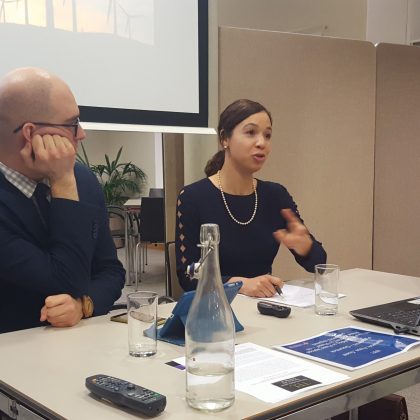
Transnational Environmental Law (TEL) was launched in 2012. Its emphasis on the contribution of non-state actors and recognition of the multilevel governance context in which law and regulatory developments now occur was path breaking.…

For centuries, scholars, judges and lawyers speculated about the error rate in the criminal justice system, many of them searching for absolute proof of the innocent person wrongfully convicted and imprisoned. …

On April 3, 2014, the Frankfurter Allgemeine Zeitung, one of the leading German daily newspapers, published a small note. The journalist reported from a meeting of the German Federal Minister of the Interior with a few selected public law professors at an Italian restaurant in Berlin.…

Last Friday, the Office of the United States Trade Representative (USTR) published its annual National Trade Estimate Report on Foreign Trade Barriers.…

There has been increased controversy in recent years surrounding the use of armed drones and their implication on the right to life.…
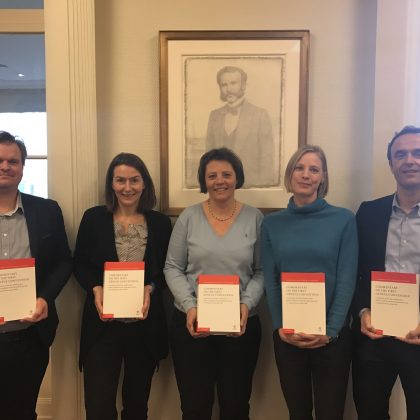
Updating the commentaries on the Geneva Conventions of 1949 and their Additional Protocols is a task that resembles more a marathon than a sprint. This is hardly a surprise, as it is now more than 60 years since the first set of Pictet Commentaries appeared, giving practical guidance on how the conventions should be implemented.

For several years transatlantic relations have been dogged by very different perspectives on privacy and intelligence-gathering held by many on the opposite sides of the Atlantic.

A collection of the most read posts published in 2016


Listen to @BBCRadio4's Start the Week, featuring @NineDotsPrize winner @jkkusiak, talking about her book, 'Radically Legal'. Learn how a group of ordinary people inspired the book when they reclaimed over 240,000 apartments back from corporate landlords 🔗

Start the Week - ‘Left behind’, but not forgotten - BBC Sounds
Tom Sutcliffe with Paul Collier, Joanna Kusiak and Matthew Xia.
cup.org
Sparking curiosity from geopolitics in Japan to the cultural implications of AI!
Explore the seven new titles we are welcoming to Cambridge and the seven #OpenAccess titles we are launching in 2025 🚀 🔗 https://cup.org/3yhAuAx
Our Flip it Open programme has published titles from authors @GibbsSpike, @liederfollower and Inés Valdez!
Discover how we are funding the publication of #OpenAccess books without changing purchasing habits 🔗 https://cup.org/4diDHii


 ;
;


