TDR

(15) rss icon
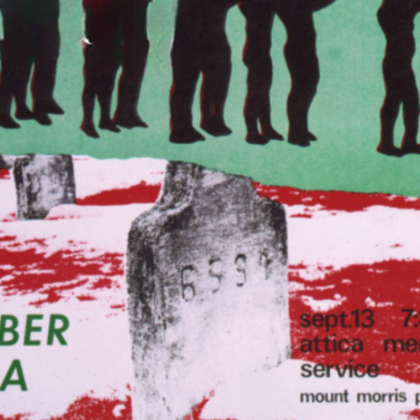
Performance, Prefiguration, and Politics at Attica

How do we define success in radical politics? This is a question I have asked myself throughout my research and writing on what many historians, politicians, and colleagues deem a sensational, unequivocal failure. The Attica Prison Uprising began with a flash of possibility yet ended with dozens killed and even more wounded, setting off a slew of pro-carceral propaganda from the Nixon and Rockefeller administrations amid intensifying mass incarceration. What does it mean to recognize the Attica Prison Uprising as a success, and what tools might we find in the language of performance for making this kind of political assessment?

Read more

The Worldwide Ukrainian Play Readings Continue to Evolve

 It is fitting but painfully frustrating to note that I write these words on the day that marks exactly three years since Russia launched a full-scale invasion of Ukraine. What has that to do with theatre? Well, my Worldwide Ukrainian Play Readings (WUPR) arose a few nanoseconds after that sad historical event, and has gone on to midwife over 700 readings, productions, installations, films, videos, conferences, and more in 33 countries. All of them present and promote the work of Ukrainian writers offering unique and powerful insights into their national tragedy.

Read more

Silicon Evolution

Two essays in this issue of TDR explore AI. Diana Taylor reexamines her by now classical distinction between the “archive and the repertoire” in terms of how digital technologies “have complicated Western systems of knowledge, raising new issues around presence, temporality, space, embodiment, liveness, sociability, and memory (usually associated with the repertoire) and those of authority, copyright, history, and preservation (linked to the archive)” (2024:25). Kathy Fang, winner of this year’s TDR Student Essay Contest, notes how ChatGPT moves “beyond performance as traced by its citationality towards performance as recursive in its iterability” (2024:133). Both these essays, and the plethora of other thinking about AI, relate deeply to my “restoration of behavior,” wherein there is no original (Schechner 1985).

Read more

Still Exhausted

As 2024 begins, AI feels simultaneously inescapable and invisible. Newspaper editorials, Davos panels, and countless advertisements tout the epochal event that is “AI.”…

Read more

The Loss of Fear as Civic Performance

Antiwar activists carve “no to war” in frozen rivers, spray-paint slogans of peace in the snow. They scrawl on banknotes, putting their opposition into circulation. Despite the looming threat of 15-year prison sentences, artists and activists in Russia continue to protest Putin’s ongoing invasion of Ukraine.

Read more

Showing up to Improvisation

Emerging to sociality during a pandemic has felt like a process of improvisation—making gestures toward imagining oneself in relation to others, to past selves, and to future possibilities.…

Read more

A Fall That Keeps on Falling

When writing about the uncertain future of contact improvisation during the summer and fall of 2020, in the wake of Nancy Stark Smith’s passing, I noted that one of her most significant contributions to understandings of CI was her theory of “the gap.”…

Read more