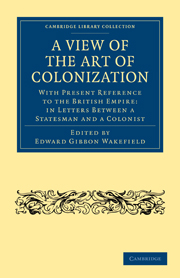

Edward Gibbon Wakefield (1796–1862) was a controversial colonial advocate and political theorist, who was the driving force behind the early colonization of New Zealand and South Australia. Barred from entering parliament after serving a three-year sentence in Newgate Prison, Wakefield read widely on contemporary economics and social questions, developing his influential theory of colonization. He formed the New Zealand Association in 1837 to create a new colony in that country, finally emigrating himself in 1852. This volume, first published in 1849, contains an explanation of Wakefield's philosophy of colonization. Writing in the form of letters to an anonymous statesman, Wakefield fully explores and discusses the social, political and economic aspects of his system of colonization, based on regulating emigration by fixing the price of land. Wakefield's ideas influenced early colonial economic policy in South Australia, and stimulated the development of later theories of colonization.
Loading metrics...
* Views captured on Cambridge Core between #date#. This data will be updated every 24 hours.
Usage data cannot currently be displayed.
This section outlines the accessibility features of this content - including support for screen readers, full keyboard navigation and high-contrast display options. This may not be relevant for you.
Accessibility compliance for the PDF of this book is currently unknown and may be updated in the future.
