Book contents
- Frontmatter
- Contents
- Figures
- Tables
- Contributors
- Acknowledgements
- Introduction
- Part I Beyond prejudice
- 1 From perception to mobilization: the shifting paradigm of prejudice
- 2 Prejudice, social identity and social change: resolving the Allportian problematic
- 3 An ambivalent alliance: hostile and benevolent sexism as complementary justifications for gender inequality
- 4 Prejudice and dehumanization
- 5 Stereotyping, prejudice and discrimination revisited
- 6 Beyond ‘old’ and ‘new’: for a social psychology of racism
- 7 The notion of ‘prejudice’: some rhetorical and ideological aspects
- 8 The prejudice problematic
- 9 Implicit prejudice in mind and interaction
- 10 Rethinking the prejudice problematic: a collaborative cognition approach
- Part II Prejudice and social change revisited
- Index
- References
8 - The prejudice problematic
from Part I - Beyond prejudice
Published online by Cambridge University Press: 05 June 2012

Book contents
- Frontmatter
- Contents
- Figures
- Tables
- Contributors
- Acknowledgements
- Introduction
- Part I Beyond prejudice
- 1 From perception to mobilization: the shifting paradigm of prejudice
- 2 Prejudice, social identity and social change: resolving the Allportian problematic
- 3 An ambivalent alliance: hostile and benevolent sexism as complementary justifications for gender inequality
- 4 Prejudice and dehumanization
- 5 Stereotyping, prejudice and discrimination revisited
- 6 Beyond ‘old’ and ‘new’: for a social psychology of racism
- 7 The notion of ‘prejudice’: some rhetorical and ideological aspects
- 8 The prejudice problematic
- 9 Implicit prejudice in mind and interaction
- 10 Rethinking the prejudice problematic: a collaborative cognition approach
- Part II Prejudice and social change revisited
- Index
- References
Summary
It required years of labour and billions of dollars to gain the secret of the atom. It will take a still greater investment to gain the secrets of man’s irrational nature.
G. W. Allport (1954)This chapter identifies and explores a discursive ordering which I shall call the ‘problematic of prejudice’. I intend to study this problematic in two of its guises: as a theoretical and analytic practice within social psychology and as a form of accounting within the discourse of Pakeha (white European) New Zealanders. I shall argue that the prejudice problematic, contrary to some of the avowed intentions of its advocates within the social sciences, fulfils some important ideological roles for Pakeha New Zealanders. Accounting in terms of prejudice can draw attention away from immediate social reform towards utopian visions; it can provide a logic and method for justifying individual conduct; and it can establish a positive identity and a benevolent ‘vocabulary of motives’ vis à vis other, supposedly less enlightened, individuals.
I use the term ‘problematic’ in this context because it suggests we are dealing with a relatively integrated framework of distinctive assumptions, intellectual strategies, questions and problems. The most integrated form of prejudice talk appears, of course, within the texts of social psychology. The ‘lived ideology’ is, as usual, much more fragmented, piecemeal and contradictory, caught up as it is in the kaleidoscope of common sense. In this chapter I use the intellectuals’ version to help chart a coherent path through the lay discourse.
Information
- Type
- Chapter
- Information
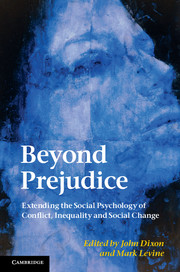
- Beyond PrejudiceExtending the Social Psychology of Conflict, Inequality and Social Change, pp. 158 - 178Publisher: Cambridge University PressPrint publication year: 2012
References
1950 The Authoritarian PersonalityNew YorkHarper and Row
1954 The Nature of PrejudiceReading, MAAddison-Wesley
1985 Prejudice, categorisation and particularisation: from a perceptual to a rhetorical approachEuropean Journal of Social Psychology 15 79Google Scholar
1988 Ideological Dilemmas: a Social Psychology of Everyday ThinkingLondonSage
1973 The Social Psychology of PrejudiceNew YorkJohn Wiley and Sons
1979 Truth and MethodLondonSheed and Ward
1987 There Ain’t no Black in the Union JackLondonHutchinson
1986 Contact is not enough: an intergroup perspective on the ‘contact hypothesis’Contact and Conflict in Intergroup EncountersOxford, UKBlackwell
1986
1972 Prejudice and RacismReading, MAAddison-Wesley
1978 White Awareness: Handbook for Anti-racism TrainingNorman, OKUniversity of Oklahoma Press
1987 Discourse and Social PsychologyLondonSage
1986 Contact, action and racialization: some British evidenceContact and Conflict in Intergroup EncountersOxford, UKBlackwell
1988 Racism and EthnicityAuckland, New ZealandOxford University Press
1984 Prejudice and DiscourseAmsterdam, the NetherlandsBenjamins
1987 Communicating RacismNewbury Park, CASage
1991 Racism and the PressLondonRoutledge
1992 Mapping the Language of Racism: Discourse and the Legitimation of ExploitationLondonHarvester Wheatsheaf
Accessibility standard: Unknown
Why this information is here
This section outlines the accessibility features of this content - including support for screen readers, full keyboard navigation and high-contrast display options. This may not be relevant for you.Accessibility Information
Accessibility compliance for the PDF of this chapter is currently unknown
and may be updated in the future.
- 16
- Cited by