

Appendix: Chapter 1 Corruption and GDP Growth
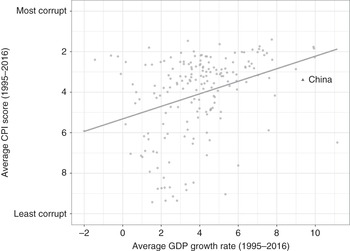
It is commonly asserted that China is an “outlier” in achieving rapid growth despite corruption. One example is an article in The Wall Street Journal (WSJ), which used a scatterplot of CPI scores and average GDP growth rates to illustrate that “corruption normally goes hand in hand with low growth – but China doesn’t fit that pattern.”Footnote 1 In fact, the figure in the WSJ makes the opposite point: corruption goes hand in hand with high growth.
Figure A1.1 updates the aforementioned figure with recent data of CPI scores of all countries plotted against their average growth rates from 1995 to 2016. As we can clearly see, more corrupt countries have higher GDP growth. This is not surprising, as corrupt countries tend to be low-income countries, which usually experience faster growth. In Figure A1.1, China’s corruption score falls below the regression line, which means that given its high growth rate, it was less corrupt than expected. The general correlation between corruption and poverty is measured by GDP per capita (see Chapter 1), not growth rates.
Updated replication of the WSJ’s scatterplot on corruption and growth rate.
As argued in the introduction, China is not anomalous in having corruption with high growth rates; rather, what makes it an outlier is that it has achieved a 40-year period of sustained economic expansion on a nearly unparalleled scale, despite moderately high levels of perceived corruption.
This example illustrates the necessity of being precise about what we mean both by corruption (see Chapter 2) and by growth. In fact, different measures of “growth” (GDP per capita, GDP growth rates, absolute GDP growth, and durability of high growth) correlate with corruption in dramatically different ways. In order to make sense of the Chinese paradox, we must first define the basic terms of our analysis.
Appendix: Chapter 2 UCI Survey Methodology
This appendix describes the survey design and implementation of the Unbundling Corruption Index (UCI) in more detail. The first step of the survey was to create a pool of potential respondents. After searching the literature and online resumes, and seeking recommendations by colleagues, I identified a group of individuals who have extensive experience in or broad knowledge of a country’s political, economic, and social context. The survey is hosted on Qualtrics, a third-party online survey platform. Each member of the expert pool was sent a private link to participate. I informed the invitees that the survey is anonymous, meaning that no personally identifiable information was collected or stored through the platform or via the questionnaire.
Of the 372 invitations sent out, 135 surveys were started and 125 completed, yielding a response rate of 36% and a completion rate of 84%, which is within the normal range of surveys. The respondents are primarily academics with area expertise in a particular country (73), journalists (11), and business leaders or professionals with at least 10 years of experience (11). Others included development consultants and mid-to-senior-level civil servants. Among the respondents, 45% are natives of the countries that they evaluated.
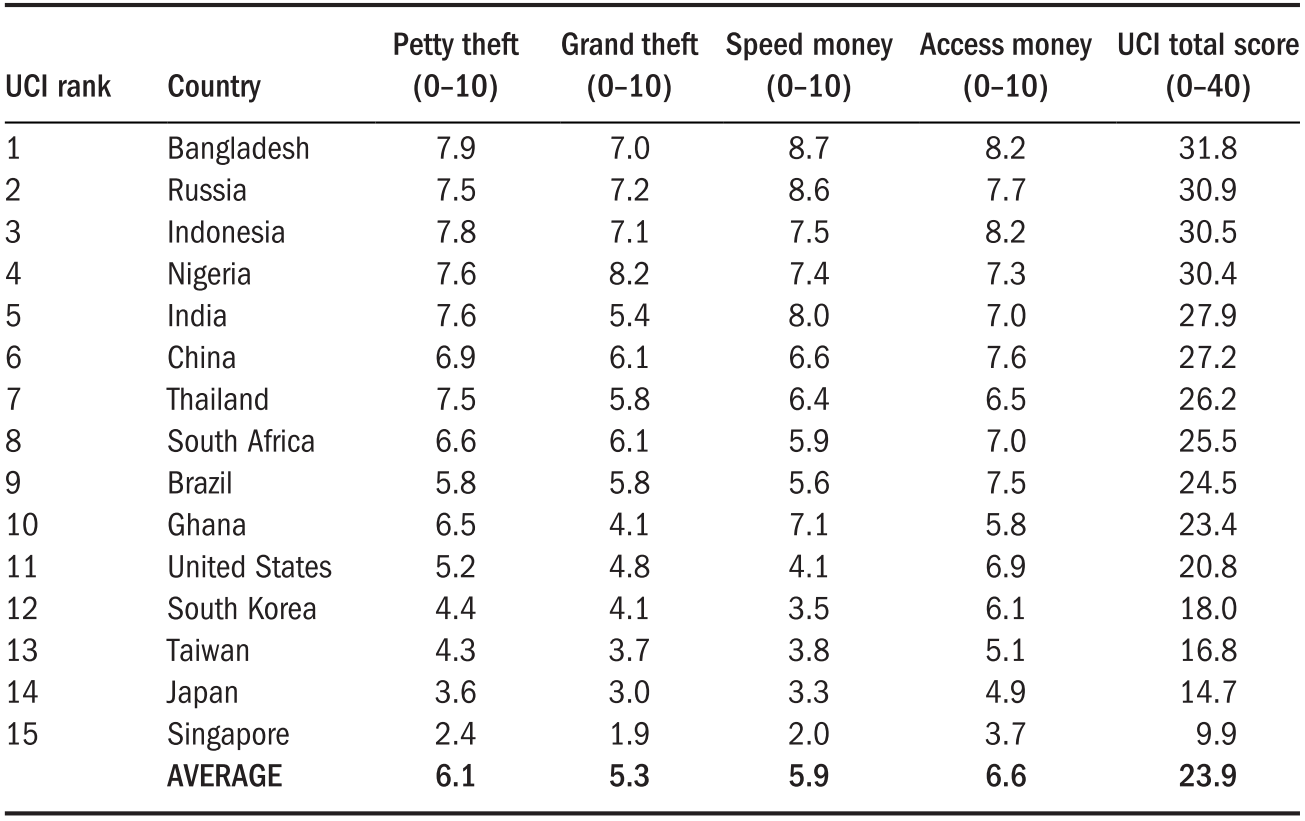
In the final dataset (Table A2.1), only countries with at least four expert responses were included. The number of responses ranged from four to 20, as follows: Bangladesh (4), Brazil (6), China (20), Ghana (5), India (6), Indonesia (5), Japan (9), Nigeria (5), Russia (12), Singapore (7), South Africa (5), South Korea (9), Taiwan (5), Thailand (4), and the United States (20).
As discussed in Chapter 2, the UCI leverages stylized vignettes to capture perceptions of distinct categories of corruption. Altogether, our survey included 20 vignette-style questions, grouped into four categories: access money, speed money, grand theft, and petty theft. For each vignette, respondents rate the prevalence of each type of corruption on a five-level Likert-type scale, ranging from “extremely common” to “never occurs.”
The greatest challenge of implementing this survey is getting experts to respond and having at least four respondents for each country. Understandably, experts and professionals are busy individuals, so it’s not easy for them to find time to take an extended survey. One reader complained about the absence of European countries in my sample. The reason for this is that, despite repeated requests, I could not get enough experts from Europe to respond. Hence, I thank all the respondents who took time from their busy schedule to take the survey, and I hope that, in future iterations of the UCI, more experts from all over the world may be willing to share their time and expertise.
Appendix: Chapter 3 Definition of Three Main Corruption Terms
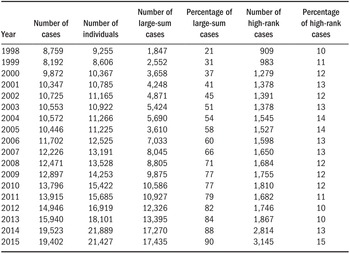
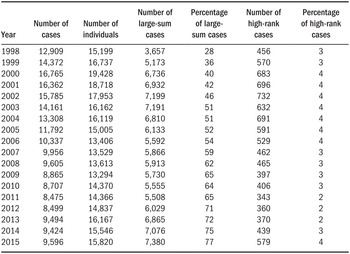
Below is a translation of the definitions of bribery, embezzlement, and misuse of public funds, as defined in the 1999 Regulations Regarding Cases Investigated by the Procuratorate (关于民检察院直接受理案侦查案件案标准的规定). See Tables A3.1 and A3.2 for data on bribery and embezzlement, respectively.
Bribery (贿赂)
Bribery includes crimes of accepting, receiving, and offering bribes, in the case both of individuals and of work units. For example, the crime of “receiving bribes” is defined as state officials using the privileges of their office to seek the property of others, or illegally accept the property of others, and to seek benefits on their behalf. “Using the privileges of office” indicates taking advantage of powers within the scope of individual work duties, the powers of supervision, undertakings, or handling of public affairs and the circumstances arising from those positions. Extorting the property of others, regardless of whether it is “seeking benefit for others” or not, can be treated as receiving bribes; illegally receiving the property of others must concurrently satisfy the condition of seeking benefits for others in order to be considered the crime of “receiving bribes,” but whether or not the benefit sought for another party is appropriate and whether or not the benefit is realized does not affect the determination of the crime. […] Those suspected of the following should have a case established against them: (1) An individual accepts a bribe of 5,000 Yuan or more; (2) An individual accepts a bribe of less than 5,000 Yuan, but it also involves one of the following conditions: 1. Because of the bribery, the state or social interests suffer serious losses; 2. Purposefully impeding the work of or threatening of related organs or individuals, causing a pernicious influence; 3. Forceful extortion of property or funds.
Embezzlement (贪污)
This crime is defined as the misuse of privileges of state office to embezzle, steal, obtain by fraud or the use of any other method to illegally obtain public property. Suspects of the following conduct should have a case established: (1) Individual corruption of 5,000 Yuan or more. (2) Individual corruption of less than 5,000 Yuan but involves the embezzlement of disaster relief, emergency, flood control, disease prevention, disabled care, poverty alleviation, or emergency funds or donations, stolen or confiscated goods; when the means used are heinous, evidence is destroyed, or stolen goods are transferred.
Misuse of Public Funds (挪用公款)
Misuse of public funds is the misuse of privileges of state office to use public funds for individual use, or the misuse of large amounts of public funds to engage in for-profit activity, or the misuse of large amounts of public funds without returning them within three months. Those suspected of the following should have a case established: (1) Misuse of public funds amounting to between 5,000 and 10,000 Yuan (or more) for individual use or use in illegal activities. (2) Misuse of public funds of 10,000 Yuan to 30,000 Yuan (or more) for individual use in profit-seeking activities. (3) Misuses of public funds for individual use between 10,000 and 30,000 Yuan (or more), that has not been returned within three months; the People’s Procuratorate of each province can specify specific levels for these amounts within the scope above to accord with local conditions, and report this to the Supreme People’s Procuratorate for its records.
Appendix: Chapter 4 Coding of Chinese Public Compensation
This section reports my method for coding actual compensation rates from the Shandong county line-item budgets, as analyzed in Chapter 4. Existing studies employ government budgets that are published in statistical yearbooks and government websites, which only list budgets by broad spending categories (e.g., education, health, construction). The category of “administration costs” reported in these budgets in fact only partially captures total administrative costs. The line-item budget data that I use has the unique advantage of listing government spending by items for each county in Shandong province. Table A4.1 shows a sample of the data structure (unit = 10,000 Yuan). From the line-item budgets, we can tell how much each county spent on formal salaries, bonuses, allowances, travel, etc.

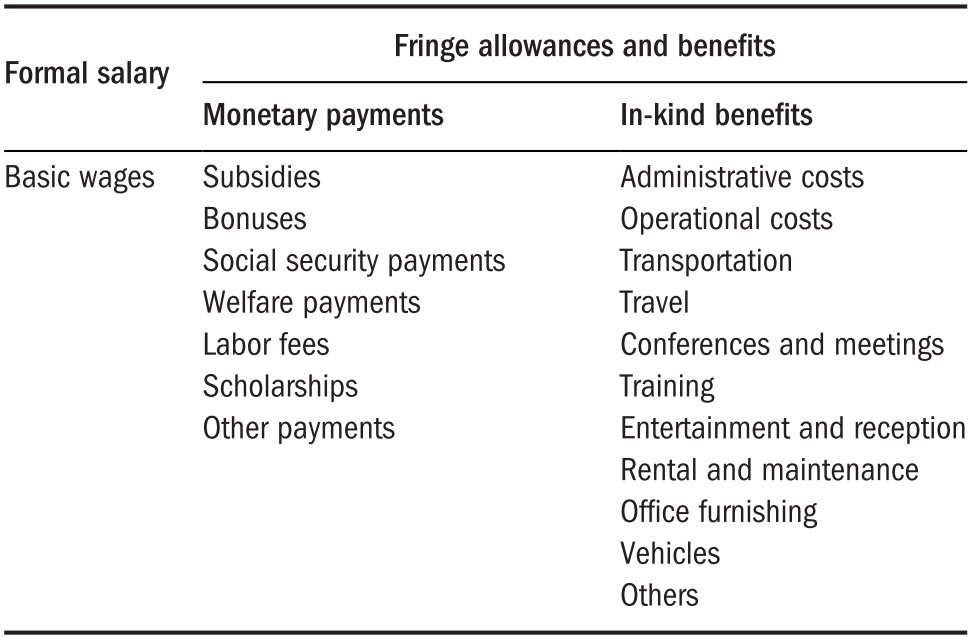
This data source provides a valuable opportunity to estimate actual compensation levels, including both formal salary and fringe benefits and pay. Measuring formal salary (jiben gongzi) is straightforward, as there is a single, clearly defined column for this item. There isn’t a single column, however, for “fringe compensation,” as it is spread out over multiple line items within the reported budgets. To accurately code fringe compensation, I drew on technical budget manuals that explained the composition of each line item and interviews with more than 40 budgetary officials.
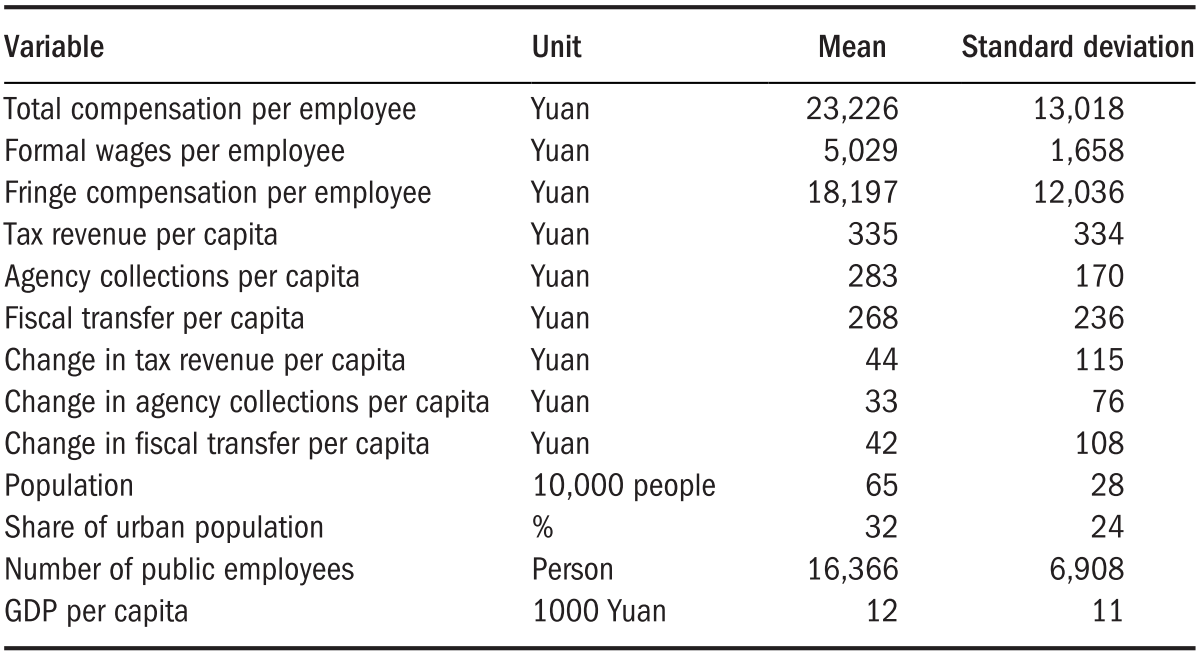
To construct fringe compensation, I included two main line items in the budgets: “personnel spending” and “administrative spending.” Personnel spending refers to government spending on financial remuneration for government employees beyond formal salary, such as bonuses, subsidies, and allowances. Administrative spending, on the other hand, captures the provision of in-kind (or non-monetized) staff benefits. For example, a wealthy tax bureau can build a lavish office or disburse gift baskets to staff members. Other well-documented perks include “entertainment,” “training,” and “conferences and meetings,” which commonly translate into free wining and dining and subsidized vacations for government employees. For a conservative estimate, I excluded administrative spending items that are not likely to contribute to staff welfare (e.g., purchase of specialized equipment and materials). Table A4.2 lists the budgetary line items I included to estimate fringe compensation in the Shandong county governments. Descriptive statistics are presented in Table A4.3.
Appendix: Chapter 5 Four Varieties of Officials
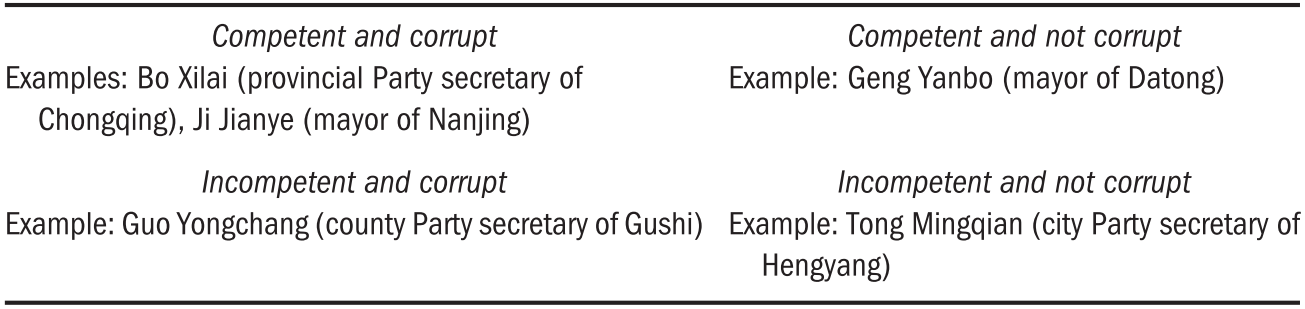
Bo and Ji exemplify Chinese officials who are both corrupt and competent. But not all are like them, of course. We should also be aware of three other varieties of officials: competent but not corrupt, incompetent and corrupt, incompetent and not corrupt (see Table A5.1). It is also useful to know that there are officials who were purged during Xi’s anti-corruption drive who did not take bribes but had failed at their jobs, which the Party considers to be a form of corruption,Footnote 1 known technically as dereliction of duty.
Entertainer-in-Chief
First, consider the category of incompetent and corrupt, illustrated by Guo Yongchang, Party secretary of Gushi, a rural county in Henan province that is officially designated poor and receives financial assistance from higher-level governments to get by. We can learn a lot about Guo because he is the star of The Transition Period, a documentary that filmed the party secretary’s daily activities. To classify Guo as incompetent may be unfair because, even though he failed to make his county rich, the documentary shows Guo hard at work all day. He is absorbed in endless meetings, hijacked by ad-hoc crises, intervenes to help workers get their owed wages, and above all, tries hard to promote growth. The most consuming aspect of his work was attracting investors, with whom he negotiated, drank, sang karaoke, and entertained constantly. In a darkly comic scene, an intoxicated Guo smeared a birthday cake on an American investor. Then, the next day, hung over but reflective, he expressed an earnest desire to make a difference to Gushi. “Failing to develop is the worst kind of corruption,” he said.Footnote 2
In the final minutes of the film, Guo was hauled away on charges of corruption. Subsequent investigation revealed that he paid a higher-level official 100,000 Yuan for his promotion to county Party secretary.Footnote 3 Unlike Bo or Ji, Guo did not turn around the fortunes of his jurisdiction. Despite an increase in foreign investment during Guo’s tenure from 800 million Yuan in 2004 to 3.8 billion Yuan in 2009, Gushi remained poor. Worse, the county government incurred a large deficit of 700 million Yuan, as Guo squandered public funds on white elephant projects, including a new government compound costing 200 million Yuan that local media described as “extravagant like a four-star hotel.”Footnote 4
Nice Guys Don’t Get Ahead
Then we turn to a second variety of officials, incompetent and not corrupt, but who nonetheless are punished by the Party. Under China’s cadre evaluation system, officials can be held responsible for scandals and protests that occur during their tenure, even though they are not directly involved and did not cause them.Footnote 5 Tong Mingqian, party secretary of Hengyang city in Hunan Province, is a case in point. (Tong is one of 54 city Party secretaries whose downfall during Xi’s anti-corruption crackdown I analyze in Chapter 6.)
In 2013, Tong was apprehended in association with a massive vote-buying scandal that broke out in his city when he was party secretary. In this case, 518 members of Hengyang’s people’s congress, the city legislative body, took a total of 110 million Yuan in bribes from 56 candidates in exchange for voting them into the provincial legislature.Footnote 6 Although Tong did not instigate the scheme, nor did he take bribes, he was punished for “dereliction of duty,” stripped of party membership and removed from office.Footnote 7
Unlike Bo, Ji, and Guo, Tong was famously clean, even morally stiff and uptight. He refused extravagant dinners, preferring to pack dinner home from the staff canteen and pay for his own meals. “He doesn’t smoke and doesn’t drink. His only hobby is to take a stroll in the Party secretary’s compound after work, with an old security guard at his side,” a local newspaper reported. One day, three businessmen who failed to get elected after bribing the city’s legislators barged into Tong’s office, demanding justice; instead of throwing the rascals behind bars, the Party secretary offered to get their money back.
In the Chinese political system, Tong’s “nice guy” (laohaoren) qualities are perceived as spinelessness, despised by bureaucratic superiors and even the media, which wrote dismissively, “Lacking audacity and authority, even county Party secretaries didn’t take him seriously.”Footnote 8 Throughout his career, Tong never made a splash, but he hoped that by toeing party lines and avoid making enemies, he could peacefully retire. Tragically, even this modest wish was dashed, as the Party punished him for inaction on the vote-buying scandal. Nice guys, apparently, don’t get ahead in Chinese politics.
Sleepless in Datong
Lastly, a fourth, ideal variety: competent and not corrupt. A good example is Geng Yanbo, Mayor of Datong, featured in the documentary, The Chinese Mayor.Footnote 9 Bearing clear resemblance to Ji Jianye, Geng is an insomniac bent on rejuvenating the smog-filled city of Datong through massive urban renewal projects. One review of the documentary aptly describes Geng as “a sort of human bulldozer.”Footnote 10 At the time the film was made, Geng was abruptly transferred from Datong to Taiyuan, where he still serves as Party secretary. Given that no charges of corruption have been made against Geng, we may assume, for now, that he isn’t corrupt. But even officials in this ideal group are controversial because, in China’s growth-obsessed autocracy, the use of state power is almost always disruptive.
Providing a count of how many officials fall into each of the four categories is not the task of this analysis. In practice, this is extremely difficult to do, as we will see in Chapter 6 (even when certain officials are exposed for corruption, we cannot know whether the remaining ones are innocent). Nevertheless, by identifying these four varieties of officials, we will see that portrayal of the entire Chinese bureaucracy as “predatory” (grab and give nothing in return) is too simplistic. Even the corrupt leader Guo Yongchang doesn’t entirely fit the caricature of “looting, debauchery, and utter lawlessness.”Footnote 11 Even he was dedicated to growth promotion and had defused social conflicts and raised investment.
Appendix: Chapter 7 Construction of Comparative Corruption Indices
Building on Glaeser and Goldin (Reference Glaeser and Goldin2006), Ramirez (Reference Ramirez2014) conducts an innovative historical comparison of Chinese and American corruption at equivalent stages of economic development. He uses media reports in a bundle of American newspapers to approximate the level of corruption in each of the two cases. The comparable periods he uses are China from 1990 to 2011 and United States from 1870 to 1930. He concludes that corruption in China is not as alarming as it appears, compared with the US historical experience. Furthermore, as America grew richer, corruption declined, reaching a similar level to China.
While Ramirez’s approach is commendable, there is a serious flaw in his method: he uses American newspapers to measure corruption in the United States and China. Using this source, it is no surprise that reported levels of corruption in China will be considerably lower than in the United States. In other words, he undercounts Chinese corruption.
For my analysis, therefore, I modify Ramirez’s analysis in two key respects. First, I measure reported corruption using indigenous news outlets in each case: the same bundle of American papers for the United States and the People’s Daily in China. I apply the same media measure to the People’s Daily in Chinese. Corruption (fubai) and China (zhongguo) are searched together, then deflated by the word “government” (zhengfu). The 1990–2011 data is from the People’s Daily Electronic Edition; for the 2012–2016 data I took averages of index values for the People’s Daily from the China National Knowledge Database (CNKI) and the Apabi Digital Newspaper Collection.
Second, I modify Ramirez’s selection of comparable years, using income data from the Penn World Table, which is the same source the author used. Upon closer examination of his methodology, I find that his selection of comparable years was open to interpretation and could be improved. I selected a different set of years during which the income per capita of China and that of the United States were, in my judgment, closer than in Ramirez’s study. The comparable periods selected for my analysis are listed in Table 7.1.
1 Tom Orlik, “Eight Questions: Andrew Wedeman, China’s Corruption Paradox,” The Wall Street Journal, 26 March 2012.
1 Cai (Reference Cai2015).
2 Also quoted in “China Bets Future on Inland Cities,” Reuters, 3 August 2010.
3 “国家贫困县河南固始:顶风建“豪衙” 伸手要救济 [The Poverty County Gushi of Henan],” Jingji Cankaobao, 29 October 2007. He was not alone, as studies find the sale of public offices rampant in poor regions of China (Zhu Reference Zhu2008).
5 Whiting (Reference Whiting, Naughton and Yang2004); Edin (Reference Edin2005); Cai (Reference Cai2015); Ang (Reference Ang2016).
6 “Hunan City’s Top Cadres Hit with Massive Vote-Buying Case,” South China Morning Post, 30 December 2013.
7 “童名谦被免去湖南省政协副主席职务 [Tong Mingqian Removed from Office in Connection with Vote-Buying Scandal in Hengyang],” People’s Daily, 27 January 2014.
8 “Mediocre official Tong Mingqian” (起底庸官样本童名谦) [Chinese], Southern Weekend (Nanfang Zhoumo), reposted in Sohu, 26 June 2014.
9 The filmmaker Zhou Hao also produced the earlier mentioned documentary, The Transition Period.
10 Dennis Harvey, “Sundance Film Review: The Chinese Mayor,” Variety, 30 January 2015.
11 Pei (Reference Pei2016, 183).

 Open access