Book contents
- Frontmatter
- Contents
- List of Tables
- List of Figures
- Preface
- Part I The American Welfare Regime
- Part II The Politics of Public and Private Pensions
- Introduction
- 2 Connected at Birth: Public and Private Pensions Before 1945
- 3 Sibling Rivalry: Public and Private Pensions After 1945
- Part III The Politics of Public and Private Health Insurance
- Part IV The Formation and Future of the American Welfare Regime
- Appendix
- Notes
- Index
Introduction
Published online by Cambridge University Press: 05 June 2012

Book contents
- Frontmatter
- Contents
- List of Tables
- List of Figures
- Preface
- Part I The American Welfare Regime
- Part II The Politics of Public and Private Pensions
- Introduction
- 2 Connected at Birth: Public and Private Pensions Before 1945
- 3 Sibling Rivalry: Public and Private Pensions After 1945
- Part III The Politics of Public and Private Health Insurance
- Part IV The Formation and Future of the American Welfare Regime
- Appendix
- Notes
- Index
Summary
The United States is currently in the midst of a heated debate over the future of Social Security, the nation's largest and most venerated social program. The urgency and prominence of this dispute inspires memories of the early 1980s, when a bipartisan coalition cobbled together a last-minute deal to restructure the program and head off an imminent funding shortfall. Yet the present debate over Social Security has been sparked not by an immediate fiscal crisis but by a long-term budgetary imbalance posed by the retirement of the baby boom generation in the next century. More portentous still, the agenda for pension reform has shifted substantially since the early 1980s. Then, the focus was on scaling back benefits so that checks could be mailed. Backers of “privatization” enjoyed little fiscal slack to fund the transition to an alternative system, and they had few positive models for a program of private investment accounts. Today, by contrast, Social Security's near-term financial situation is strong, tax-favored retirement accounts are ubiquitous, and leading political figures, including President George W. Bush, openly embrace proposals for the full or partial conversion of Social Security into compulsory individual accounts. Even a limited version of these plans would represent the most fundamental transformation of Social Security – and the balance of public and private retirement provision – since the foundation of Social Security itself.
Though Social Security now faces one of the most serious challenges of its sixty-plus-year history, the debate over its place in American old-age provision is hardly new.
Information
- Type
- Chapter
- Information
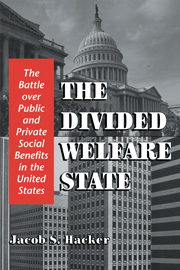
- The Divided Welfare StateThe Battle over Public and Private Social Benefits in the United States, pp. 71 - 84Publisher: Cambridge University PressPrint publication year: 2002
Accessibility standard: Unknown
Why this information is here
This section outlines the accessibility features of this content - including support for screen readers, full keyboard navigation and high-contrast display options. This may not be relevant for you.Accessibility Information
Accessibility compliance for the PDF of this book is currently unknown
and may be updated in the future.