Book contents
- Frontmatter
- Contents
- List of Illustrations
- Contributors
- Preface
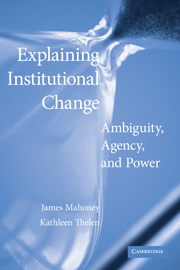
- Explaining Institutional Change
- 1 A Theory of Gradual Institutional Change
- 2 Infiltrating the State: The Evolution of Health Care Reforms in Brazil, 1964–1988
- 3 The Contradictory Potential of Institutions: The Rise and Decline of Land Documentation in Kenya
- 4 Policymaking as Political Constraint: Institutional Development in the U.S. Social Security Program
- 5 Altering Authoritarianism: Institutional Complexity and Autocratic Agency in Indonesia
- 6 Rethinking Rules: Creativity and Constraint in the U.S. House of Representatives
- 7 Historical Institutionalism in Rationalist and Sociological Perspective
- Index
Preface
Published online by Cambridge University Press: 05 June 2012

Book contents
- Frontmatter
- Contents
- List of Illustrations
- Contributors
- Preface
- Explaining Institutional Change
- 1 A Theory of Gradual Institutional Change
- 2 Infiltrating the State: The Evolution of Health Care Reforms in Brazil, 1964–1988
- 3 The Contradictory Potential of Institutions: The Rise and Decline of Land Documentation in Kenya
- 4 Policymaking as Political Constraint: Institutional Development in the U.S. Social Security Program
- 5 Altering Authoritarianism: Institutional Complexity and Autocratic Agency in Indonesia
- 6 Rethinking Rules: Creativity and Constraint in the U.S. House of Representatives
- 7 Historical Institutionalism in Rationalist and Sociological Perspective
- Index
Summary
Until recently, gradual institutional change has not been a central focus of explanation in the social sciences. Instead, most institutional analysts have considered change during moments of abrupt, wholesale transformation. Yet it is not clear that such episodes of institutional upheaval capture the most common ways through which political institutions change over time. A growing body of work suggests that important changes often take place incrementally and through seemingly small adjustments that can, however, cumulate into significant institutional transformation. These forms of gradual institutional change call for more attention than they have received so far.
The present volume seeks to respond to this call. In the introduction, we propose a theory of gradual institutional change grounded in a power-distributional view of institutions that emphasizes ongoing struggles within but also over prevailing institutional arrangements. On this view, analyses of stability and change are intimately linked. Institutional stability is a function not simply of positive feedback but of active, ongoing political mobilization, and institutions are vulnerable to change not just in moments of crisis but on a more ongoing basis. Features of the overarching context and the properties of the institutions themselves hold the key to understanding the processes through which such change can be accomplished. We emphasize in particular that institutional rules are subject to varying interpretations and levels of enforcement and therefore exhibit ambiguities that provide space for interested agents to exploit in their effort to alter them.
Information
- Type
- Chapter
- Information
- Explaining Institutional ChangeAmbiguity, Agency, and Power, pp. xi - xivPublisher: Cambridge University PressPrint publication year: 2009
Accessibility standard: Unknown
Why this information is here
This section outlines the accessibility features of this content - including support for screen readers, full keyboard navigation and high-contrast display options. This may not be relevant for you.Accessibility Information
Accessibility compliance for the PDF of this chapter is currently unknown
and may be updated in the future.