Book contents
- Frontmatter
- Contents
- Preface to the second edition
- Preface to the first edition
- 1 Introduction
- 2 Developing a coding scheme
- 3 Recording behavioral sequences
- 4 Assessing observer agreement
- 5 Representing observational data
- 6 Analyzing sequential data: First steps
- 7 Analyzing event sequences
- 8 Issues in sequential analysis
- 9 Analyzing time sequences
- 10 Analyzing cross-classified events
- 11 Epilogue
- Appendix: A Pascal program to compute kappa and weighted kappa
- References
- Index
1 - Introduction
Published online by Cambridge University Press: 13 October 2009

Book contents
- Frontmatter
- Contents
- Preface to the second edition
- Preface to the first edition
- 1 Introduction
- 2 Developing a coding scheme
- 3 Recording behavioral sequences
- 4 Assessing observer agreement
- 5 Representing observational data
- 6 Analyzing sequential data: First steps
- 7 Analyzing event sequences
- 8 Issues in sequential analysis
- 9 Analyzing time sequences
- 10 Analyzing cross-classified events
- 11 Epilogue
- Appendix: A Pascal program to compute kappa and weighted kappa
- References
- Index
Summary
Interaction and behavior sequences
Birds courting, monkeys fighting, children playing, couples discussing, mothers and infants exchanging gleeful vocalizations all have this in common: Their interaction with others reveals itself unfolded in time. This statement should surprise no one, certainly not readers of this volume. What is surprising, however, is how often in the past few decades researchers interested in dynamic aspects of interactive behavior – in how behavior is sequenced moment to moment – have settled for static measures of interaction instead. This need not be. In fact, our aim in writing this book is to demonstrate just how simple it often is not just to record observation data in a way that preserves sequential information, but also to analyze that data in a way that makes use of – and illuminates – its sequential nature.
We assume that readers of this book may be interested in different species, observed at various ages and in diverse settings, but that most will be interested specifically in observing interactive social behavior. This is because we think sequential methods are tailor-made for the study of social interaction. As noted, a defining characteristic of interaction is that it unfolds in time. Indeed, it can hardly be thought of without reference to a time dimension. Sometimes we are concerned with actual time units – what happens in successive seconds, for example; at other times, we are just concerned with what events followed what. In either case, we think it is a sequential view that offers the best chance for illuminating dynamic processes of social interaction.
Information
- Type
- Chapter
- Information
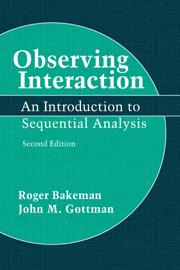
- Observing InteractionAn Introduction to Sequential Analysis, pp. 1 - 14Publisher: Cambridge University PressPrint publication year: 1997
Accessibility standard: Unknown
Why this information is here
This section outlines the accessibility features of this content - including support for screen readers, full keyboard navigation and high-contrast display options. This may not be relevant for you.Accessibility Information
Accessibility compliance for the PDF of this chapter is currently unknown
and may be updated in the future.
- 1
- Cited by