Skip to main content Accessibility help
×
Hostname: page-component-68c7f8b79f-kpv4p Total loading time: 0 Render date: 2026-01-01T11:21:45.148Z Has data issue: false hasContentIssue false

1 - Introduction

Published online by Cambridge University Press:  05 June 2012

J. Samuel Barkin
Affiliation:
University of Florida
Get access

Summary

In the sociology of science, paradigms are a bit like castles. Scientists are knights in this metaphor, and assumptions are the liege-lords that the knights/scientists are sworn to defend. The strength of a paradigm can be measured by how many scientists are willing to defend its ramparts. Scientists tend to retain allegiance to their assumptions, so that the paradigmatic castles defend their inhabitants successfully, until those inhabitants die off. In this metaphor, it is in the nature of paradigms to be mutually exclusive – as a knight/scientist, one is more concerned about defending one's castle/paradigm, and in defeating others, than in building bridges among them. Paradigms, in other words, are distinct from, and in opposition to, each other.

This view of paradigms has been regularly co-opted in discussing both the sociology and the epistemology of international relations as a discipline. Thomas Kuhn's seminal discussion of paradigms and the sociology of science is regularly taught in graduate international relations theory courses, despite Kuhn's suggestions that his argument does not necessarily apply to social science. Whether or not one accepts Kuhn's argument about the sociology of the natural sciences, and whether or not one sees paradigms in the social sciences as being equivalent to those in the natural sciences, it remains the case that the language of paradigms pervades thinking about international relations theory.

Information

Type
Chapter
Information
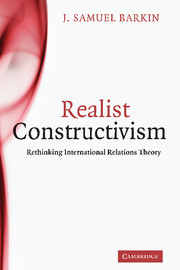
Realist Constructivism
Rethinking International Relations Theory
, pp. 1 - 12
Publisher: Cambridge University Press
Print publication year: 2010

Access options

Get access to the full version of this content by using one of the access options below. (Log in options will check for institutional or personal access. Content may require purchase if you do not have access.)

Book purchase

Temporarily unavailable

Accessibility standard: Unknown

Why this information is here

This section outlines the accessibility features of this content - including support for screen readers, full keyboard navigation and high-contrast display options. This may not be relevant for you.

Accessibility Information

Accessibility compliance for the PDF of this book is currently unknown and may be updated in the future.

Save book to Kindle

To save this book to your Kindle, first ensure no-reply@cambridge.org is added to your Approved Personal Document E-mail List under your Personal Document Settings on the Manage Your Content and Devices page of your Amazon account. Then enter the ‘name’ part of your Kindle email address below. Find out more about saving to your Kindle.

Note you can select to save to either the @free.kindle.com or @kindle.com variations. ‘@free.kindle.com’ emails are free but can only be saved to your device when it is connected to wi-fi. ‘@kindle.com’ emails can be delivered even when you are not connected to wi-fi, but note that service fees apply.

Find out more about the Kindle Personal Document Service.

  • Introduction
  • J. Samuel Barkin, University of Florida
  • Book: Realist Constructivism
  • Online publication: 05 June 2012
  • Chapter DOI: https://doi.org/10.1017/CBO9780511750410.001
Available formats
×

Save book to Dropbox

To save content items to your account, please confirm that you agree to abide by our usage policies. If this is the first time you use this feature, you will be asked to authorise Cambridge Core to connect with your account. Find out more about saving content to Dropbox.

  • Introduction
  • J. Samuel Barkin, University of Florida
  • Book: Realist Constructivism
  • Online publication: 05 June 2012
  • Chapter DOI: https://doi.org/10.1017/CBO9780511750410.001
Available formats
×

Save book to Google Drive

To save content items to your account, please confirm that you agree to abide by our usage policies. If this is the first time you use this feature, you will be asked to authorise Cambridge Core to connect with your account. Find out more about saving content to Google Drive.

  • Introduction
  • J. Samuel Barkin, University of Florida
  • Book: Realist Constructivism
  • Online publication: 05 June 2012
  • Chapter DOI: https://doi.org/10.1017/CBO9780511750410.001
Available formats
×