Book contents
- Frontmatter
- Contents
- List of Tables
- Preface
- CHAPTER 1 A Watershed Election?
- CHAPTER 2 A Distinctive Scottish Voice? Identities, Values and Attitudes
- CHAPTER 3 What has Devolution Achieved? The Public's View
- CHAPTER 4 Governing Scotland: The People's Preferences?
- CHAPTER 5 Lost Labour Votes? Records, Personalities and Issues
- CHAPTER 6 How the SNP Won
- CHAPTER 7 Do Voters Care about Parties Any More?
- CHAPTER 8 A Personal Vote? How Voters Used the STV Ballot
- CHAPTER 9 Conclusion
- Technical Appendix
- Index
CHAPTER 3 - What has Devolution Achieved? The Public's View
Published online by Cambridge University Press: 12 September 2012

Book contents
- Frontmatter
- Contents
- List of Tables
- Preface
- CHAPTER 1 A Watershed Election?
- CHAPTER 2 A Distinctive Scottish Voice? Identities, Values and Attitudes
- CHAPTER 3 What has Devolution Achieved? The Public's View
- CHAPTER 4 Governing Scotland: The People's Preferences?
- CHAPTER 5 Lost Labour Votes? Records, Personalities and Issues
- CHAPTER 6 How the SNP Won
- CHAPTER 7 Do Voters Care about Parties Any More?
- CHAPTER 8 A Personal Vote? How Voters Used the STV Ballot
- CHAPTER 9 Conclusion
- Technical Appendix
- Index
Summary
According to its advocates, devolution was meant to improve the way that Scotland was governed. First, as we noted in the previous chapter, it was hoped that the creation of the Scottish Parliament would ensure that public policy would be better attuned to the needs and wishes of the people of Scotland. In part this was an argument about ensuring that the wishes of the people of Scotland could not be overridden by the votes cast by people in England. But it was also an argument about the functional benefits of devolving decisions away from London. Scotland's economic growth had long tended to lag behind that of southern England, and the country had seemed to have been ill-served by centralised rule (Paterson, 1998). Now following globalisation, the ability of even large states like the UK to steer their economies was limited. In this new environment the main economic role of governments was to make their part of the world an attractive place for companies to locate, by providing a skilled workforce and a pleasant working environment – ‘supply side’ measures that were pursued more effectively at a regional rather than a statewide level (Keating and McGarry, 2001; Ohmae, 1995). As the then Secretary of State for Scotland, Donald Dewar, put it in his foreword to the UK government's white paper on Scottish devolution, ‘the Scottish Parliament will be in a position to encourage vigorous sustainable growth in the Scottish economy. Policies on health, housing and education will respond more directly to Scotland's needs’ (Scottish Office, 1997; see also Scottish Constitutional Convention, 1995).
Information
- Type
- Chapter
- Information
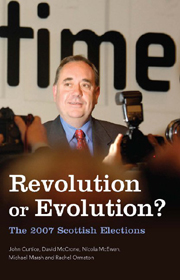
- Revolution or Evolution?The 2007 Scottish Elections, pp. 42 - 55Publisher: Edinburgh University PressPrint publication year: 2009
Accessibility standard: Unknown
Why this information is here
This section outlines the accessibility features of this content - including support for screen readers, full keyboard navigation and high-contrast display options. This may not be relevant for you.Accessibility Information
Accessibility compliance for the PDF of this book is currently unknown
and may be updated in the future.