Accidental Orientalists

-
The digital format of this book is no longer available to purchase from Cambridge Core. Other formats may be available.
-
Select format
-
- Publisher:
- Liverpool University Press
- Publication date:
- 01 February 2018
- 28 July 2017
- ISBN:
- 9781786948083
- 9781786940209
- Dimensions:
- Weight & Pages:
- Dimensions:
- Weight & Pages:
- Subjects:
- Middle East Studies, Area Studies, History, Middle East History
You may already have access via personal or institutional login- Subjects:
- Middle East Studies, Area Studies, History, Middle East History
Show more authors 
You may already have access via personal or institutional login
Book description
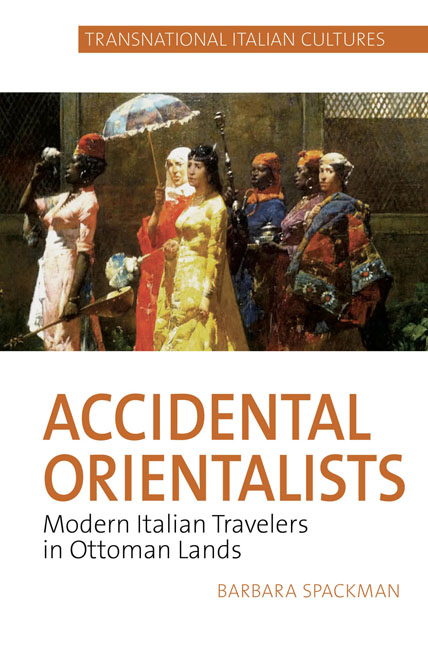
This book identifies a strand of what it calls “Accidental Orientalism” in narratives by Italians who found themselves in Ottoman Egypt and Anatolia in the late nineteenth and early twentieth centuries through historical accident and who wrote about their experiences in Italian, English, and French. Among them are young woman, Amalia Nizzoli, who learned Arabic, conversed the inhabitants of an Ottoman-Egpytian harem, and wrote a memoir in Italian; a young man, Giovanni Finati, who converted to Islam, passed as Albanian in Muhammad Ali’s Egypt, and published his memoir in English; a strongman turned antiquarian, Giovanni Belzoni, whose narrative account in English documents the looting of antiquities by Europeans in Egypt ; a princess and patriot, Cristina Trivulzio di Belgiojoso, who lived in exile in Anatolia and wrote in French condemning the Ottoman harem and proposing social reforms in in the Ottoman empire; and an early twentieth century anarchist and anti-colonialist, Leda Rafanelli, who converted to Islam, wrote prolifically, and posed before the camera in an Orient of her own fashioning. Crossing class, gender, dress, and religious boundaries as they move about the Mediterranean basin, their accounts variously reconfigure, reconsolidate, and often destabilize the imagined East-West divide. Ranging widely on an affective spectrum from Islamophobia to Islamophilia, their narratives are the occasion for the book’s reflection on the practices of cultural cross-dressing, conversion to Islam, and passing and posing as Muslim on the part of Italians who had themselves the object of an Orientalization on the part of Northern Europeans, and whose language had long been the lingua franca of the Mediterranean.
Reviews
"Barbara Spackman’s brilliantly argued and meticulously researched work engages its reader in a complex questioning of how some of the most basic structures that support a sense of collective or individual identity have been negotiated, appropriated and performed [...] The historical range and conceptual depth of Accidental Orientalists are such that it will prove essential reading for anyone who wishes to delve into the dynamics of transcultural exchange during a period of relentless social and political change."
Charles Burdett, Bristol University
Contents
Contents
Metrics
Altmetric attention score
Full text views
Full text views helpTotal number of HTML views: 0
Total number of PDF views: 0 *
 Loading metrics...
* Views captured on Cambridge Core between #date#. This data will be updated every 24 hours.
Usage data cannot currently be displayed.
Accessibility standard: Unknown
Why this information is here
This section outlines the accessibility features of this content - including support for screen readers, full keyboard navigation and high-contrast display options. This may not be relevant for you.
Accessibility Information
Accessibility compliance for the PDF of this book is currently unknown and may be updated in the future.