
Skip to main content Accessibility help
×
  • Cited by 34
    • Show more authors
    • You may already have access via personal or institutional login
    • Select format
    • Publisher:
      Cambridge University Press
      Publication date:
      20 October 2017
      02 November 2017
      ISBN:
      9781108283731
      9781108417945
      9781108406086
      Dimensions:
      (228 x 152 mm)
      Weight & Pages:
      0.67kg, 390 Pages
      Dimensions:
      (229 x 152 mm)
      Weight & Pages:
      0.59kg, 396 Pages
    You may already have access via personal or institutional login
  • Selected: Digital
    Add to cart View cart Buy from Cambridge.org

    Book description

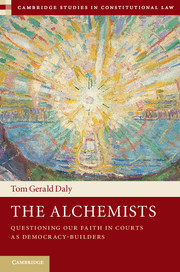
    Can courts really build democracy in a state emerging from authoritarian rule? This book presents a searching critique of the contemporary global model of democracy-building for post-authoritarian states, arguing that it places excessive reliance on courts. Since 1945, both constitutional courts and international human rights courts have been increasingly perceived as alchemists, capable of transmuting the base materials of a nascent democracy into the gold of a functioning democratic system. By charting the development of this model, and critically analysing the evidence and claims for courts as democracy-builders, this book argues that the decades-long trend toward ever greater reliance on courts is based as much on faith as fact, and can often be counter-productive. Offering a sustained corrective to unrealistic perceptions of courts as democracy-builders, the book points the way toward a much needed rethinking of democracy-building models and a re-evaluation of how we employ courts in this role.

    Reviews

    'This extraordinarily timely work deals with a critical question for democratisation about the weight of the expectations placed on constitutional and human rights courts. The work is global in its focus, soundly based in fact, impeccably researched and convincingly argued. It will be a staple of the democratisation literature for some time to come.'

    Cheryl Saunders - Laureate Professor Emeritus, Melbourne Law School and Co-convenor of Constitution Transformation Network

    'Tom Gerald Daly's The Alchemists is an important contribution to the growing comparative constitutional law of democracy, and takes the literature in exciting new directions. By examining in detail the 'democracy-building' jurisprudence of the Brazilian Supreme Court, and the complex interplay between regional human rights courts and national constitutional courts, especially in Latin America, The Alchemists raises a host of important questions and insights that will spark many scholarly conversations.'

    Sujit Choudhry - I. Michael Heyman Professor of Law, University of California, Berkeley and Founding Director, Center for Constitutional Transitions

    'The Alchemists is an important new book in the field of comparative constitutional studies, which poses a serious challenge to recent arguments in favour of constitutional courts as promoters or defenders of democracy. It highlights the danger, in this context, of high popular expectations of such courts, twinned with low court capacity. It also points to distinct dangers related to courts assuming an ambitious role in democratic transformation, such as via the enforcement of social rights, the danger of obfuscating underperformance in other key areas, distracting from core political struggles, and underplaying the centrality of political rights. In making these arguments it also canvasses a broad and diverse range of jurisdictions. It is essential reading for anyone working or writing in the field of democratisation and comparative constitutionalism.'

    Rosalind Dixon - Professor of Law, University of New South Wales Faculty of Law

    'Comparative constitutionalists, political scientists, and policymakers have recently shown great faith in the work of courts in new democracies. Anchored by a rich case study of Brazil and drawing on a wide range of comparative evidence, The Alchemists is not only an important caution pushing back against this trend, but also provides a thoughtful map of the ways in which domestic and international courts might work towards a more achievable role conception. Scholars of courts and democratization processes will benefit immensely from grappling with Tom Gerald Daly's arguments.'

    David E. Landau - Mason Ladd Professor and Associate Dean for International Programs, Florida State University College of Law

    Refine List

    Actions for selected content:

    Select all | Deselect all
    • View selected items
    • Export citations
    • Download PDF (zip)
    • Save to Kindle
    • Save to Dropbox
    • Save to Google Drive

    Save Search

    You can save your searches here and later view and run them again in "My saved searches".

    Please provide a title, maximum of 40 characters.
    ×

    Contents

    Metrics

    Altmetric attention score

    Full text views

    Total number of HTML views: 0
    Total number of PDF views: 0 *
    Loading metrics...

    Book summary page views

    Total views: 0 *
    Loading metrics...

    * Views captured on Cambridge Core between #date#. This data will be updated every 24 hours.

    Usage data cannot currently be displayed.

    Accessibility standard: Unknown

    Why this information is here

    This section outlines the accessibility features of this content - including support for screen readers, full keyboard navigation and high-contrast display options. This may not be relevant for you.

    Accessibility Information

    Accessibility compliance for the PDF of this book is currently unknown and may be updated in the future.
