
Skip to main content Accessibility help
×
  • Cited by 7
    • Show more authors
    • You may already have access via personal or institutional login
    • Select format
    • Publisher:
      Cambridge University Press
      Publication date:
      25 March 2019
      30 May 2019
      ISBN:
      9781139034388
      9780521895057
      9780521719261
      Dimensions:
      (228 x 152 mm)
      Weight & Pages:
      0.58kg, 284 Pages
      Dimensions:
      (228 x 152 mm)
      Weight & Pages:
      0.47kg, 284 Pages
    You may already have access via personal or institutional login
  • Selected: Digital
    Add to cart View cart Buy from Cambridge.org

    Book description

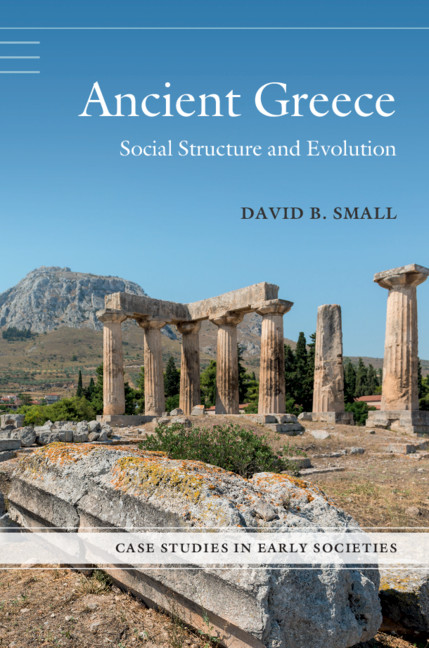
    This book examines the development of ancient Greek civilization through a path-breaking application of social scientific theories. David B. Small charts the rise of the Minoan and Mycenaean civilizations and the unique characteristics of the later classical Greeks through the lens of ancient social structure and complexity theory, opening up new ideas and perspectives on these societies. He argues that Minoan and Mycenaean institutions evolved from elaborate feasting, and that the genesis of Greek colonization was born from structural chaos in the eighth century. Small isolates distinctions between Iron Age Crete and the rest of the Greek world, focusing on important differences in social structure. His book differs from others on Ancient Greece, highlighting the perpetuation of classical Greek social structure into the middle years of the Roman Empire, and concluding with a comparison of the social structure of classical Greece to that of the classical Maya civilization.

    Reviews

    '… text is a highly specialized, scholarly offering and will make a valuable addition to collections with strong sections on ancient history and archaeology.'

    D. C. Kierdorf Source: Choice

    Refine List

    Actions for selected content:

    Select all | Deselect all
    • View selected items
    • Export citations
    • Download PDF (zip)
    • Save to Kindle
    • Save to Dropbox
    • Save to Google Drive

    Save Search

    You can save your searches here and later view and run them again in "My saved searches".

    Please provide a title, maximum of 40 characters.
    ×

    Contents

    Metrics

    Altmetric attention score

    Full text views

    Total number of HTML views: 0
    Total number of PDF views: 0 *
    Loading metrics...

    Book summary page views

    Total views: 0 *
    Loading metrics...

    * Views captured on Cambridge Core between #date#. This data will be updated every 24 hours.

    Usage data cannot currently be displayed.

    Accessibility standard: WCAG 2.2 AAA

    Why this information is here

    This section outlines the accessibility features of this content - including support for screen readers, full keyboard navigation and high-contrast display options. This may not be relevant for you.

    Accessibility Information

    The HTML of this book complies with version 2.2 of the Web Content Accessibility Guidelines (WCAG), offering more comprehensive accessibility measures for a broad range of users and attains the highest (AAA) level of WCAG compliance, optimising the user experience by meeting the most extensive accessibility guidelines.

    Content Navigation
    Table of contents navigation

    Allows you to navigate directly to chapters, sections, or non‐text items through a linked table of contents, reducing the need for extensive scrolling.

    Index navigation

    Provides an interactive index, letting you go straight to where a term or subject appears in the text without manual searching.

    Reading Order and Textual Equivalents
    Single logical reading order

    You will encounter all content (including footnotes, captions, etc.) in a clear, sequential flow, making it easier to follow with assistive tools like screen readers.

    Full alternative textual descriptions

    You get more than just short alt text: you have comprehensive text equivalents, transcripts, captions, or audio descriptions for substantial non‐text content, which is especially helpful for complex visuals or multimedia.

    Visualised data also available as non‐graphical data

    You can access graphs or charts in a text or tabular format, so you are not excluded if you cannot process visual displays.

    Visual Accessibility
    Use of high contrast between text and background colour

    You benefit from high‐contrast text, which improves legibility if you have low vision or if you are reading in less‐than‐ideal lighting conditions.
