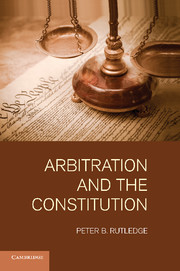

Arbitration has become an increasingly important mechanism for dispute resolution, both in the domestic and international setting. Despite its importance as a form of state-sanctioned dispute resolution, it has largely remained outside the spotlight of constitutional law. This landmark work represents one of the first attempts to synthesize the fields of arbitration law and constitutional law. Drawing on the author's extensive experience as a scholar in arbitration law who has lectured and studied around the world, the book offers unique insights into how arbitration law implicates issues such as separation of powers, federalism and individual liberties.
"Arbitration and the Constitution constitutes one of those few pieces of scholarship that really opens the door to a new way of thinking about a particular issue. While the combination of arbitration and constitutional law may not yet be as predictable as Mom and apple pie, the visionary work of Professor Peter Rutledge has been invaluable in introducing this important subject to audiences in the United States and beyond."
--S.I. Strong, University of Missouri School of Law, reviewing for the Cardozo Journal of Conflict Resolution
"Professor Rutledge’s Arbitration and the Constitution offers a thoughtful and provocative study of what, in the United States, are surprising companions... [He] combines a rich historical and doctrinal study with incisive observations and provocative prescriptions, all informed by practical experience in both domestic and international arbitrations."
--Gary Born, Wilmer Cutler Pickering Hale and Dorr LLP, reviewing for Kluwer Arbitration Blog
Loading metrics...
* Views captured on Cambridge Core between #date#. This data will be updated every 24 hours.
Usage data cannot currently be displayed.
This section outlines the accessibility features of this content - including support for screen readers, full keyboard navigation and high-contrast display options. This may not be relevant for you.
Accessibility compliance for the PDF of this book is currently unknown and may be updated in the future.
