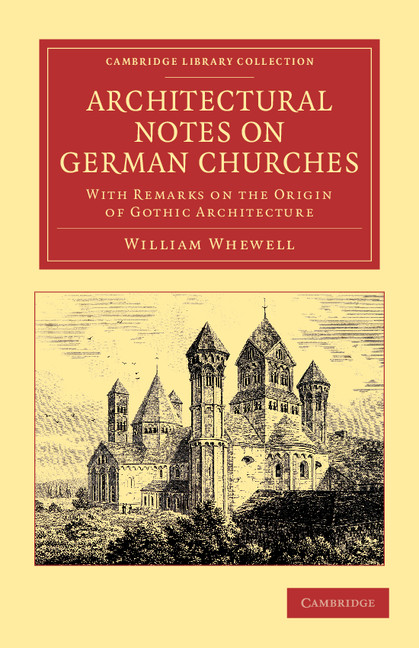

A tutor of mathematics at Cambridge, William Whewell (1794–1866) mostly published on mechanics. He became professor of mineralogy in 1828, Knightbridge professor of moral philosophy in 1838, and master of Trinity College in 1841. This work is unusual among his writings for its focus on architecture, yet the emphasis placed on terminology is consistent with his other publications, such as An Essay on Mineralogical Classification and Nomenclature (1828). Architectural Notes is significant for offering a detailed theoretical analysis of the origins of Gothic architecture, especially of the mechanical principles underlying it, notably the pointed arch. The discussion of German churches, despite the book's title, is of secondary concern, although guidance is given for recording Gothic buildings. This first edition was published anonymously in 1830. The second (1835) and third (1842) editions bore Whewell's name and were partially revised to reflect recent research on the origin of the pointed arch.
Loading metrics...
* Views captured on Cambridge Core between #date#. This data will be updated every 24 hours.
Usage data cannot currently be displayed.
This section outlines the accessibility features of this content - including support for screen readers, full keyboard navigation and high-contrast display options. This may not be relevant for you.
Accessibility compliance for the PDF of this book is currently unknown and may be updated in the future.
