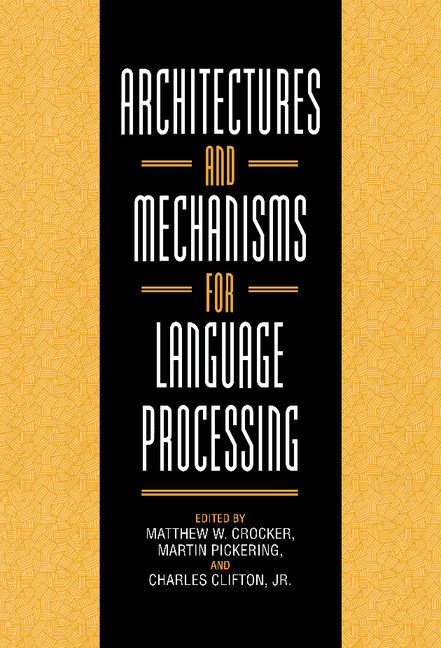

The architectures and mechanisms underlying language processing form one important part of the general structure of cognition. This book, written by leading experts in the field, brings together linguistic, psychological and computational perspectives on some of the fundamental issues. Several general introductory chapters offer overviews on important psycholinguistic research frameworks and highlight both shared assumptions and controversial issues. Subsequent chapters explore syntactic and lexical mechanisms; statistical and connectionist models of language understanding; the crucial importance of linguistic representations in explaining behavioural phenomena; evidence from a variety of studies and methodologies concerning the interaction of syntax and semantics; and the implications for cognitive architecture. The book concludes with a set of contributions on select issues of interpretation, including quantification, focus and anaphora in language understanding. Architectures and Mechanisms for Language Processing will appeal to students and scholars alike as a comprehensive and timely survey of recent work in this interdisciplinary area.
"This book represents the state of the art in sentence processing, with interesting examples and opportunities for computational modeling." Computational Linguistics
Loading metrics...
* Views captured on Cambridge Core between #date#. This data will be updated every 24 hours.
Usage data cannot currently be displayed.
This section outlines the accessibility features of this content - including support for screen readers, full keyboard navigation and high-contrast display options. This may not be relevant for you.
Accessibility compliance for the PDF of this book is currently unknown and may be updated in the future.
