Asteroids

-
Select format
-
- Publisher:
- Cambridge University Press
- Publication date:
- 05 May 2015
- 16 April 2015
- ISBN:
- 9781107447899
- 9781107061446
- Dimensions:
- (228 x 152 mm)
- Weight & Pages:
- 0.72kg, 368 Pages
- Dimensions:
- Weight & Pages:
You may already have access via personal or institutional login
Show more authors 
You may already have access via personal or institutional login
Book description
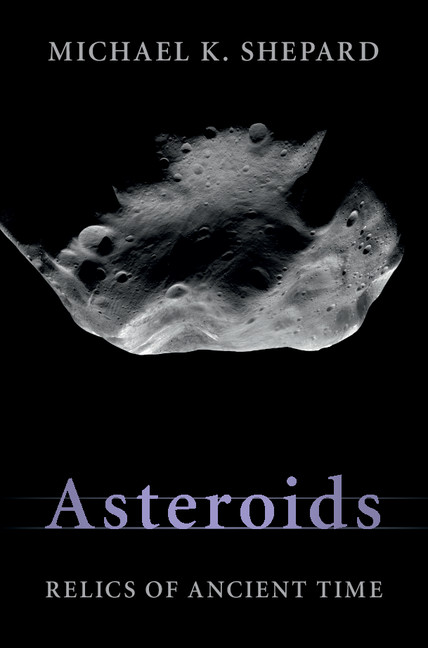
Where do asteroids come from and what are they made of? What clues do they hold about the evolution of the Solar System? Scientists have catalogued hundreds of thousands of asteroids, and many are thought to contain water and amino acids, the building blocks of life. Michael K. Shepard tells the fascinating story of their discovery, and what they can tell us about the history of our own planet. He describes how we find and study asteroids, what they look like through the eyes of powerful telescopes and spacecraft, and plans for future sample return missions. This timely book interweaves accessible scientific explanations with historical background and personal narrative, providing an engaging read for anyone curious about asteroids and what they may mean for our future - both as threats and opportunities.
Reviews
'Asteroids is a timely, up-to-date and accurate account of a field of astronomy, one that is becoming ever more important to humankind. But more, it’s a delight to read. [Shepard] tells the science by telling how people have done the science, and so he turns what could have been a dry assemblage of factoids into a delightful, page-turning story. I can think of no better book to bring the whole story together of what we know, what we hope to know and what we’ll need to know about these bodies as we become a space-faring race.'
Brother Guy Consolmagno, SJ - Vatican Observatory, Vatican City
'If you have ever wondered about the origin of our solar system, this book reveals its fascinating story. The key to our history lies in the study of asteroids, comets and meteorites. Michael Shepard presents this subject in an enjoyable and educational way, describing humanity’s quest to explore these new worlds. The result is a journey through one of history’s greatest scientific adventures - one that may ultimately decide the fate of our planet and our survival as a species.'
Dante S. Lauretta - University of Arizona
'The asteroid belt is the 'Downton Abbey' of our solar system, a gorgeous lived-in relic filled with fascinating characters that tell us about our past. Michael Shepard brings to life their engaging stories, from those of the oldest residents, the remnant building blocks of our planets, to their outlandish offspring, in the form of meteorites and asteroids that sometimes hit Earth, to the scientific busybodies who bring their secrets to light. It is a great read about our ultimate ancestors.'
William F. Bottke - Southwest Research Institute, Boulder, Colorado
'Asteroids is a comprehensive, authoritative and entertaining summary of our current knowledge of asteroids and their related kin, meteorites. Starting with the history of their discovery and classification, Shepard weaves an accurate and highly readable story of how first telescopes, and now spacecraft missions, have come to help us understand the properties of these little worlds, including the things that they can tell us about the origin and evolution of their big planetary cousins. While this is a great book for an introductory class on the topic, it is also an educational and engaging read for science and space buffs in general.'
Jim Bell - Arizona State University; President of The Planetary Society and author of The Space Book and The Interstellar Age
'The chunks of broken protoplanet we call asteroids are potential killers as well as scientific gold mines. Both thrills are explored in this comprehensive study of these 'little worlds'. Planetary geoscientist Michael Shepard recounts the history of asteroid spotting, from pioneers such as Giuseppe Piazzi - who detected the first, Ceres, in 1801 - to today’s Catalina Sky Survey, run by the University of Arizona. Interweaving anecdotes from his own work with copious technical detail, Shepard leads us on an expert tour of a fecund branch of astronomy and its lessons for planetary science.'
Barbara Kiser Source: Nature
'Asteroids: relics of Ancient Time provides a comprehensive and remarkably readable overview of asteroid and meteorite studies. An engaging combination of personal anecdote, historical discussion and scientific explanation, it is both authoritative and accessible, and brings its subject to life uncommonly well. … Foremost amongst the book’s many strengths is its focus on human experience. With evocative descriptions of people combing exotic landscapes for meteorites and first-person reflections on his daily work, Shepard grabs readers’ attention on a human level and doesn’t let go. While the material is detailed and quite technical, the science is clearly explained and, time and again, reconnected to the big picture questions that motivate it, and are relevant to us all.'
Olivia Johnson Source: BBC Sky at Night
Contents
Contents
References
Metrics
Altmetric attention score
Full text views
Full text views helpTotal number of HTML views: 0
Total number of PDF views: 0 *
 Loading metrics...
* Views captured on Cambridge Core between #date#. This data will be updated every 24 hours.
Usage data cannot currently be displayed.
Accessibility standard: Unknown
Why this information is here
This section outlines the accessibility features of this content - including support for screen readers, full keyboard navigation and high-contrast display options. This may not be relevant for you.
Accessibility Information
Accessibility compliance for the PDF of this book is currently unknown and may be updated in the future.