Skip to main content Accessibility help
×
  • Cited by 23
    • 9th edition
      Show more authors
    • You may already have access via personal or institutional login
    • Select format
    • Publisher:
      Cambridge University Press
      Publication date:
      24 August 2018
      13 September 2018
      ISBN:
      9781108367806
      9781108431743
      Dimensions:
      Weight & Pages:
      Dimensions:
      (244 x 170 mm)
      Weight & Pages:
      1.06kg, 530 Pages
    You may already have access via personal or institutional login
  • Selected: Digital
    Add to cart View cart Buy from Cambridge.org

    Book description

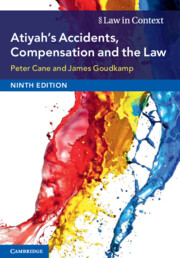
    Now in its ninth edition, Atiyah's Accidents, Compensation and the Law explores the recent and continuous developments in personal injury law by applying social context to the relevant legal principles. Those principles remain in need of radical reform. Updates to the text include discussion of the major changes to the way compensation is calculated and claimed, evolving funding arrangements for personal injury litigation, and dramatic shifts in the claims management industry. Suitable for both undergraduate and postgraduate students taking courses in tort law, this new edition balances theory, practice and context. It draws on new legislation, research and case law to offer the reader thought-provoking examples and analysis.

    Reviews

    ‘Since the 1970s, Atiyah's Accidents, Compensation and the Law has provided an invaluable counter-narrative to mainstream tort scholarship and this new edition is no exception. The core critique, whilst familiar, is integrated with an updated analysis of the political, social and economic context in which the law, and the system that underpins it, operates. It remains a ‘must read' for students.'

    Annette Morris - Cardiff University

    ‘As it has been from its first edition, this remains the definitive work on liability and compensation for accidental injury. The new editorial team (Goudkamp joining Cane) treads a careful path through the controversies surrounding the alleged 'compensation culture' but never shies from advancing its own, informed and persuasive perspective on the issues.'

    Ken Oliphant - Deputy Head of School, University of Bristol Law School

    ‘This classic text has provided a continuing source of inspiration for my research and an essential accompaniment to my teaching for the past forty years. In revealing the wider context of tort law it brings the subject to life. Its critique of personal injury litigation remains as important as ever.'

    Richard Lewis - Cardiff University

    Refine List

    Actions for selected content:

    Select all | Deselect all
    • View selected items
    • Export citations
    • Download PDF (zip)
    • Save to Kindle
    • Save to Dropbox
    • Save to Google Drive

    Save Search

    You can save your searches here and later view and run them again in "My saved searches".

    Please provide a title, maximum of 40 characters.
    ×

    Contents


    Page 1 of 2


    Page 1 of 2


    Metrics

    Altmetric attention score

    Full text views

    Total number of HTML views: 0
    Total number of PDF views: 0 *
    Loading metrics...

    Book summary page views

    Total views: 0 *
    Loading metrics...

    * Views captured on Cambridge Core between #date#. This data will be updated every 24 hours.

    Usage data cannot currently be displayed.

    Accessibility standard: WCAG 2.2 AAA

    Why this information is here

    This section outlines the accessibility features of this content - including support for screen readers, full keyboard navigation and high-contrast display options. This may not be relevant for you.

    Accessibility Information

    The HTML of this book complies with version 2.2 of the Web Content Accessibility Guidelines (WCAG), offering more comprehensive accessibility measures for a broad range of users and attains the highest (AAA) level of WCAG compliance, optimising the user experience by meeting the most extensive accessibility guidelines.

    Content Navigation
    Table of contents navigation

    Allows you to navigate directly to chapters, sections, or non‐text items through a linked table of contents, reducing the need for extensive scrolling.

    Table of contents navigation

    Allows you to navigate directly to chapters, sections, or non‐text items through a linked table of contents, reducing the need for extensive scrolling.

    Index navigation

    Provides an interactive index, letting you go straight to where a term or subject appears in the text without manual searching.

    Index navigation

    Provides an interactive index, letting you go straight to where a term or subject appears in the text without manual searching.

    Reading Order and Textual Equivalents
    Single logical reading order

    You will encounter all content (including footnotes, captions, etc.) in a clear, sequential flow, making it easier to follow with assistive tools like screen readers.

    Single logical reading order

    You will encounter all content (including footnotes, captions, etc.) in a clear, sequential flow, making it easier to follow with assistive tools like screen readers.

    Short alternative textual descriptions

    You get concise descriptions (for images, charts, or media clips), ensuring you do not miss crucial information when visual or audio elements are not accessible.

    Short alternative textual descriptions

    You get concise descriptions (for images, charts, or media clips), ensuring you do not miss crucial information when visual or audio elements are not accessible.

    Visualised data also available as non‐graphical data

    You can access graphs or charts in a text or tabular format, so you are not excluded if you cannot process visual displays.

    Visualised data also available as non‐graphical data

    You can access graphs or charts in a text or tabular format, so you are not excluded if you cannot process visual displays.

    Visual Accessibility
    Use of high contrast between text and background colour

    You benefit from high‐contrast text, which improves legibility if you have low vision or if you are reading in less‐than‐ideal lighting conditions.

    Use of high contrast between text and background colour

    You benefit from high‐contrast text, which improves legibility if you have low vision or if you are reading in less‐than‐ideal lighting conditions.

    Structural and Technical Features
    ARIA roles provided

    You gain clarity from ARIA (Accessible Rich Internet Applications) roles and attributes, as they help assistive technologies interpret how each part of the content functions.

    ARIA roles provided

    You gain clarity from ARIA (Accessible Rich Internet Applications) roles and attributes, as they help assistive technologies interpret how each part of the content functions.