
Skip to main content Accessibility help
×
  • Cited by 10
    • Show more authors
    • You may already have access via personal or institutional login
    • Select format
    • Publisher:
      Cambridge University Press
      Publication date:
      05 March 2016
      06 August 2015
      ISBN:
      9781316105061
      9781107088603
      9781107459694
      Dimensions:
      (247 x 174 mm)
      Weight & Pages:
      1.01kg, 427 Pages
      Dimensions:
      (244 x 170 mm)
      Weight & Pages:
      0.73kg, 430 Pages
    You may already have access via personal or institutional login
  • Selected: Digital
    Add to cart View cart Buy from Cambridge.org

    Book description

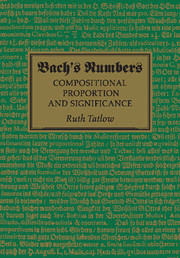
    In eighteenth-century Germany the universal harmony of God's creation and the perfection of its proportions still held philosophical, moral and devotional significance. Reproducing proportions close to the unity (1:1) across compositions could render them beautiful, perfect and even eternal. Using the principles of her groundbreaking theory of proportional parallelism and the latest source study research, Ruth Tatlow reveals how Bach used the number of bars to create numerical perfection across his published collections, and explains why he did so. The first part of the book illustrates the wide-ranging application of belief in the unity, showing how planning a well-proportioned structure was a normal compositional procedure in Bach's time. In the second part Tatlow presents practical demonstrations of this in Bach's works, illustrating the layers of proportion that appear within a movement, a work, between two works in a collection, across a collection and between collections.

    Awards

    Winner, 2016 Choice Outstanding Academic Title

    Reviews

    '[This book] takes in all Bach’s major collections and more, including the two Passions, three Oratorios and the B minor Mass. In sheer extent and richness of background, and number of works examined, Tatlow’s book is a most original and impressive achievement that will need to be taken into account in future discussions of these fascinating compositions.'

    David Ledbetter Source: Early Music

    'For anyone who wishes to explore the logical pathways of Bach's genius, Tatlow's analysis gets to the heart of the aesthetic, theological and Pythagorean presuppositions underlying the Bachian concepts of 'Vollkommenheit', perfection through calculation; and 'Harmonie' … the harmony of proportion, here a mirror of divine order.'

    Gian Mario Benzing Source: translated from Corriere della Sera (La Lettura)

    '… Tatlow’s approach to the subject matter is unique, and the vigorousness with which her methodology is applied has uncovered numerous new and unexpected facts. Bach scholarship cannot ignore her voice.'

    Yo Tomita Source: Music and Letters

    … Bach’s Numbers clears the way for some promising new directions in Bach scholarship. Tatlow’s work should be valued not only for what it suggests for future study, however, but for what it provides in its own right: a bold historical rendering of Bach’s compositional process that forces us to view some of the composer’s greatest works in a new light, and with deepened appreciation.'

    Robert L. Wells Source: Music Analysis

    Refine List

    Actions for selected content:

    Select all | Deselect all
    • View selected items
    • Export citations
    • Download PDF (zip)
    • Save to Kindle
    • Save to Dropbox
    • Save to Google Drive

    Save Search

    You can save your searches here and later view and run them again in "My saved searches".

    Please provide a title, maximum of 40 characters.
    ×

    Contents

    Metrics

    Altmetric attention score

    Full text views

    Total number of HTML views: 0
    Total number of PDF views: 0 *
    Loading metrics...

    Book summary page views

    Total views: 0 *
    Loading metrics...

    * Views captured on Cambridge Core between #date#. This data will be updated every 24 hours.

    Usage data cannot currently be displayed.

    Accessibility standard: Unknown

    Why this information is here

    This section outlines the accessibility features of this content - including support for screen readers, full keyboard navigation and high-contrast display options. This may not be relevant for you.

    Accessibility Information

    Accessibility compliance for the PDF of this book is currently unknown and may be updated in the future.
