
Skip to main content Accessibility help
×
  • Cited by 5
    • Show more authors
    • Access check Access
      You have digital access to this book
    • Select format
    • Publisher:
      Cambridge University Press
      Publication date:
      14 March 2024
      21 March 2024
      ISBN:
      9781009006804
      9781316518731
      Dimensions:
      (229 x 152 mm)
      Weight & Pages:
      0.66kg, 350 Pages
      Dimensions:
      Weight & Pages:
    Access check Access
    You have digital access to this book
    Selected: Digital
    Add to cart View cart Buy from Cambridge.org

    Book description

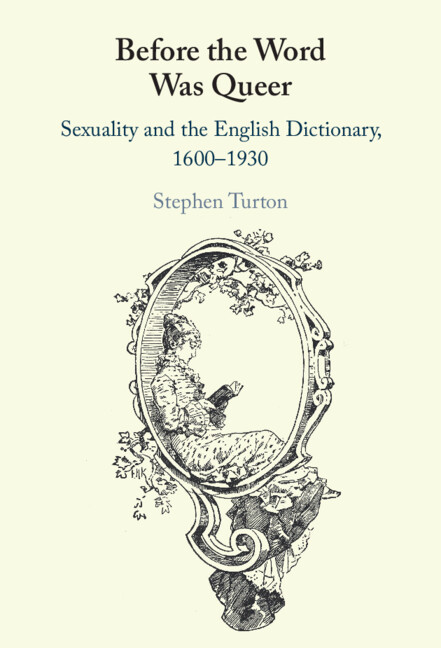
    Bringing together research from queer linguistics and lexicography, this book uncovers how same-sex acts, desires, and identities have been represented in English dictionaries published in Britain from the early modern to the inter-war period. Moving across time – from the appearance of the first standalone English dictionary to the completion of the first edition of the Oxford English Dictionary – and shuttling across genres – from general usage, hard words, thieves' cant, and slang to law, medicine, classical myth, women's biography, and etymology – it asks how dictionary-writers made sense of same-sex intimacy, and how they failed or refused to make sense of it. It also queries how readers interacted with dictionaries' constructions of sexual morality, against the broader backdrop of changing legal, religious, and scientific institutions. In answering these questions, the book responds and contributes to established traditions and new trends in linguistics, queer theory, literary criticism, and the history of sexuality.

    Awards

    Finalist, 2025 PROSE- Humanities, Association of American Publishers

    Reviews

    ‘Written with grace and clarity, this book makes an irrefutable case for historical lexicography and the light it sheds on past understanding of same-sex desire. In particular, it sets out new research on love and sex between women. It combines mastery of lexicographical detail with lucid exploration of the intellectual frameworks shaping historical attitudes to sex.'

    Charlotte Brewer - Hertford College, University of Oxford

    ‘Turton's well-crafted, highly readable monograph uses a scavenger methodology to expose privileged voices repeatedly erasing references to marginalized sexuality in English dictionaries, 1600–1930. A convincing introduction to the method and theory of queer historical linguistics.'

    William L. Leap - Women's, Gender and Sexuality Studies Program. Florida Atlantic University, USA

    ‘This book brilliantly demonstrates what queer theory can do for lexicography – and vice versa. An essential read for lovers and scholars of language, dictionaries, and the long arc of LGBTQ+ history.'

    Jeffrey Masten - author of Queer Philologies

    ‘Stephen Turton’s lively book is a wonderfully rich mine of forgotten sexual slang, … its great strength lies in a generative interweaving of the histories of words and sex, its recognition that dictionary-makers and users are actors in the construction of social and sexual identities. As dictionaries get better at capturing discursively how we talk about ourselves today, they remain a standout resource in our exploration of the way our queer forebears understood themselves in the past.’

    Will Tosh Source: The Times Literary Supplement

    Refine List

    Actions for selected content:

    Select all | Deselect all
    • View selected items
    • Export citations
    • Download PDF (zip)
    • Save to Kindle
    • Save to Dropbox
    • Save to Google Drive

    Save Search

    You can save your searches here and later view and run them again in "My saved searches".

    Please provide a title, maximum of 40 characters.
    ×

    Contents

    • Before the Word Was Queer
      pp i-ii
    • Before the Word Was Queer - Title page
      pp iii-iii
    • Sexuality and the English Dictionary, 1600–1930
    • Copyright page
      pp iv-iv
    • Dedication
      pp v-vi
    • Epigraph
      pp vii-viii
    • Contents
      pp ix-ix
    • Figures
      pp x-x
    • Tables
      pp xi-xi
    • Acknowledgements
      pp xii-xiii
    • Notes
      pp xiv-xiv
    • Abbreviations
      pp xv-xvi
    • Introduction
      pp 1-29
    • Charting the Sexual and Lexical Outlands
    • 1 - Legislating Acts
      pp 30-55
    • The Limits of Buggery, Sodomy, and Copulation
    • 2 - Estranging English
      pp 56-83
    • The Centre of the Language and the Queer Frontier
    • 3 - Silencing Sex
      pp 84-116
    • Social Propriety and Lexical Censorship
    • 4 - Dissecting Matter
      pp 117-144
    • Odd Bodies in Medical Dictionaries
    • 5 - Taxonomizing Desire
      pp 145-175
    • Science and Sexuality in the Oxford English Dictionary
    • Conclusion
      pp 176-197
    • Looking beyond the Queer and Now
    • Appendices
      pp 198-280
    • Appendix I - Anne Lister’s Erotic Glossary
      pp 198-199
    • Appendix II - Same-Sex Definitions in Dictionaries, 1604–1933
      pp 200-280
    • References
      pp 281-314
    • Index
      pp 315-334

    Metrics

    Altmetric attention score

    Full text views

    Total number of HTML views: 0
    Total number of PDF views: 0 *
    Loading metrics...

    Book summary page views

    Total views: 0 *
    Loading metrics...

    * Views captured on Cambridge Core between #date#. This data will be updated every 24 hours.

    Usage data cannot currently be displayed.

    Accessibility standard: Unknown

    Why this information is here

    This section outlines the accessibility features of this content - including support for screen readers, full keyboard navigation and high-contrast display options. This may not be relevant for you.

    Accessibility Information

    Accessibility compliance for the HTML of this book is currently unknown and may be updated in the future.
