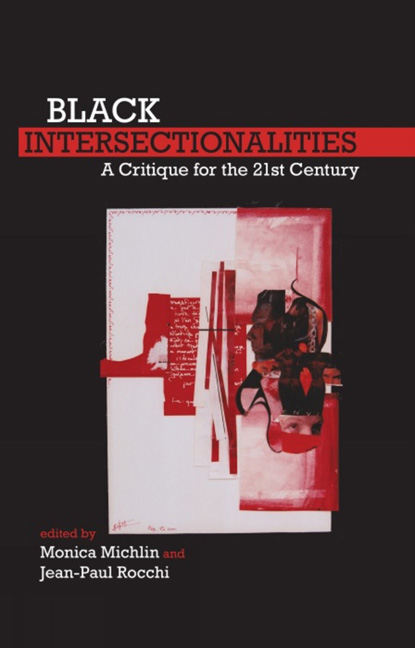
Black Intersectionalities

-
The digital format of this book is no longer available to purchase from Cambridge Core. Other formats may be available.
-
Select format
-
- Publisher:
- Liverpool University Press
- Publication date:
- 22 July 2017
- 31 December 2013
- ISBN:
- 9781781385531
- 9781846319389
- Dimensions:
- Weight & Pages:
- Dimensions:
- Weight & Pages:
- Subjects:
- Literature, Literary Theory
You may already have access via personal or institutional login- Subjects:
- Literature, Literary Theory
Show more authors 
You may already have access via personal or institutional login
Book description
Black Intersectionalities: A Critique for the 21st Century explores the complex interrelationships between race, gender, and sex as these are conceptualised within contemporary thought. Markers of identity are too often isolated and presented as definitive, then examined and theorised, a process that further naturalises their absoluteness; thus socially generated constructs become socialising categories that assume coercive power. The resulting set of oppositions isolate and delimit: male or female, black or white, straight or gay. A new kind of intervention is needed, an intervention that recognises the validity of the researcher’s own self-reflexivity. Focusing on the way identity is both constructed and constructive, the collection examines the frameworks and practices that deny transgressive possibilities. It seeks to engage in a consciousness raising exercise that documents the damaging nature of assigned social positions and either/or identity constructions. It seeks to progress beyond the socially prescribed categories of race, gender and sex, recognising the need to combine intellectualization and feeling, rationality and affectivity, abstraction and emotion, consciousness and desire. It seeks to develop new types of transdisciplinary frameworks where subjective and political spaces can be universalized while remaining particular, leaving texts open so that identity remains imagined, plural, and continuously shifting. Such an approach restores the complexity of what it means to be human.
Contents
Contents
Metrics
Full text views
Full text views helpTotal number of HTML views: 0
Total number of PDF views: 0 *
 Loading metrics...
* Views captured on Cambridge Core between #date#. This data will be updated every 24 hours.
Usage data cannot currently be displayed.
Accessibility standard: Unknown
Why this information is here
This section outlines the accessibility features of this content - including support for screen readers, full keyboard navigation and high-contrast display options. This may not be relevant for you.
Accessibility Information
Accessibility compliance for the PDF of this book is currently unknown and may be updated in the future.